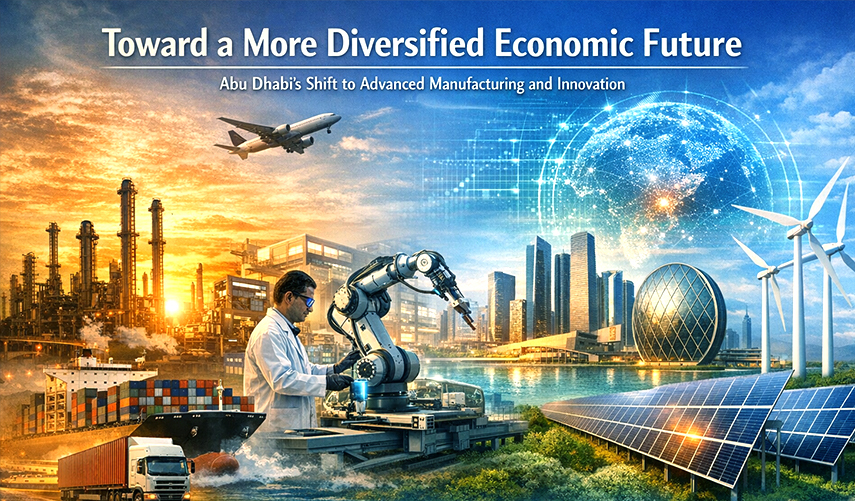
Abu Dhabi is currently executing a forced march toward industrialization that many Western analysts fail to grasp. While the global narrative focuses on the glitz of tourism and the ebb of oil prices, the emirate is quietly pouring billions into a foundation of hard steel, advanced polymers, and silicon. This isn't just a backup plan for when the wells run dry. It is a calculated, aggressive attempt to move up the global value chain by controlling the means of production, rather than just the raw materials.
The strategy hinges on the Abu Dhabi Industrial Strategy (ADIS), which aims to more than double the size of the manufacturing sector to $46 billion by 2031. To do this, the government is not just inviting foreign companies to set up shops; they are building the entire ecosystem from the ground up. This involves a massive expansion of the Khalifa Industrial Zone (KIZAD) and its transition into the Khalifa Economic Zones Abu Dhabi (KEZAD).
The End of the Rentier State Model
For decades, the Gulf economies functioned on a simple loop. They extracted oil, sold it on the open market, and used the proceeds to fund a vast public sector and social safety net. That model is dead. The leadership in Abu Dhabi realized that job creation for a young, increasingly educated population cannot happen through government bureaucracy alone.
Manufacturing provides a specific kind of economic resilience that services and finance do not. It creates a "multiplier effect." For every job created in a high-tech factory, several more are supported in logistics, maintenance, and specialized professional services. By focusing on sectors like chemicals, machinery, and electrical equipment, Abu Dhabi is attempting to bake itself into the global supply chain. They want to be the place where the world's solar panels, aircraft parts, and pharmaceuticals are made, not just where the energy to produce them originates.
Why Subsidies Are Only Half the Story
Critics often point to the heavy state involvement as a sign of artificial growth. They argue that without government backing, these industries would collapse. This perspective misses the logistical reality of the Middle East. Abu Dhabi is using its sovereign wealth to offset the inherent risks of building an industrial base in a region historically known for volatility.
The real advantage isn't just cheap electricity or tax-free zones. It is the integration of the integrated supply chain. Take Emirates Global Aluminium (EGA). It is one of the largest "premium aluminum" producers in the world. Instead of just exporting raw ingots, Abu Dhabi has built an "aluminum cluster" around the plant. Now, mid-stream and down-stream companies sit right next door, taking molten metal directly from the smelter. This eliminates the massive costs of reheating and transporting metal, providing a built-in margin that competitors in Europe or North America simply cannot match.
The Hidden Logistics Engine
The success of this transformation rests on the shoulders of the Khalifa Port. It is one of the fastest-growing deep-water ports in the world. But a port is just a dock without a network. The development of Etihad Rail—the national railway network—is the missing link that is finally coming online.
Moving heavy freight by truck across the desert is expensive and inefficient. By connecting the industrial hubs of the interior directly to the maritime gateways, the emirate is slashing the "landed cost" of goods. For a manufacturer of heavy machinery, the ability to move products from the factory floor to a container ship via rail is a massive operational win. It turns a geographic challenge into a streamlined corridor.
Chasing the Fourth Industrial Revolution
Abu Dhabi is skipping the "sweatshop" phase of industrialization. They are not competing with low-wage labor markets in Southeast Asia. Instead, they are betting heavily on Industry 4.0—the integration of the Internet of Things (IoT), big data, and robotics into the manufacturing process.
The "Smart Manufacturing" program incentivizes companies to automate. This is a necessity, not a luxury. With a relatively small local workforce, the only way to scale production is through high output per worker. By deploying sensors across the production line, companies can predict machine failures before they happen. They use digital twins to simulate factory workflows before a single brick is laid. This level of technical sophistication attracts a different kind of investor—the kind looking for precision and reliability rather than just the lowest possible price point.
The Geopolitical Insurance Policy
There is a harder edge to this industrial push. Domestic manufacturing is a form of national security. The global supply chain shocks of the early 2020s proved that depending on distant nations for essential goods is a massive vulnerability.
Abu Dhabi is aggressively building out its pharmaceutical and food security infrastructure. The Life Sciences Hub in KEZAD is a direct response to this. By producing vaccines and essential medicines locally, the emirate ensures it isn't at the mercy of global shipping lanes during a crisis. This same logic applies to their investments in the defense sector through entities like EDGE Group. They are no longer content being a top-tier buyer of Western technology; they want to be the ones holding the patents.
The Talent Gap Problem
Despite the massive capital infusions, a significant hurdle remains: people. You can build a state-of-the-art semiconductor plant in the middle of the desert, but you cannot manifest a workforce of 5,000 specialized engineers overnight.
The government is attacking this from two sides. First, they have overhauled residency laws, introducing the "Golden Visa" to lock in high-skilled talent for the long term. They want the engineers who build these factories to move their families there and stay. Second, they are forcing a massive shift in local education, pivoting toward STEM subjects and vocational training that aligns with industrial needs. However, the transition from a service-oriented mindset to an industrial one takes a generation. This is the most significant risk to the entire project. If the "knowledge transfer" from foreign experts to the local workforce stalls, the factories become expensive monuments to ambition rather than self-sustaining economic engines.
Hydrogen and the Green Manufacturing Pivot
As the world moves toward decarbonization, Abu Dhabi is trying to position itself as the capital of "Green Industry." This sounds like marketing, but the infrastructure tells a different story. The massive investment in the Barakah Nuclear Energy Plant and massive solar parks like Al Dhafra provides the "clean" baseload power required for green manufacturing.
The real prize is Green Hydrogen. By using renewable energy to split water molecules, Abu Dhabi aims to produce hydrogen that can power heavy industries—like steel and cement—without the massive carbon footprint. If they can crack the code on large-scale hydrogen export and domestic use, they will have effectively "future-proofed" their industrial sector against global carbon taxes and shifting environmental regulations.
The Reality of Competition
Abu Dhabi isn't doing this in a vacuum. Neighboring Saudi Arabia is pursuing an even larger industrial expansion under its Vision 2030. Dubai continues to dominate the regional logistics and trade space. This creates a high-stakes environment where the GCC countries are often competing for the same pool of foreign direct investment and global talent.
Abu Dhabi’s differentiator is its "plug-and-play" approach. They are not just selling land; they are selling a pre-integrated environment. A company can arrive and find their power, water, gas, and fiber optics already at the plot edge, with a regulatory framework designed to approve permits in weeks rather than years. This speed-to-market is the primary weapon in their arsenal.
The Cost of Failure
The stakes are incredibly high. The capital being deployed comes from the very oil reserves that the emirate is trying to move away from. If these industrial zones fail to reach the necessary scale, it will represent one of the most expensive "stranded asset" scenarios in history.
Success requires more than just high-tech hardware. It requires a fundamental shift in how the region does business. It means moving away from the "agent" model where local partners take a cut of profits without adding value, and toward a meritocratic system where efficiency is the only metric that matters. The "Industrial Strategy 2031" is a map, but the terrain is shifting under the weight of global inflation and geopolitical realignments.
The transition from a desert outpost to a global manufacturing hub is an act of sheer will. It is an attempt to rewrite the economic DNA of a nation. Whether Abu Dhabi can actually manufacture its way into the future depends on its ability to turn these gleaming new facilities into centers of genuine innovation, rather than just high-tech assembly lines for foreign intellectual property.
The machinery is moving. The furnaces are lit. The only question is whether the global market is ready for a new industrial powerhouse in the heart of the Middle East. Stop looking at the skyscrapers and start looking at the shipping containers.


