The air in Edmonton during the winter doesn't just bite. It judges. It’s a cold that seeps through the concrete of Rogers Place, reminding everyone that in this city, hockey isn't a pastime. It’s a civic requirement. For years, the Oilers have been a team built on the blinding, kinetic brilliance of generational forwards—men who can turn a mundane Tuesday night into a highlight reel that defies physics. But those same fans know the haunting truth that usually arrives in May: goals are easy to find until they aren't, and games are won by the guys who stop them.
Connor McDavid can outrun a shadow, and Leon Draisaitl can pass a puck through a needle’s eye. Yet, the Achilles heel has always been the same. The defensive zone. The frantic scrambles. The "big, steady presence" that every GM talks about but few actually secure.
Enter Connor Murphy.
The news broke with the clinical brevity of a wire report. The Edmonton Oilers acquired the veteran defenceman from the Chicago Blackhawks. On paper, it’s a transaction of assets—draft picks moving one way, a $4.4 million cap hit moving the other. But in the locker room, and in the standings, this isn't about spreadsheets. It’s about the physics of the playoffs.
The Anatomy of a Shutdown
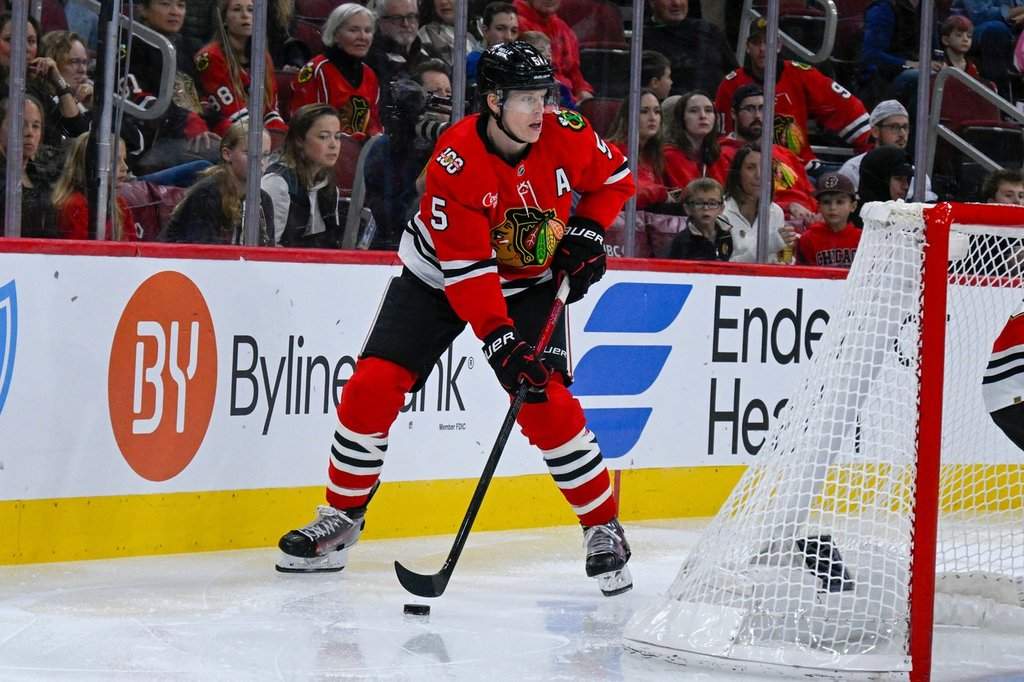
To understand why this move matters, you have to look at what Murphy represents. He is not a puck-mover who will join the rush and pad his stats. He is a sacrificial lamb in a helmet. Murphy is the kind of player who views a 95-mile-per-hour slap shot not as a threat, but as a job description. He blocks shots with a frequency that suggests a total disregard for his own longevity.
In Chicago, he was the veteran anchor on a ship that was taking on water. He played heavy minutes against the league’s most terrifying scoring lines. When the Blackhawks were pinned in their own zone, Murphy was the one wrestling bodies away from the crease, using his 6-foot-4 frame to create a "no-fly zone" around the goaltender.
For the Oilers, this is a course correction. For too long, the defensive corps in Edmonton has leaned toward the offensive side of the spectrum. They had the speed. They had the transition game. What they lacked was the "mean." They lacked the player who makes an opposing power forward think twice before driving the net.
The Invisible Stakes of the Salary Cap
Hockey in the modern era is a game of Tetris played with millions of dollars. The Oilers didn't just trade for a player; they traded for a commitment. By taking on Murphy’s contract, Edmonton is signaling that their window is not just open—it is being propped up by a heavy timber.
The Blackhawks, meanwhile, are playing a different game. They are in the business of the future. By moving Murphy, they shed a veteran salary and gain assets that won't bear fruit for years. It is a divorce of necessity. Chicago needs to be bad enough to get better; Edmonton needs to be tough enough to stay great.
Consider the perspective of a goaltender like Stuart Skinner. For a young goalie, the difference between a chaotic night and a manageable one often comes down to the "clear." Can your defenseman win the puck in the corner and get it out of the zone on the first attempt? Can he move the 220-pound winger who is camping in your peripheral vision?
Murphy does the things that don't make the evening news. He wins the ugly battles. He disrupts the cycle. He allows the stars to breathe.
Why Now?
Timing is everything in the NHL. The trade deadline is often a frenzy of overpayment, a place where desperate teams give up their future for a rental player who might leave in July. By moving now, the Oilers have avoided the bidding war. They’ve secured a player who isn't just a "rental" but a fixture.
The Western Conference is a gauntlet of heavy teams. To get to the Finals, Edmonton has to potentially go through the size of Vegas or the relentless pressure of Colorado. You don't beat those teams with finesse alone. You beat them by surviving them. You beat them by having a player like Murphy who can play twenty minutes a night and finish the game with more bruises than points.
There is a psychological weight to this trade. It tells the room that the management sees the flaw and is willing to pay to fix it. It tells McDavid and Draisaitl that they don't have to score five goals to win every night. Sometimes, three will be enough because the back end is finally locked down.
The Human Toll of the Trade
We often forget that behind the "Chicago receives" and "Edmonton acquires" text, there is a man packing a bag. Murphy had become a leader in Chicago, a steady hand during a tumultuous rebuild. Now, he joins a pressure cooker. He moves from a team where losing was expected to a team where losing is a catastrophe.
The expectations are immediate. There is no "getting settled" in Edmonton. The fans will analyze his first shift, his first blocked shot, and his first mistake with a magnifying glass. He is being asked to be the missing piece of a puzzle that has been incomplete for nearly two decades.
The Oilers are betting that Murphy’s style of play—gritty, unselfish, and physically demanding—will be infectious. They aren't just buying a defenseman. They are buying a culture of defensive accountability.
But the real test isn't a Wednesday night in February. The real test comes when the whistles get tucked away, the intensity doubles, and the game slows down to a crawl in the corners. That is where Murphy lives. That is where he earned his reputation.
As the sun sets early over the North Saskatchewan River, the newest Oiler is likely looking at a playbook, learning the tendencies of his new partners. He knows what he’s here for. He isn't here to be a hero. He’s here to make sure the heroes can do their jobs without looking over their shoulders.
The trade is done. The picks are gone. The salary is locked in. Now, the ice will tell the rest of the story.
In the end, championship runs aren't just built on the goals that are scored, but on the ones that were never allowed to happen because someone was willing to stand in the way.


