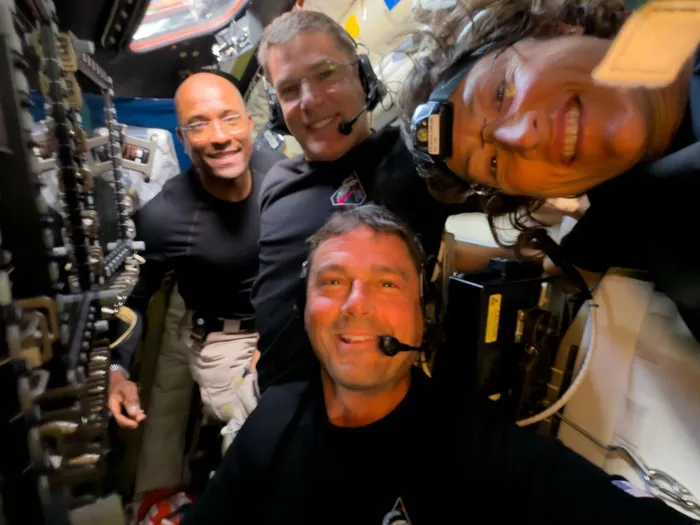
The four humans currently bobbing in the Pacific Ocean just became the most famous people off-planet, but their real ordeal begins the moment the recovery hatch swings open. After 10 days inside the Orion capsule—aptly named Integrity—Commander Reid Wiseman, Victor Glover, Christina Koch, and Jeremy Hansen have returned from a lunar flyby that shattered records and, perhaps more importantly, NASA’s own streak of caution. Within the hour, they will swap the weightlessness of deep space for the grueling, clinical reality of a post-flight quarantine and a press cycle that will attempt to turn their survival into a geopolitical victory lap.
While the public celebrates the first lunar mission in over 50 years, the internal reality at NASA is far more volatile. This was not a routine orbital jaunt. The crew returned from a trajectory that took them further from Earth than any human in history, but they did so in a vehicle that engineers privately feared might not hold together.
The Heat Shield Gamble That Paid Off
The most pressing question during the final hours of the mission wasn't about the astronauts' health, but whether the Avcoat ablative material on Orion’s base would behave. During the uncrewed Artemis I test in 2022, the heat shield didn't just char; it "spalled," shedding chunks of material in a way that computer models failed to predict.
NASA leadership made a calculated, high-stakes decision to fly Artemis II with only minor refinements to the heat shield application process rather than a total redesign. A redesign would have pushed the mission to 2028 or beyond, a delay the agency’s budget couldn't survive. Engineers had to accept a "1 in 20" chance of catastrophic failure—odds that would be considered unacceptable in almost any other field of transportation.
The crew knew this. Every time the capsule rattled, the specter of those Artemis I "divots" sat in the back of their minds. Now that they are down, the primary investigative focus moves from the crew to the hardware. Engineers will spend the next six months dissecting the charred remains of the shield to see if the spalling occurred again. If the damage is as severe as the 2022 flight, the 2027 lunar landing goal for Artemis III is effectively dead.
The Psychological Cliff of the Deep Space Return
Gravity is a cruel master. After 10 days of fluid shifts that make faces puffy and legs thin, the crew will spend the next 48 hours struggling with "the leans"—a vestibular disorientation where the brain can't quite figure out which way is up. But the physical recovery is secondary to the psychological "re-entry" into a world that has moved on without them.
Unlike the International Space Station (ISS) crews, who can call home with relatively low latency and see the Earth as a constant, massive neighbor, the Artemis II crew saw the Earth shrink to a marble. They experienced a level of isolation that hasn't been felt since 1972.
- Communication Delays: In deep space, even light-speed radio waves take time. The crew had to operate with a level of autonomy that ISS astronauts never face.
- The Earthrise Effect: Seeing the planet as a fragile, distant object often triggers a cognitive shift known as the Overview Effect. For the Artemis crew, this was amplified by the fact that for several hours, they were on the far side of the moon, completely cut off from every other human being.
The return to the "real world" involves more than just physical therapy. It involves a mandatory "quiet period" where the crew is shielded from the media to process the mission. However, with the current political climate, that period will be shorter than ever. The White House is already planning a multi-city tour to capitalize on the optics of the mission's success.
The Budget Blade and the 2027 Deadline
Behind the ticker-tape parades, a fiscal war is brewing. Just as the crew made their lunar flyby, the administration proposed a FY 2027 budget that would slash NASA’s overall funding while nominally increasing the "Exploration" line item.
It is a classic shell game. By cutting the science and safety budgets to fund the high-profile moon landing, the agency is being forced to "cannibalize" its future to pay for its present. The Artemis II success has ironically made the agency more vulnerable; politicians now see deep space travel as something NASA can do "on the cheap" or through sheer grit.
The reality is that Artemis III—the mission intended to put boots on the lunar South Pole—requires a functional Starship HLS (Human Landing System) from SpaceX and a fleet of Axiom space suits that are still in various stages of testing. Artemis II proved we can get to the moon. It did nothing to prove we can stay there.
The Silence of the Far Side
While the media focuses on the "Earthrise" photos, the crew’s most vital data might be what they saw on the lunar far side. This mission was a reconnaissance flight masquerading as a PR win. Using high-resolution cameras, the crew documented potential landing sites in the Aitken Basin, looking for the tell-tale signs of water ice that the machines might have missed.
The crew also served as biological test subjects for deep-space radiation. Outside the protection of Earth's Van Allen belts, they were bombarded by cosmic rays at a rate far higher than anything seen on the ISS. The dosimeters they wore will provide the most accurate map of human radiation exposure ever recorded. This data is the "true" return on investment, far more valuable than any photo-op.
What No One is Saying About the Recovery
The recovery operation in the Pacific was the largest since the Apollo era, involving the USS San Diego and a small army of divers. But the "Integrity" capsule didn't just bring back four people; it brought back a mountain of salt-water-soaked hardware that must be preserved.
The rush to get the crew out and into the cameras often risks the integrity of the data stored on the ship’s internal servers. There is a tension between the "show" of the recovery and the "science" of the recovery. As the astronauts are airlifted to shore, a separate team of forensic engineers is already beginning the process of "desalting" the capsule to ensure that the secrets of why it survived—and where it almost failed—aren't lost to corrosion.
The mission was a success because the crew is alive. But in the cold math of aerospace engineering, survival is not the same as safety. The Artemis II astronauts are home, but the Artemis program itself is still drifting in dangerous territory, waiting to see if the next budget cycle or the next hardware failure will ground the moon for another fifty years.
The celebration will last a week. The inspection of the heat shield will last a year. We won't know if Artemis II was truly a success until the first piece of Avcoat is put under a microscope in a Houston lab later this month.
The mission didn't end at splashdown. It just changed venues.