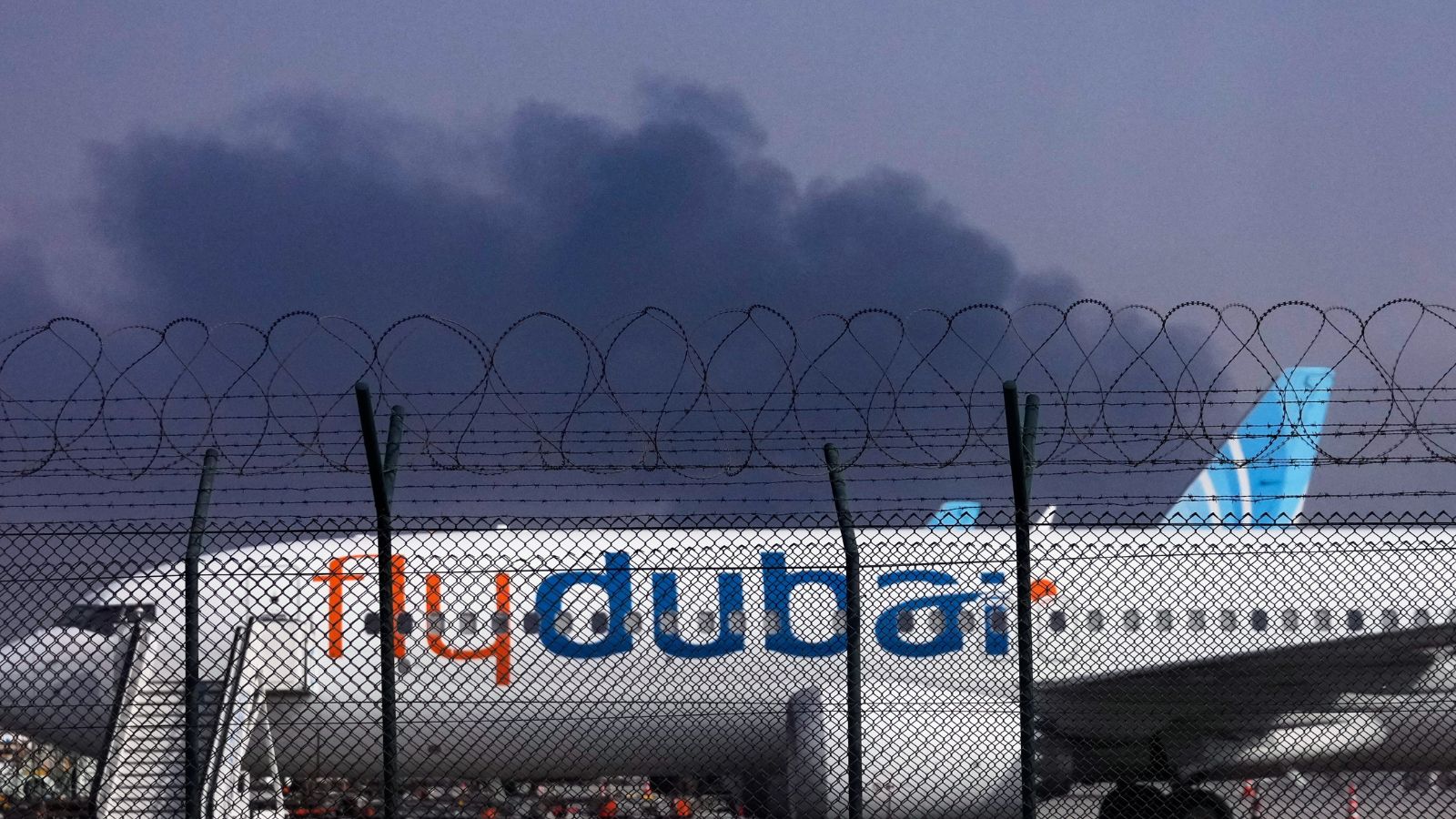
The divergent performance between US-based domestic carriers and international flag carriers during Middle Eastern escalations is not a matter of luck, but a structural byproduct of geographical insulation and revenue mix. While conflict in the Middle East—specifically involving Iran—immediately devalues the equity of European and Asian airlines through fuel surcharges and forced rerouting, US domestic-heavy airlines operate within a protected economic theater. This "Domestic Buffer" allows US carriers to capitalize on a relative stability in demand while their international peers grapple with the physics of longer flight paths and the psychology of war-zone proximity.
The Triple Constraint of International Conflict
When a kinetic conflict emerges in the Middle East, international airlines face a simultaneous degradation of three core operational variables: Airspace Accessibility, Fuel Efficiency, and Consumer Risk Appetite.
1. The Geometry of Rerouting
Airspace is a finite asset. When Iranian or Iraqi airspace closes or becomes high-risk, carriers flying between Europe and Southeast Asia must divert. This is not a simple detour; it often adds 90 to 120 minutes of flight time. In the physics of aviation, weight is the enemy. To fly longer, an aircraft must carry more fuel. Carrying more fuel increases the takeoff weight, which in turn increases the fuel burn per mile. This creates a feedback loop where the marginal cost of the final hour of flight is significantly higher than the first. US domestic carriers, operating primarily within the North American "Blue Sky" corridor, face zero rerouting pressure, maintaining their planned fuel-to-payload ratios.
2. The Jet Fuel Correlation Gap
Global oil prices spike on the threat of supply disruption in the Strait of Hormuz. However, the impact on an airline’s bottom line depends on its Fuel Intensity Ratio—the percentage of total operating costs tied to kerosene. US airlines have historically transitioned toward more fuel-efficient fleets (e.g., the Boeing 737 MAX and Airbus A321neo) which lowers the break-even load factor during price spikes. Furthermore, the US domestic market allows for more aggressive "fuel pass-through" pricing. Because the demand for domestic travel (business and essential VFR—Visiting Friends and Relatives) is more inelastic than discretionary international tourism, US carriers can raise fares to offset fuel costs with less fear of a "demand cliff."
3. The Psychology of Distance
Demand destruction follows a geographic gradient. A traveler in London is far more likely to cancel a trip to Dubai or Istanbul than a traveler in Chicago is to cancel a trip to Phoenix. US carriers lean on a massive, captive internal market that perceives itself as insulated from Middle Eastern instability. This creates a "Safe Haven" effect for capital. Investors rotate out of high-exposure stocks like Lufthansa or Air France-KLM and into Delta, United, or Southwest, seeking the stability of the American consumer base.
The Revenue Fortress Logic
The strength of US airlines during overseas turmoil is rooted in the Domestic Revenue Fortress. This is defined by three specific structural advantages that international peers cannot replicate.
High-Margin Loyalty Monopolies
US carriers have evolved from transportation companies into financial services entities that happen to fly planes. A significant portion of their valuation is derived from credit card partnerships (e.g., Delta and American Express). These revenue streams are decoupled from jet fuel prices and airspace closures. As long as American consumers continue to spend on their credit cards domestically, the airlines receive a steady flow of high-margin cash. International carriers, particularly those in markets with lower credit card interchange fees like Europe, lack this diversified "synthetic" revenue.
The Hub-and-Spoke Efficiency Buffer
In a period of rising costs, efficiency becomes the primary lever for survival. The US hub-and-speak system allows for a higher Passenger Load Factor (PLF) by aggregating demand from hundreds of smaller "spoke" cities into central "hubs." During a crisis, a carrier like United can downgauge an aircraft (switching from a wide-body to a narrow-body) on a route to maintain high PLF without abandoning the market. International carriers running "Point-to-Point" long-haul routes have less flexibility; if demand drops on a London-Singapore route, the flight becomes a massive sunk cost.
Labor Contract Lag
Unlike European carriers which often face immediate industrial action or government-mandated wage adjustments during inflationary periods, US airlines typically operate under long-term collective bargaining agreements (CBAs) governed by the Railway Labor Act. This act makes it intentionally difficult for unions to strike, providing US management with a "labor cost ceiling" that remains fixed even as geopolitical chaos fluctuates. This provides a predictable cost window to navigate short-term shocks.
Analyzing the Fuel-Demand Seesaw
The primary risk to this thesis is the Cross-Elasticity of Fuel and Fare. When crude oil moves toward $100 per barrel, the domestic buffer begins to thin.
- The Threshold of Pain: At a certain price point, the "fuel surcharge" integrated into domestic tickets hits a psychological ceiling.
- The Yield Management Pivot: US airlines use sophisticated AI-driven revenue management systems to calculate the exact point where a fare increase will result in a net loss of revenue due to empty seats.
- The Cargo Offset: While passenger demand might soften, international instability often increases the demand for air cargo as sea routes (like the Red Sea/Suez Canal) become threatened. US carriers with large "belly cargo" capacity on international routes (United and Delta) can partially hedge their fuel losses through increased freight rates.
Strategic Divergence in Fleet Architecture
The divergence in performance is also visible in fleet composition. The "lean" mentioned in the original analysis refers to a pivot toward narrow-body dominance.
- Narrow-body Versatility: Aircraft like the A321XLR allow US carriers to fly "long-thin" routes (e.g., East Coast US to Western Europe) with the fuel economics of a domestic flight. If a war makes a specific destination unviable, these planes are easily redeployed to domestic routes like New York to Los Angeles.
- Wide-body Liability: International peers are often "over-fleeted" with heavy, four-engine, or large twin-engine wide-bodies (A380s, 777s) that are prohibitively expensive to fly if they aren't 85% full. These planes cannot be profitably "hidden" in domestic markets during an international crisis.
Quantifying the Geopolitical Risk Discount
Markets currently apply a "Geopolitical Risk Discount" to any airline with significant ASKs (Available Seat Kilometers) touching EUMEA (Europe, Middle East, Africa) airspace.
- Metric 1: ASK Exposure: Calculate the percentage of total capacity flying through or near the conflict zone.
- Metric 2: Fuel Hedge Position: Determine if the carrier has locked in fuel prices or is buying at "spot" rates. US carriers have largely moved away from aggressive hedging, betting on their ability to pass costs to the consumer.
- Metric 3: Debt-to-EBITDA Ratio: In a high-interest, high-conflict environment, the cost of servicing debt on grounded or rerouted planes can trigger a liquidity crisis.
The current "lean" toward domestic demand is not a permanent state but a tactical retreat to higher ground. US airlines are utilizing the North American landmass as a defensive moat. The mechanism is simple: utilize the world's most robust domestic economy to subsidize the volatility of the global stage.
The optimal move for institutional investors is to overweight US carriers with high Domestic-to-International Ratios (DIR) and strong loyalty program EBITDA. Monitor the "Crack Spread"—the difference between the price of crude oil and the price of jet fuel. If the spread widens significantly despite stable crude prices, the domestic buffer will begin to erode, signaling a transition from a "revenue play" to a "cost-containment play." Focus on carriers with the lowest "Cost per Available Seat Mile" (CASM) excluding fuel, as these entities have the most structural "room" to absorb the inevitable energy shocks of a Middle Eastern war.