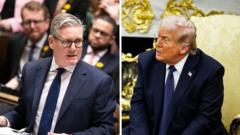
The notion of a special relationship between London and Washington has long been the primary sedative of British foreign policy. It suggests a unique, unbreakable bond forged in the fires of the mid-twentieth century that grants the United Kingdom a seat at the table of global hegemony. The reality is far more transactional. As of 2026, the gears of this partnership are grinding against a new geopolitical friction that neither side seems willing to acknowledge publicly. Washington has shifted its gaze toward the Pacific, viewing the UK not as a peer or a bridge to Europe, but as a medium-sized satellite whose primary utility is providing naval docking rights and intelligence feeds.
This is not a temporary dip in diplomatic temperature. It is a fundamental realignment of American interests that leaves the UK increasingly isolated. The old assumptions of shared destiny are being replaced by a cold, data-driven assessment of what London actually brings to the fight.
The Myth of Sentimental Diplomacy
For decades, British Prime Ministers have traveled to the White House seeking the validation of a "special" mention in a joint press conference. This performance is largely for a domestic British audience. In the halls of the State Department and the Pentagon, the sentimentality is non-existent. The U.S. operates on the principle of national interest, and currently, those interests are drifting away from the Atlantic.
The UK’s departure from the European Union stripped it of its primary value to Washington. Previously, London acted as the English-speaking champion of American free-market ideals within the EU. Without that lever, the UK is a standalone actor with a shrinking defense budget and a fractured domestic economy. When the U.S. looks at Europe now, it looks at Berlin and Paris for economic stability and Warsaw for military deterrence. London is an afterthought.
Intelligence is the Only Hard Currency Left
If there is a remaining pillar holding the roof up, it is the Five Eyes alliance. The intelligence-sharing apparatus between the U.S., UK, Canada, Australia, and New Zealand remains the most sophisticated network in history. Britain’s GCHQ provides a level of SIGINT (signals intelligence) coverage that the U.S. still finds indispensable, particularly in monitoring Russian communications and Middle Eastern data flows.
However, even this pillar is under pressure. The U.S. is increasingly leaning on private tech giants—the Silicon Valley behemoths—to provide the kind of data analysis and surveillance that used to be the sole province of state agencies. As the U.S. government integrates more deeply with private American tech, the relative value of British state-collected intelligence diminishes. If the UK cannot keep pace with the sheer computational power of American AI-driven surveillance, its seat at the table becomes a folding chair in the corner.
The Trade Deal That Never Was
The promise of a comprehensive US-UK Free Trade Agreement was the carrot dangled before the British public during the Brexit campaign. It was supposed to be the definitive proof that the special relationship could provide economic salvation. Six years later, the prospects are dead.
Washington has moved into a protectionist era. The Inflation Reduction Act (IRA) and various "Buy American" initiatives have signaled a turn away from the kind of sweeping trade deals the UK desperately needs. For the U.S., a deal with the UK offers marginal gains and significant political headaches, particularly regarding agricultural standards and the NHS. For the UK, the lack of a deal is a glaring indictment of its diminished standing.
The power imbalance is undeniable.
The U.S. GDP is roughly eight times that of the UK. When negotiations do happen, they are not discussions between equals; they are dictates from a superpower to a supplicant. This is most visible in the tech sector, where the UK’s attempts to regulate American platforms are often met with quiet but firm threats of reduced investment or data-sharing restrictions.
Defense Spending and the Hollow Force
America is tired of subsidizing European security. While the UK remains one of the few NATO members to consistently meet the 2% spending target, the actual "mass" of the British military has reached a critical low. The Royal Navy, despite its two aircraft carriers, struggles with a lack of support ships and personnel. The British Army is at its smallest size since the Napoleonic era.
From a Washington perspective, a partner that can only deploy a single brigade in a crisis is not a strategic heavyweight. The U.S. military is currently obsessed with "integrated deterrence," which requires partners to have high-end, scalable capabilities. The UK is increasingly seen as a "niche" contributor—useful for special forces operations or specific maritime patrols, but no longer capable of sustained, independent large-scale warfare.
The AUKUS Diversion
Some point to the AUKUS submarine pact as evidence that the relationship is thriving. It is actually evidence of the UK’s desperation to remain relevant by latching onto the U.S.-China rivalry. By committing to provide nuclear-powered submarine technology to Australia, the UK has tied its long-term naval strategy to the South China Sea.
This move pleases the hawks in Washington, but it stretches British resources thin. It forces the Royal Navy to project power thousands of miles from home when the primary threat to British soil remains in the North Atlantic and Eastern Europe. It is a high-stakes gamble: London is betting that by becoming America’s deputy in the Pacific, it can secure its status for another fifty years. If the U.S. decides to pivot again, or if the costs of the program spiral, the UK will be left with a massive bill and no strategic fallback.
Divergent Paths on China and the Middle East
The cracks are widening in the realm of foreign policy alignment. While both nations are wary of Beijing, the UK’s economic dependency on Chinese investment makes it more hesitant to engage in the total "de-coupling" that some factions in Washington demand. London still clings to the idea of a "middle path," while Washington increasingly views the world in binary terms.
In the Middle East, the alignment is similarly frayed. The UK continues to support the basic tenets of the Iran nuclear deal (JCPOA) long after the U.S. walked away. On the Israel-Palestine issue, the UK government faces significant domestic pressure that often forces a more critical public stance than Washington is comfortable with. These are not just "differences of opinion"; they are fundamental disagreements on how to manage global volatility.
The Cultural Drift
Beyond the corridors of power, the cultural glue is also failing. For the Boomer and Gen X generations, the "special relationship" was anchored in the shared experience of the Cold War and the cultural dominance of American music and film in the UK. For Gen Z and Alpha, that connection is different. It is filtered through social media algorithms that highlight American dysfunction and British decline.
The younger generation of American policymakers does not feel a nostalgic pull toward London. They are more likely to have heritage from Asia, Latin America, or Africa. To them, the UK is just another European country with a fancy history and a struggling present. The "sentimental capital" that British diplomats have relied on for decades is being spent, and no one is making fresh deposits.
The Economic Extraction
American private equity is currently cannibalizing British industry. From defense contractors to water utilities and tech startups, American firms are buying up UK assets at a discount due to the weak Pound. This is not the behavior of a partner; it is the behavior of a liquidator. When the UK’s most promising AI companies or biotech firms are swallowed by Silicon Valley, the UK loses its ability to compete in the future economy.
London’s role as a global financial hub is also under threat. As the U.S. weaponizes the dollar through sanctions and moves toward a more digital-centric financial system, the City of London’s traditional advantages are being eroded. Washington is not interested in protecting London’s status; it is interested in ensuring New York remains the undisputed center of the financial universe.
The Intelligence Trap
Britain’s reliance on American military hardware creates a "sovereignty gap." From the F-35 fighter jets to the Trident nuclear deterrent, the UK’s most critical defense systems are effectively on loan from the United States. Without American software updates, satellite navigation (GPS), and maintenance logs, the British military would be grounded within weeks.
This creates a paradox. To be a "great power," the UK believes it must have these high-end capabilities. But to have these capabilities, it must surrender its strategic independence to Washington. This is the "Special Relationship" trap: the closer the UK gets to the U.S. to gain power, the less power it actually has to act on its own.
The Reality of the "Junior Partner"
There is no such thing as a "junior partner" in a superpower's orbit. There are only assets and liabilities. The UK has spent the last decade trying to prove it is an asset, but it has done so by ignoring its own internal rot. A nation with crumbling infrastructure, a stagnant productivity rate, and a political class obsessed with internal squabbles is not a compelling partner for a superpower facing an existential challenge from China.
Washington respects strength. It respects technological innovation, industrial capacity, and military lethality. It does not respect historical ties or shared language when the chips are down. If the UK wants to salvage its relevance, it must stop asking for a "special" status and start building a nation that Washington cannot afford to ignore.
The era of the "special relationship" as a diplomatic security blanket is over. What remains is a lopsided arrangement where one side provides the orders and the other provides the applause. London can continue to pretend the bond is unique, or it can face the cold reality that in the 21st century, you are only as special as your last quarterly GDP report.
Check the current status of the UK's military procurement contracts with US defense firms to see exactly how much sovereignty has been traded for hardware.