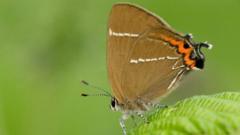
The sighting of rare butterflies following the planting of 430 trees is often framed as a spontaneous miracle of nature. It makes for a comforting headline. It suggests that if we simply put enough saplings in the ground, the broken machinery of our local ecosystems will hum back to life. But for those who track biodiversity in concrete jungles, the appearance of a rare species isn't just a feel-good story. It is a data point in a high-stakes experiment that usually fails.
Urban rewilding is a numbers game where the house almost always wins. Planting 430 trees—a specific, modest figure—might create a local "sink" for a specific butterfly species, but it does not address the fragmentation that makes these insects rare in the first place. When a rare butterfly appears in a newly planted grove, it hasn't necessarily been "saved." Often, it has simply been lured into an ecological trap.
The Island Effect and Why Numbers Lie
Most city-led greening projects suffer from the "Island Effect." You can plant a thousand trees in a city park, but if that park is surrounded by six lanes of asphalt and glass skyscrapers, it remains an island. Butterflies are fragile navigators. For a population to be sustainable, individuals must be able to move between habitats to maintain genetic diversity. Without corridors, these 430 trees are just a pretty cage.
We see the same pattern in metropolitan planning across the globe. A developer or a city council clears a patch of scrubland, puts in a manicured "green space," and waits for the applause. They count the trees, not the connectivity. True restoration requires more than just biological decoration; it requires a structural overhaul of how we view urban land use.
If those 430 trees were planted as a singular block, their impact is limited. If they were planted as a thin line connecting two larger, existing habitats, their value increases tenfold. However, most projects focus on the aesthetic density of a single location because that is what looks best in a press release.
The Soil Paradox
You cannot grow a prehistoric ecosystem on top of construction rubble. This is the silent hurdle that most journalists ignore. The "rare butterflies" cited in these reports often require specific host plants that only thrive in particular soil chemistries.
Urban soil is frequently compacted, contaminated with heavy metals, or stripped of the mycorrhizal fungi necessary for tree health. When we plant 430 trees, we are often forcing them into a hostile subterranean environment. If the trees struggle, the insects that depend on them will never establish a permanent colony. They might visit, but they won't stay.
Success in these projects is usually the result of invisible work. It’s the three years of soil remediation that happened before the first shovel hit the dirt. It’s the selection of native species over the cheaper, faster-growing nursery staples that landscapers prefer. When we focus only on the count of the trees, we ignore the complexity of the life support system they require.
The Cost of Maintenance Failure
The most dangerous part of a rewilding project is the second year. Anyone can get a photo op with a sapling and a golden shovel. Very few organizations have the budget or the will to water, prune, and protect those trees through a record-breaking summer heatwave.
In many cities, the mortality rate for urban trees in their first five years exceeds 30 percent. If a third of those 430 trees die, the canopy cover disappears, the microclimate shifts, and the rare butterflies vanish as quickly as they arrived. We are currently trapped in a cycle of "plant and forget."
Conservationists are beginning to realize that "rare" is a moving target. As the climate shifts, the species we consider native to a specific city may no longer be able to survive there. We are trying to rebuild the past in a future that won't support it. This creates a friction between traditional conservation—saving what was—and adaptive restoration—planting for what is coming.
Selection Over Scale
Small-scale interventions often outperform massive, poorly planned forests. A single acre of diverse, messy meadow can support more insect life than ten acres of a single tree species.
- Host Plants: Butterflies are specialists. They don't just need "trees"; they need the exact plant their larvae can eat.
- Shelter: Mature ecosystems provide windbreaks and thermal regulation that young saplings cannot.
- Chemical Abstinence: If a city plants 430 trees but continues to spray nearby lawns with neonicotinoids, the project is a death trap.
The Illusion of the Quick Fix
The public wants to believe that nature is resilient enough to bounce back the moment we stop hitting it. It isn't. Ecosystems are more like antique watches than elastic bands; once you break the gears, you can't just shake them back into motion.
The appearance of a rare butterfly should be treated as a warning, not just a victory. It tells us that a remnant population is desperately searching for a home. If we don't expand the 430 trees into 4,000, and if we don't connect those trees to the wider geography, that butterfly sighting will be a historical footnote rather than a new beginning.
We must stop measuring success by the number of stems in the ground. We should measure it by the number of years a population survives, the depth of the leaf litter, and the lack of human interference. The obsession with the "430" figure reveals a fundamental misunderstanding of biology. Nature does not care about our round numbers or our project milestones.
Moving Beyond Decoration
Real impact requires a shift from "landscaping" to "ecology." This means leaving dead wood on the ground for beetles. It means allowing "weeds" like milkweed and nettles to grow in public view. It means accepting that a healthy ecosystem might look unkempt to the untrained eye.
Most urban residents want nature, but they want it to be tidy. They want butterflies, but they don't want the caterpillars that eat their garden plants. They want trees, but they complain about the fallen leaves on their windshields. You cannot have the "rare" without the "raw."
If we are serious about bringing biodiversity back to our cities, we have to stop treating green space as an amenity and start treating it as essential infrastructure. This involves a cold, hard look at the trade-offs. Are we willing to lose parking spaces for a butterfly corridor? Are we willing to turn off the decorative lights on our buildings to prevent disorienting migrating insects?
The 430 trees are a start, but they are also a distraction if they don't lead to a total re-evaluation of the urban footprint. We are currently trying to fit nature into the gaps left by commerce. We need to start building our commerce around the requirements of nature.
Stop counting the trees and start counting the connections between them.