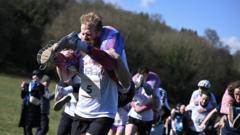
The air in central Finland during July doesn’t behave like summer in the rest of the world. It is thick with the scent of crushed pine needles, stagnant pond water, and the metallic tang of human sweat. In the small town of Sonkajärvi, a place usually defined by its silence, the quiet is shattered by a sound that defies logic: the rhythmic, wet thud of hundreds of feet hitting a muddy track, accompanied by the strained grunts of men carrying their wives upside down.
This is the Wife Carrying World Championships. To the uninitiated, it looks like a punchline. To those chest-deep in the water hazard, it is a visceral test of cardiovascular endurance, skeletal integrity, and the unspoken contracts of a marriage.
The Ghost of Ronkainen the Robber
We have to look back to the late 19th century to understand why a grown man would voluntarily sprint 253.5 meters with a woman’s legs wrapped around his neck. Legend speaks of Rosvo-Ronkainen, a literal robber baron who led a gang of thieves in the Finnish forests. To join his ranks, you had to prove your worth. You had to be fast. You had to be strong. Most importantly, you had to be able to carry a heavy sack—or a stolen woman—on your back while fleeing through the brush.
Today, the "stolen" element has been replaced by consent and a very specific set of rules, but the primal energy remains. The track is not a paved road. It is a gauntlet of sand, grass, and two dry obstacles, punctuated by a one-meter-deep water pool that has claimed many a pride.
Consider a hypothetical competitor we’ll call Henrik. Henrik is a middle-manager from Helsinki. He spends his weeks looking at spreadsheets. But today, Henrik is standing at the starting line, his wife, Elena, draped over his back in the "Estonian Carry." Her head hangs near his lower back; her arms are locked around his waist. He can feel her heartbeat through his spine.
This isn't just a race. It’s a 253.5-meter metaphor for the weight we carry for the people we love.
The Physics of the Estonian Carry
You might assume a piggyback ride is the way to go. You would be wrong. The "Estonian Carry" is the undisputed king of the track. In this position, the wife hangs upside down, her legs hooked over the husband’s shoulders. It lowers the center of gravity. It keeps the carrier’s arms free for balance. It is also, for the woman, an exercise in sheer, upside-down terror.
The weight of the "wife"—who must be at least 17 years old and weigh a minimum of 49 kilograms—is more than just a physical burden. If she is lighter than 49 kilos, she must wear a weighted rucksack to make up the difference. There is no cheating the scale.
Imagine the sensation of sprinting into a pool of waist-high water while someone is strapped to your neck. The resistance is immediate. The water grabs at your thighs. Your lungs scream for oxygen that is being compressed by the person on your back. For Elena, the water hazard means her face is inches from the murky surface as Henrik lunges forward. One trip, one slip on a submerged rock, and they are both submerged in a chaotic tangle of limbs.
Why We Run
The "chaotic" label often applied to this sport by outsiders misses the point of the chaos. The chaos is the attraction. We live in a world of cushioned corners and safety railings. Modern life is designed to remove friction. Wife carrying is 100% friction. It is the grit of the sand in your shoes and the literal weight of another human being reminding you that you are alive.
The stakes are deceptively high. While the atmosphere is festive—replete with costumes and beer—the winners take home the "wife’s weight in beer." It is a trophy that is consumed, a communal reward for a grueling physical feat. But the real prize is the peculiar bond forged in the mud.
Think about the trust required. Elena has to trust that Henrik won’t drop her head-first onto the timber hurdle. Henrik has to trust that Elena will hold her breath when they hit the water. They are a single unit. If she falls, he is penalized 15 seconds. In a race where the world record hovers around the one-minute mark, 15 seconds is an eternity. It is the difference between glory and a very quiet drive home.
The Global Spread of a Finnish Fever
While Sonkajärvi is the Mecca, the sport has migrated. There are championships in North America, Australia, and across Europe. Each region adds its own flavor, but the core remains the same: a celebration of the absurdly difficult.
It’s easy to dismiss it as a relic of a more patriarchal time, but that ignores the modern reality of the track. Many teams aren’t even married. The rules state she can be "your own, or the neighbor’s, or you may have found her further afield." The terminology is archaic, but the participation is modern. It has become a sport about partnership, regardless of the label.
Consider the training. To be competitive, Henrik doesn't just run on a treadmill. He runs through the woods. He does squats with Elena on his back in their living room while the evening news plays in the background. He learns the exact rhythm of her breathing. He knows the precise moment her grip starts to slip.
The Final Meter
The last stretch of the course is a flat sprint to the finish line. This is where the legs turn to jelly. The spectators are screaming, a wall of sound that blurs into the sound of your own blood rushing in your ears.
Henrik emerges from the water hazard, dripping and gasping. His quads are on fire. He can feel the lactic acid pooling in his muscles like molten lead. But he sees the line. He feels Elena shift her weight, tightening her grip, a silent signal that she is still with him.
They cross. He doesn't drop her immediately. He can't. His fingers are cramped into the shape of her legs. When they finally untangle, they are covered in the gray-brown silt of the Finnish countryside. They are exhausted. They are probably bruised.
People ask why. They look at the "chaos" and see a lack of order. But there is a profound order in wife carrying. It is the order of the burden. We all carry things. We carry debt, we carry grief, we carry the expectations of our parents. Most of the time, those burdens are invisible and lonely.
On the track in Sonkajärvi, the burden is visible. It is tangible. It is 49 kilograms of a person who believes in you. And for sixty seconds, you aren't a middle-manager or a citizen or a consumer. You are a runner, a carrier, a protector, and a partner.
You are simply a man carrying his world on his back, trying not to fall in the water.


