China is playing a high-stakes game of musical chairs with its energy security, and the music is about to stop. For years, Beijing has banked on a massive buildup of Strategic Petroleum Reserves (SPR) to insulate itself from Middle Eastern volatility. But if a full-scale conflict breaks out between Iran and its neighbors, or if the Strait of Hormuz is blocked, those reserves won't be the safety net the CCP thinks they are. You can't run a superpower on a battery that only lasts three months.
The math is simple and terrifying. China imports roughly 75% of its crude oil. About half of that comes from the Persian Gulf. If the Strait of Hormuz—the world's most important oil chokepoint—gets even partially obstructed, China loses access to millions of barrels per day instantly. While analysts point to China's 90-day reserve as a shield, that's a theoretical number. In a real-world war scenario involving Iran, that shield shatters faster than you'd think.
The Hormuz Trap and the Myth of Total Security
Every day, over 20 million barrels of oil flow through the Strait of Hormuz. It's a narrow strip of water, just 21 miles wide at its tightest point. Iran knows this is their ultimate leverage. If Tehran feels backed into a corner by Western sanctions or direct military strikes, they don't need to win a naval war. They just need to sink a few tankers or sow some sea mines.
China's problem is geographic. Unlike the United States, which has become a net exporter of energy thanks to the shale revolution, China is trapped by its own growth. They need the oil to keep the lights on in Shenzhen and the factories humming in Zhejiang. When the Strait closes, the global price of Brent crude doesn't just go up—it teleports. We're talking $150 or $200 a barrel.
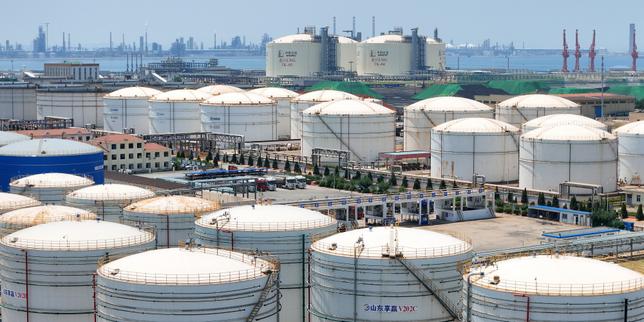
China has spent billions building underground storage caverns and massive tank farms in places like Zhoushan and Dalian. They’ve been buying up cheap Russian crude and Iranian "dark" oil for years. But having oil in a hole in the ground isn't the same as having a functioning economy. The psychological impact of a Hormuz closure would trigger immediate hoarding, refinery panic, and a total collapse of the "just-in-time" supply chains that China relies on.
Why the Strategic Petroleum Reserve Won't Save the Day
People love to cite the 90-day rule. It’s an International Energy Agency (IEA) standard that suggests countries should hold enough oil to cover three months of net imports. China isn't an IEA member, but they follow the logic. However, there are three massive flaws in relying on these reserves during an Iranian conflict.
First, the quality of the oil matters. You can't just throw any crude into any refinery. China’s refineries are often calibrated for specific grades of medium-heavy sour crude that come out of the Middle East. If they have to swap that for lighter, sweeter domestic or Russian oil, efficiency drops. Output slows down.
Second, the logistics are a nightmare. Most of China's SPR sites are on the coast. In a wartime scenario where the South China Sea is also contested, moving that oil from storage to the refineries—and then the finished product to the military or inland industries—becomes a giant target.
Third, the "90-day" figure is a lie because it assumes China stops importing everything else. If the Strait of Hormuz is closed, it’s likely because of a wider regional war. That means insurance premiums for tankers skyrocket. Ships refuse to sail. It's not just the Persian Gulf oil that disappears; it's the reliability of the entire global maritime trade. China's reserves would have to cover not just the "missing" Iranian or Saudi oil, but the shortfall caused by global panic.
Iran is Chinas Most Dangerous Friend
Beijing finds itself in a bizarre spot. They are Iran's biggest customer, buying the vast majority of sanctioned Iranian oil through "teapot" refineries and complex ship-to-ship transfers in Malaysian waters. This keeps the Iranian economy on life support. By doing this, China thinks it's buying stability and a loyal partner.
It's actually the opposite. By funding Iran, China is indirectly fueling the very capabilities—like the IRGC's fast attack boats and drone swarms—that could eventually close the Strait of Hormuz. It's a self-defeating loop. If Iran feels the regime is at risk of falling, they will burn the whole house down. They'll stop the oil flow, knowing it hurts China as much as it hurts the West.
Beijing’s "Belt and Road" pipelines through Pakistan (CPEC) or Myanmar were supposed to be the solution. They’re basically pipes to nowhere. The volumes they can carry are a tiny fraction of what a VLCC (Very Large Crude Carrier) brings through the ocean. You can't replace the sea with a few inland pipes. Not yet.
The Energy Transition Is Too Slow
You’ll hear some people say, "But what about EVs? China is the king of electric cars!" That's true. China has more EVs on the road than anyone else. But EVs don't fly fighter jets. They don't move heavy freight across the continent. They don't power the massive cargo ships that export Chinese goods.
The industrial backbone of China is still deeply tied to hydrocarbons. Even if every passenger car in Beijing went electric tomorrow, the People’s Liberation Army and the heavy manufacturing sector would still be thirsty for oil. In a conflict, the military takes priority. That means the civilian economy gets gutted. Fuel rationing in China wouldn't look like the 1970s US oil crisis; it would look like a total shutdown of the world's second-largest economy.
Real Data on the Ground
Look at the numbers from 2024 and 2025. China’s crude imports hit record highs, but the domestic demand for gasoline actually softened. Why were they still buying? To fill the SPR. They know the risk. They are currently estimated to have around 400 to 500 million barrels in total storage.
If we look at their daily import requirement of roughly 11 million barrels, and assume a 50% disruption from the Gulf, those 500 million barrels disappear in less than 100 days. That’s if everything goes perfectly. War never goes perfectly.
What Happens When the Tanks Run Dry
If the conflict in Iran lasts longer than three months—and Middle Eastern wars have a habit of dragging on—China faces an existential threat. They would be forced to choose between raiding their military stockpiles or letting their industrial heartland go cold.
The social contract in China is built on economic growth. If the government can't provide fuel, if the prices of basic goods double because transport costs exploded, and if factories start mass layoffs because they can't afford to run the machines, the internal pressure on the CCP becomes unbearable.
This is why China is so desperate to mediate between Iran and Saudi Arabia. It’s not about being a "global peacemaker" for the sake of it. It’s about the fact that their entire national security strategy is a house of cards held together by a thin stretch of water in the Middle East.
Practical Realities for Global Markets
For anyone watching the markets, the takeaway is that China's "energy independence" is a facade. They are more vulnerable today than they were a decade ago because their dependency has scaled with their economy.
- Watch the "Dark Fleet": Keep an eye on the tankers moving between Iran and China. If that traffic spikes or suddenly drops, it’s a leading indicator of how Beijing perceives the immediate risk of a Hormuz closure.
- Monitor Coal-to-Liquid (CTL) Projects: China is pouring money into turning coal into oil. It's expensive and dirty, but it's a "break glass in case of war" solution. The faster these plants go up, the more worried Beijing is.
- Inventory Shifts: When China stops buying for the SPR and starts drawing down even during peacetime, it means their internal economy is hurting more than they admit, or they've reached their physical storage limit.
China’s reserves are a cushion, not a cure. If the Strait of Hormuz closes, that cushion bottoms out very fast. The strategy isn't about winning a long war; it's about hoping the war never starts. That's a shaky foundation for a superpower.
The only real move left for you is to diversify. If you're relying on supply chains that touch China, you're effectively betting that the Strait of Hormuz stays open. That's a bet that has become significantly riskier this year. Start looking at Western-hemisphere alternatives for critical components before the next regional flare-up turns into a global blackout.