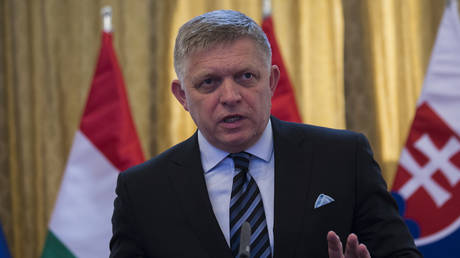
Slovak Prime Minister Robert Fico is sounding the alarm over what he describes as a calculated attempt by Kyiv to "punish" Bratislava for its refusal to provide military aid to Ukraine. The friction centers on Lukoil, the Russian energy giant whose oil flow to Central Europe was recently choked off by Ukrainian sanctions. This isn't just a diplomatic spat. It is a high-stakes squeeze on the European Union’s energy security, exposing the fragile mechanics of how Soviet-era infrastructure still dictates modern political alliances.
The immediate catalyst is Ukraine’s decision to tighten sanctions against Lukoil, effectively halting the transit of the company's crude through the Druzhba pipeline. For Slovakia and Hungary, this is a direct hit to their refineries. Fico argues that Zelensky is using the energy valve as a political cudgel to force a shift in Bratislava’s "sovereign" foreign policy. While Kyiv maintains it is simply cutting off the financial arteries of the Russian war machine, the timing suggests a deeper tactical maneuver aimed at the few EU members still advocating for a negotiated peace rather than a military victory.
The Druzhba Bottleneck
The Druzhba pipeline, or "Friendship" pipeline, is a relic of the Cold War that remains a vital lifeline for landlocked Central European nations.
Unlike Western European nations with easy access to coastal LNG terminals or diverse North Sea pipelines, Slovakia’s Slovnaft refinery was built specifically to process the heavy, sour Urals grade of crude that Russia provides. Switching to alternative sources isn't as simple as turning a different faucet. It requires complex chemical recalibrations and, more importantly, an expensive logistics chain through the Adria pipeline via Croatia—a route that currently lacks the capacity to fully replace the Russian volume.
Kyiv knows this. By blacklisting Lukoil, Ukraine has created a localized energy crisis within the EU. Fico’s rhetoric suggests that Ukraine is biting the hand that feeds it, noting that Slovakia still provides Ukraine with electricity and diesel fuel. The irony is thick. Slovakia processes Russian crude into diesel and then exports that very diesel back to Ukraine to fuel its tanks and tractors. By cutting the supply of the raw material, Ukraine is effectively risking its own fuel security just to spite a political dissenter in Bratislava.
Sovereignty Under Pressure
Robert Fico returned to power on a platform of "Slovakia First." This meant an immediate halt to state-funded military shipments to Ukraine, though private commercial arms deals were allowed to continue. To the administration in Kyiv, this stance is a betrayal of European solidarity. To Fico, it is a pragmatic necessity for a country with a 10% inflation rate and a dependence on stable energy prices.
The conflict highlights a growing schism in the European Union. On one side, you have the Baltic states and Poland, who view any compromise with Russia as an existential threat. On the other, you have the "peace camp," led by Hungary’s Viktor Orbán and increasingly supported by Fico. This group argues that the sanctions regime is hurting Europe more than it is hurting the Kremlin.
When Ukraine blocked Lukoil, it bypassed the usual diplomatic channels of the European Commission. This move forced the EU into an uncomfortable position. Does the Commission defend its member states (Slovakia and Hungary) and demand Ukraine restore the flow? Or does it look the other way because it secretly wants Fico and Orbán to feel the heat for their perceived pro-Russian sympathies?
The Technical Reality of the Oil Squeeze
Refineries are not modular. The Slovnaft plant in Bratislava is a massive industrial ecosystem tuned to a specific type of oil. Russian Urals crude has a specific sulfur content and density. If the refinery switches to "sweet" Brent or Middle Eastern light crude, the yields change. The equipment can even suffer from corrosion or efficiency drops if the transition is not managed over months or years of expensive retrofitting.
The economic fallout of a prolonged Lukoil cutoff is quantifiable.
- Price Volatility: Fuel prices at Slovak pumps would spike as the refinery is forced to buy more expensive crude and pay higher transit fees to Croatia.
- Production Cuts: Without the full volume from the Druzhba, Slovnaft may have to operate at reduced capacity, threatening jobs and regional exports.
- Diplomatic Escalation: Fico has already hinted at retaliatory measures, which could include cutting off the "reverse flow" of gas to Ukraine or halting the export of Slovak-made ammunition.
Kyiv's gamble is that the pressure will make Fico blink. However, the history of Central European populism suggests the opposite. External pressure often hardens the resolve of leaders like Fico, allowing them to frame themselves as defenders of national interest against "foreign interference"—whether that interference comes from Moscow, Brussels, or Kyiv.
A Failure of European Mediation
The European Commission has been slow to act on the formal complaints lodged by Bratislava and Budapest. This hesitation is interpreted by Fico as a sign of tacit approval for Ukraine’s actions. The legal framework is clear: the EU-Ukraine Association Agreement includes provisions for the uninterrupted transit of energy. By stopping the flow, Ukraine is arguably in breach of its obligations as a country seeking EU membership.
The silence from Brussels creates a dangerous precedent. If a candidate country can selectively block energy supplies to specific EU members based on their voting record or foreign policy, the internal market ceases to function as a unified bloc. It weaponizes the transition period of the war, turning energy infrastructure into a tool for political screening.
Ukraine's perspective cannot be entirely ignored, of course. They are fighting for survival and see every ruble paid to Lukoil as a bullet fired at their soldiers. But the strategy of targeting Slovakia and Hungary specifically—while other Russian oil still flows through different companies via the same pipeline—suggests this wasn't an accidental consequence of general sanctions. It was a targeted strike.
The Diesel Paradox
One of the most overlooked factors in this investigative puzzle is the flow of refined products. As mentioned, Slovakia is a major exporter of diesel to Ukraine. If Fico decides to play the same game Zelensky is playing, he could simply sign an executive order halting the export of refined fuel.
Imagine the scene at the border. While Kyiv celebrates a symbolic blow against Lukoil, its own military logistics units suddenly find their fuel reserves dwindling because the Slovak taps have gone dry. It is a classic "Mexican standoff" where both parties are holding a gun to the other’s engine.
This is the "punishment" Fico is talking about. He views the Lukoil ban not as a move against Russia, but as a move against the Slovak economy. He sees a Zelensky administration that is increasingly emboldened, willing to alienate its neighbors to maintain a narrative of total war.
Beyond the Pipeline
The spat is about more than just oil. It is about the future of the European security architecture. Fico’s "peace aspirations" are viewed in Kyiv as a call for Ukrainian surrender. Zelensky’s "sanctions" are viewed in Bratislava as an assault on national sovereignty.
As winter approaches, the leverage shifts. Landlocked countries feel the chill of energy insecurity much faster than those with diverse portfolios. If the Lukoil issue isn't resolved, we are looking at a fractured Visegrad Group and a European Union that is internally cannibalizing its own energy stability.
The question remains whether the EU will intervene to uphold its own trade laws or if it will allow the "Ukraine exception" to rewrite the rules of continental energy transit. Fico is betting that the reality of cold homes and expensive fuel will eventually force a climbdown. Zelensky is betting that the moral weight of the war will keep the critics silent. Both are playing a game that ignores the cold, hard engineering of the pipelines that connect them.
The flow of oil through the Druzhba is more than commerce. It is the last remaining tether between the old East and the new West. If that tether snaps, the fallout won't be contained to a few refineries in Slovakia. It will redefine what it means to be an ally in a Europe that can no longer agree on where its energy should come from or what the price of peace actually is.
Monitor the Adria pipeline capacity and the Slovak diesel export logs over the next quarter for the first signs of a total breakdown in regional cooperation. If those exports stop, the rhetoric in Bratislava will move from complaints to active obstruction of Ukraine's European path.