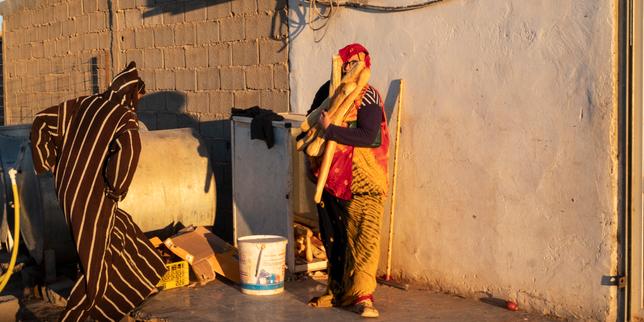
Fifty years is an eternity to live in a temporary shelter. In the harsh, wind-blasted hamada of southwest Algeria, more than 173,000 Sahrawi refugees are currently enduring a slow-motion catastrophe that the rest of the world has largely tuned out. The crisis in the Tindouf camps is no longer just a matter of political stalemate between the Polisario Front and Morocco. It has evolved into a structural collapse of international empathy. As global attention shifts toward newer, louder conflicts in Eastern Europe and the Middle East, the pipeline of food, medicine, and basic funding that keeps these camps breathing is drying up.
This isn't just a "funding gap" in the sterile language of NGOs. It is a fundamental breakdown of the humanitarian contract. When the World Food Programme (WFP) cuts rations in Tindouf, it isn't cutting into "surplus" or "waste." It is cutting into the literal survival of a population that has no economy, no soil to till, and no legal right to work outside the camp structures. The Sahrawis are trapped in a geopolitical waiting room where the walls are made of sand and the clock stopped in 1975.
The Arithmetic of Starvation
The numbers coming out of the camps are grim. Recent data indicates that nearly half of the children under five suffer from anemia. Stunting is common. This is the direct result of a calorie deficit that has been building for years. The international community used to provide a diversified basket of goods: flour, oil, sugar, and occasionally fresh produce or protein. Today, that basket is shrinking.
Donors are fatigued. The European Union, the United States, and various UN agencies have shifted their financial priorities. In the brutal logic of global aid, a "protracted" crisis—one that lasts decades without a resolution—is often viewed as a lost cause. Money flows to the front lines of active wars, leaving the Sahrawis to subsist on the leftovers.
The Algerian government provides significant logistical support and security, but it cannot carry the burden alone. The cost of basic commodities has spiked globally due to supply chain disruptions and inflation. A dollar today buys roughly 30% less grain than it did three years ago. For a population 100% dependent on imports, that math is lethal.
The Myth of the Temporary
The fundamental problem with the Tindouf camps is the "temporary" label that has been applied to them for five decades. Humanitarian aid is designed for emergencies. It is meant to bridge a gap of six months, maybe two years, until people can return home or integrate into a new society. It is not designed to sustain a semi-permanent state-in-exile.
Because the camps are viewed as temporary, there is almost no investment in sustainable infrastructure. There are no permanent factories. There is no large-scale agriculture because the soil is a salt-crusted wasteland. The Sahrawis have built houses out of mud bricks that dissolve when the rare, violent rains hit the desert. They rebuild them every time, using the same fragile materials, because building with concrete would signal an acceptance of their permanent displacement.
This psychological and political deadlock creates a unique kind of poverty. It is a poverty of stagnation. A young Sahrawi born in the camps today is likely the third generation to live in a tent or a mud hut. They are educated—the Sahrawis boast one of the highest literacy rates in the region—but they have nowhere to apply their skills. This creates a dangerous vacuum. When you have a highly educated, deeply frustrated youth population with no economic prospects and dwindling food supplies, you are no longer managing a refugee crisis; you are managing a powder keg.
The Geopolitical Stranglehold
The Western Sahara conflict is often described as the "Last Colony in Africa." On one side, Morocco claims the territory as its own, citing historical ties and maintaining "de facto" control over the vast majority of the land, including the lucrative phosphate mines and fishing waters. On the other side, the Polisario Front, backed by Algeria, demands a referendum on self-determination that was promised by the UN decades ago but never materialized.
The camps are the physical manifestation of this stalemate. For Morocco, the camps are a political tool used by Algeria. For the Polisario, the camps are the heart of their nascent state, the Sahrawi Arab Democratic Republic (SADR). For the refugees themselves, the camps are a prison where the guards are the climate and the international community's indifference.
The recent shifts in diplomacy have only made things worse for the refugees. As major powers like Spain and the United States move toward supporting Morocco's autonomy plan, the hope for a return to the "homeland" dims. This political shift has a direct correlation with aid. When a cause loses its political "cool," the donor checks stop arriving.
The Logistics of Despair
Running a camp in the middle of the Sahara is a logistical nightmare. Every drop of water, every bag of rice, and every vial of insulin must be trucked in across hundreds of miles of desert.
- Water Scarcity: Ground water is scarce and often high in fluoride or salt. Desalination plants are expensive to run and maintain.
- Heat Extremes: Temperatures regularly exceed 50°C (122°F) in the summer. Without consistent electricity for refrigeration, food spoilage is a constant threat.
- Health Infrastructure: The clinics are staffed by dedicated Sahrawi doctors, but they lack basic diagnostic equipment. A simple infection can become life-threatening if the right antibiotic isn't in the month's shipment.
The dependency is absolute. In other refugee contexts, like those in Jordan or Turkey, refugees can sometimes find work in the informal economy. In Tindouf, there is no informal economy of scale. The nearest Algerian city is a military outpost. The refugees are essentially guests of the Algerian military, living in a sensitive border zone. Their movement is restricted for security reasons, which further chokes any chance of self-sufficiency.
Why Traditional Aid is Failing
The old model of "dumping grain and hoping for the best" is broken. In Tindouf, we are seeing the limits of charity. The WFP and UNHCR are perpetually begging for funds, often operating on 20% or 30% of their required budgets. This leads to a "triage" approach to human life.
They prioritize the "most vulnerable"—meaning the pregnant women and the severely malnourished. But what about the man who is "only" moderately hungry? He gets skipped. Over time, that "moderately hungry" man becomes "severely malnourished," and the cycle continues. It is a system that manages decline rather than preventing it.
There is also the issue of the "Black Hole" of information. Because the camps are located in a sensitive military zone and are governed by the Polisario, there are often accusations regarding the diversion of aid. While NGOs on the ground work hard to track every kilo of flour, the lack of total transparency gives cynical donors an excuse to tighten the purse strings. Whether the diversion is systemic or incidental is almost irrelevant to the starving child; the perception of corruption is enough to kill the funding.
The Radical Alternative
If the world cannot solve the political problem of Western Sahara, it must at least change the economic reality of the camps. This would require a radical shift from "humanitarian aid" to "developmental investment."
This means building permanent water infrastructure that doesn't rely on daily trucking. It means investing in solar energy—one resource the Sahara has in abundance—to power small-scale hydroponic farms that can provide the vitamins these people are missing. It means allowing Sahrawis to participate in the broader Algerian and regional economy without losing their refugee status or their political claims.
But this requires courage. It requires Morocco to allow development without seeing it as a threat to their sovereignty. It requires the Polisario to allow economic integration without fearing a loss of political control over their people. And it requires Algeria to open up a sensitive border region to more than just military transport.
Most importantly, it requires the West to stop seeing the Sahrawis as a footnote. We are currently witnessing the death of a dream and the physical wasting away of a people. The dust storms of the Sahara are literal and metaphorical; they are burying the Sahrawi people in real-time.
The international community must decide if it wants to keep providing the bare minimum for survival or if it wants to actually support a life. Right now, it is doing neither. It is simply watching a population fade into the sand.
We have a choice to make before the next sandstorm clears and there is no one left to receive the grain. The Sahrawis don't need another "fact-finding mission" or a "statement of concern." They need the calories they were promised and a reason to believe that fifty years was long enough.
Stop treating the Sahrawi people as a political bargaining chip and start treating them as a starving population.