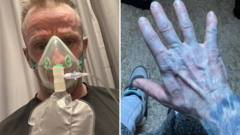
You don't expect a falling suitcase to be a diagnostic tool. Most of us would just curse our luck, rub a bruised shoulder, and move on with our day. But for one woman, a mundane travel mishap became the only reason she discovered a ticking time bomb in her skull. It sounds like a freak occurrence because it is. Yet, stories like this highlight a terrifying reality about how brain cancer hides in plain sight until something—literally—knocks it into the light.
When we talk about terminal brain cancer, we usually focus on the "terminal" part. We talk about the end. We rarely talk about the bizarre, almost cinematic ways these tumors are found. In this specific case, the blunt force of a suitcase falling from an overhead bin didn't cause the cancer, but it caused the symptoms that led to a scan. Without that impact, the tumor likely would've continued growing in silence until it was far too late for any intervention at all.
It’s a brutal irony. A painful accident ends up being the "lucky" break that buys a patient a few more months or years.
Why Brain Tumors Stay Hidden So Long
The brain is a master at compensating. You can have a mass the size of a golf ball pressing against your frontal lobe and not feel a thing. Your brain just reroutes, adjusts, and keeps you moving. This is why so many glioblastomas and other high-grade gliomas aren't caught until they reach a critical mass.
Doctors often see patients who've ignored "soft" symptoms for months. Maybe you're a bit more tired than usual. Maybe you've had a dull headache that won't quit, or you’ve been slightly more irritable. You blame work. You blame your kids. You blame the weather. You don't think "cancer."
Then, something happens. An accident. A fall. A suitcase hits you in the head.
The inflammation from a minor head injury can cause a pre-existing tumor to swell or shift. Suddenly, those subtle symptoms become impossible to ignore. Vision blurs. Seizures start. The "accident" isn't the cause, but it’s the catalyst for discovery. According to the National Brain Tumor Society, thousands of people are diagnosed every year following unrelated trauma. It’s a pattern neurologists know well, even if it feels like a one-in-a-million shot to the person living it.
The Reality of a Terminal Diagnosis
Hearing the word "terminal" changes the molecular structure of your life. It's not just a medical status. It’s a total shift in how you view time. For the woman in this story, the diagnosis was likely a Glioblastoma Multiforme (GBM). If you aren't familiar with GBM, it’s the most aggressive form of cancer that begins in the brain.
It doesn't play fair. Even with surgery, radiation, and chemotherapy, the recurrence rate is nearly 100%.
People often ask why we can't just "cut it all out." The problem is that these tumors are like sand in a shag carpet. You can get the big chunks, but the microscopic "fingers" of the tumor weave into healthy brain tissue. Surgeons can’t take those out without destroying who you are—your speech, your memory, your ability to walk. So, you’re left with a treatment plan that’s basically a holding action. You’re trading side effects for time.
What the Statistics Don't Tell You
The median survival rate for a grade IV brain tumor is roughly 15 to 18 months. That’s a grim number. But it’s also just a median. Some people get three months. Some get five years.
When you read a headline about a woman finding cancer after a suitcase fell on her, it’s easy to focus on the "freak" nature of the event. But the real story is what happens on Day 2. It’s the logistical nightmare of clinical trials, the soul-crushing fatigue of steroid treatments, and the weirdly specific grief of losing your future while you’re still very much alive.
Navigating the Healthcare Minefield
If you or someone you love gets hit with this news, don't just take the first opinion you get. Brain cancer is specialized. You need a neuro-oncologist, not just a general oncologist. You need a facility that’s designated as a Comprehensive Cancer Center by the National Cancer Institute.
Most people make the mistake of staying local because it’s easier. Honestly, that’s a mistake. The difference between a standard hospital and a research-heavy institution like Mayo Clinic or Johns Hopkins can literally mean the difference between access to a life-extending clinical trial and "standard of care" which hasn't changed much in decades.
- Get the biopsy results. Not all tumors are the same. Molecular markers like IDH mutation status or MGMT methylation can tell you if chemotherapy will actually work.
- Opt for genomic sequencing. Knowing the specific genetic makeup of the tumor can open doors to targeted therapies.
- Question everything. If a surgeon says a tumor is inoperable, ask why. Then ask someone else.
The Mental Toll of the Long Goodbye
There’s a specific kind of trauma involved in knowing your timeline. Most of us live with the delusion of immortality. We think we have decades. When a suitcase falls and takes that away, the psychological fallout is massive.
Patients often describe a "fog." Part of it’s the chemo. Part of it’s the sheer weight of the "terminal" label. You start mourning yourself. You watch your family mourn you. It’s heavy. It’s messy. And frankly, our medical system is pretty bad at handling the emotional side of it. They’re great at the scans and the infusions, but they’re terrible at the "how do I tell my kids I’m dying" part.
We need to stop treating terminal illnesses as just a series of appointments. It’s a life. It’s still a life until the very last second.
What to Do If You Suspect Something is Wrong
Don't wait for a suitcase to fall on your head. Most brain tumors aren't found by accident; they're found because someone finally listened to their gut.
If you have a headache that feels "different"—especially if it’s worse in the morning or accompanied by nausea—get a scan. If you find yourself fumbling for words that used to come easily, get a scan. If your personality seems to be shifting in ways your friends notice, get a scan. It’s probably nothing. It usually is. But on the off chance it’s something, early detection is the only lever you have to pull.
If you are currently facing a diagnosis, your first move is to secure a second opinion from a major brain tumor center. Check the Society for Neuro-Oncology for a list of specialists. Don't waste time on "wait and see" approaches. Demand the most aggressive molecular testing available for your pathology. Your timeline depends on the data you gather in these first few weeks. Get the data, find the best surgical team you can afford to reach, and don't let the "terminal" label stop you from seeking every available day. Every day counts. Every single one.