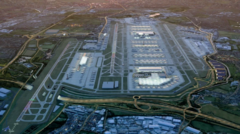
The viability of Heathrow’s third runway is not a question of tarmac or terminal capacity, but a function of surface access throughput. While aviation discussions focus on noise contours and carbon offsets, the operational failure point lies in the "last mile" connectivity between London’s arterial transport networks and the airport perimeter. If the proposed expansion proceeds without a radical reconfiguration of the M4/M25 interchange and the rail delivery frequency, the project will face a terminal "chokepoint" where passenger growth outpaces the physical capacity of the surrounding infrastructure to move them. This analysis deconstructs the expansion through three critical lenses: the elasticity of transport demand, the carbon-cap on ground movements, and the systemic risk of regional gridlock.
The Tri-Modal Surface Access Equation
To understand the Heathrow expansion, one must evaluate the total passenger throughput as a sum of three distinct modal vectors. Heathrow’s current planning assumes a significant shift in the "modal split"—the ratio of passengers arriving by public transport versus private vehicles. If you found value in this article, you might want to read: this related article.
- The Rail Saturation Variable: The Elizabeth Line and Heathrow Express represent the primary high-capacity arteries. However, these systems share tracks with regional and freight services. The expansion requires an increase in "path availability" that the current Great Western Main Line (GWML) cannot support without displacing existing commuter flows.
- The Strategic Road Network (SRN) Friction: The M25/M4 junction is already one of the most congested nodes in Europe. Increasing airport capacity by roughly 50% introduces a non-linear increase in vehicle delays. Because road capacity is finite, the marginal cost of adding one additional vehicle at peak times results in an exponential spike in total system delay.
- Active and Sustainable Transit (AST): This includes bus, coach, and emerging micro-mobility. While often touted as a "green" solution, these modes are subject to the same road congestion as private cars, meaning their reliability degrades at the exact moment they are most needed.
The No-Car-Growth Constraint
The UK government and local authorities have placed a "no-car-growth" pledge on the expansion. This is a hard technical constraint: Heathrow must increase its annual passenger numbers from approximately 80 million to 130 million without increasing the absolute number of airport-related car journeys.
This creates a Efficiency Gap that must be closed through aggressive public transport adoption. If the airport fails to hit a public transport mode share of roughly 50-55%, it breaches its environmental permit. The logic holds that for every new flight added, a corresponding number of existing car-bound passengers must be transitioned to rail. This is not a linear transition. Historically, the "wealthier" long-haul demographic shows a high inelasticity of demand for private hire vehicles (PHVs) and taxis due to luggage requirements and time-sensitivity. For another perspective on this development, check out the recent coverage from Forbes.
The Western Rail Link (WRLtH) and Southern Access (SARA)
The current infrastructure suffers from a geographic bias; access is heavily weighted toward Central London. For the third runway to be functionally accessible to the rest of the UK—thereby justifying its status as a "national" asset—two specific infrastructure interventions are required:
- The Western Rail Link: A proposed tunnel connecting the GWML to Terminal 5. This removes the "Paddington Backhaul," where passengers from the West (Reading, Bristol, Wales) must travel past the airport into London only to double back.
- Southern Access to Heathrow (SARA): Connecting the airport to the Waterloo line and potentially the South Coast. Without this, the entire southern catchment area remains dependent on the M3 and M25, ensuring the "no-car-growth" target remains mathematically impossible.
The failure to confirm funding and timelines for these specific links creates a Strategic Asset Mismatch. You cannot build a 21st-century global hub while relying on a 20th-century radial rail network.
Environmental Capacity and the "Polluter Pays" Feedback Loop
The expansion is governed by the Air Quality Standards Regulations. Nitrogen Dioxide (NO2) levels around the Heathrow perimeter frequently border on legal limits. Because aircraft emissions at altitude contribute less to local ground-level NO2 than the thousands of idling cars and heavy goods vehicles (HGVs) on the M25, the transport network is the primary variable in the airport's legal "right to operate."
To manage this, Heathrow must implement a Ground Access Tax or an Ultra-Low Emission Zone (ULEZ) equivalent for the airport estate. This creates an economic feedback loop:
- Increased Access Cost: Driving to the airport becomes prohibitively expensive.
- Revenue Reinvestment: Ideally, these funds subsidize rail fares.
- The Risk: If rail fares remain high (as with the Heathrow Express), the airport creates a "tax on travel" that diminishes its competitive advantage against European hubs like Schiphol or Charles de Gaulle, which enjoy superior integrated rail-air connectivity.
The Operational Risk of "Network Shock"
The most significant overlooked factor in the expansion debate is the lack of redundancy. In a three-runway configuration, the airport operates at 98-99% capacity. Any disruption on the Piccadilly Line or a breakdown on the M25 doesn't just cause a local delay; it creates a "Network Shock" that cascades into the terminal.
When surface access fails, "dwell time" in the terminals increases. Passengers miss flights, creating a backlog in the departure lounges that exceeds fire safety limits. This necessitates "flow control," where the airport must actively slow down arrivals to prevent terminal overcrowding. Thus, a stalled car on the M25 can, in a high-utilization environment, lead to flight cancellations. The systemic fragility of Heathrow is directly proportional to its utilization rate.
Quantifying the Economic Displacement
The expansion is often framed as a net gain for the UK economy, but a rigorous analysis must account for Economic Displacement. If the expansion requires heavy government subsidies for rail infrastructure that would otherwise be spent on regional connectivity (e.g., Northern Powerhouse Rail), the "Opportunity Cost" is the loss of productivity in other sectors.
Furthermore, the "Business Case" relies on high-yield business travelers. If the friction of getting to the airport (measured in time and unpredictability) exceeds a certain threshold, the "Generalised Cost of Travel" increases. Businesses then shift to digital alternatives or secondary hubs. The "Agglomeration Benefits" of a larger Heathrow are only realized if the transit time to the airport remains stable or decreases.
Strategic Recommendation for Infrastructure Integration
The current approach of treating airport expansion and surface access as separate planning silos is a recipe for stranded assets. To de-risk the Heathrow expansion, the following structural shifts are mandatory:
- Mandatory Decoupling of Slots and Surface Access: New takeoff and landing slots should only be released in "tranches" predicated on the verified completion of rail milestones (e.g., 10 million additional passengers capacity on rail equals X new flights).
- Implementation of an Integrated Luggage Logistics System: To break the car-dependency of long-haul travelers, Heathrow must pioneer "off-airport" check-in at major rail hubs (Bristol, Reading, Birmingham). Removing the physical burden of luggage is the only way to shift the high-yield demographic onto rail.
- Dynamic Access Pricing: Moving away from flat-rate drop-off charges to a dynamic model that scales based on real-time M25 congestion levels. This uses price as a throttle to manage road demand during peak transit windows.
The expansion of Heathrow is not a construction project; it is a logistics and behavioral engineering challenge. If the focus remains on the runway rather than the railhead, the project will result in a world-class terminal connected to a world-class traffic jam. The strategic play is to pivot investment from the airfield to the perimeter, ensuring the "no-car-growth" constraint is treated as a hard engineering limit rather than a political aspiration.
Would you like me to model the projected rail capacity requirements versus passenger growth for the 2030-2040 period?