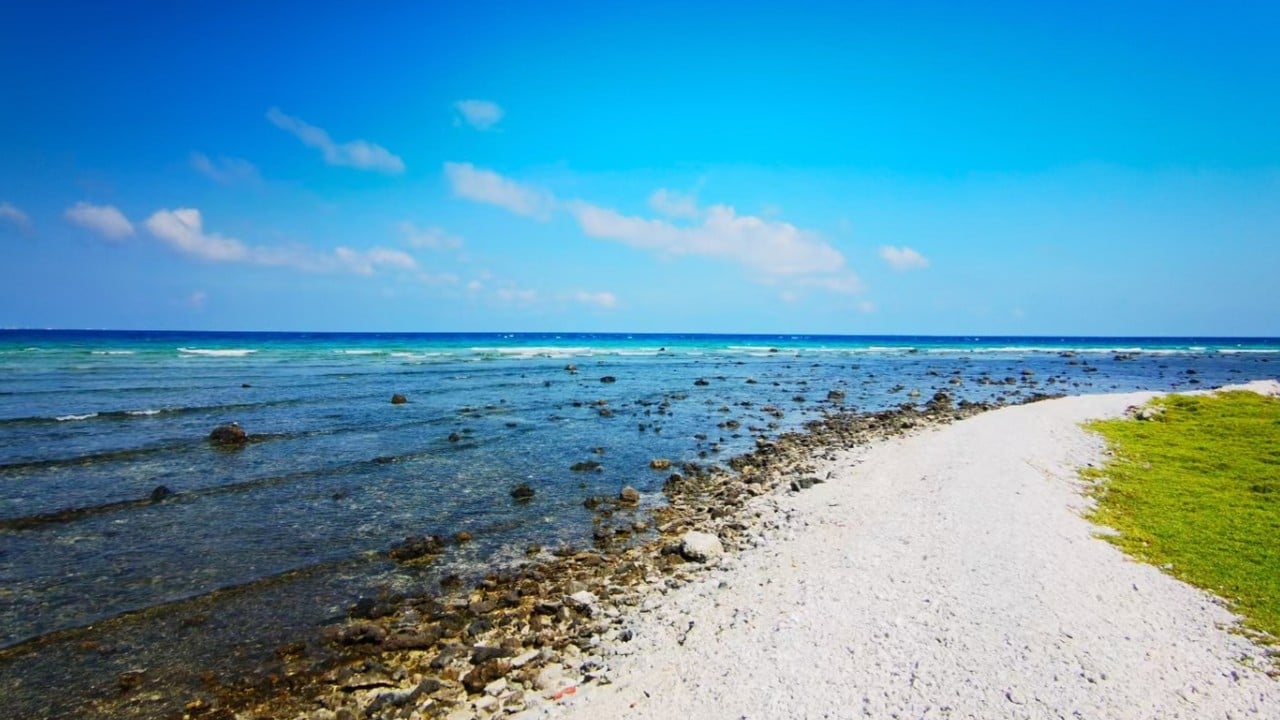
The sea here is a shade of blue that doesn't feel real. It is a predatory turquoise, so bright it hurts the eyes, shifting into a bruised purple where the floor of the South China Sea drops away into nothingness. If you were drifting above Antelope Reef, you might think you’d found paradise. From the air, the formation looks like a crescent moon carved from jade, a silent witness to the tides.
But look closer. There are no palm trees. No white sand beaches for tourists to loung on. Antelope Reef is a submerged secret, a platform of coral and rock that spends most of its life hiding beneath the waves of the Paracel Islands. It is a place defined by what isn't there, and yet, nations are willing to risk everything for it.
The Ghost in the Water
To understand why this sliver of calcium carbonate matters, you have to imagine a fisherman named Linh. He isn't a politician. He doesn't care about "exclusive economic zones" or "maritime boundaries." He cares about the engine of his wooden boat and the weight of his nets. For generations, men like Linh have followed the seasonal migrations of tuna and mackerel through these waters. To them, Antelope Reef—known to the Vietnamese as Đảo Ba Ba—was a landmark, a shallow sanctuary where the sea life thrived.
When the tide retreats, the reef reveals its jagged teeth. It is a dangerous, beautiful obstacle. But in the modern era, the danger has changed. It’s no longer about a hull scraping against coral. It’s about the gray hulls of white-painted coast guard ships that didn't use to be there.
The reef exists in a geopolitical tug-of-war between China, Vietnam, and Taiwan. To some, it’s a strategic observation post. To others, it is an ancestral fishing ground. To the rest of the world, it is a spark in a tinderbox.
The Concrete Mirage
Consider what happens when a piece of the ocean floor becomes "sovereign territory." It isn't just about fish anymore. It’s about the soil beneath the fish—the potential for oil, gas, and mineral wealth. This is the invisible stake. Antelope Reef is one of the many pawns on the chessboard of the Paracels, a cluster of islands that China has occupied since 1974 after a brief, bloody naval clash with South Vietnam.
Walking across the dry parts of the reef during a spring low tide is an eerie experience. You are standing on a graveyard of calcium. It feels ancient, yet the tension surrounding it is vibrating with 21st-century energy. China has spent decades "reclaiming" land in these waters, turning tiny shoals into military fortresses. While Antelope Reef hasn't yet seen the massive runways or radar towers of Subi Reef or Mischief Reef, its location makes it a silent sentinel.
It sits near the Money Islands, a name that feels too on-the-nose for a region defined by its economic value. If you control Antelope, you control the eyes of the neighborhood. You see every vessel that passes through the busy shipping lanes. You own the silence of the sea.
The Vanishing Catch
The real problem lies elsewhere, far below the high-level diplomatic meetings in Beijing or Hanoi. It’s in the stomach of the ocean. The coral of Antelope Reef is dying.
Climate change is the obvious villain, warming the waters and bleaching the vibrant reefs until they look like skeletal remains. But there is a more immediate, more violent threat. Over the last decade, the race to claim the South China Sea has led to ecological devastation. Giant clam harvesting, destructive fishing practices, and the dredging of nearby atolls to build artificial islands have choked the life out of the water.
Linh remembers when the water was thick with life. Now, he casts his nets and prays to the sea goddess Mazu for more than just plastic waste and a few small fry. The fish don't care about borders, but they are disappearing because of them. When every nation is fighting for the right to harvest, nobody is responsible for the health of the harvest itself.
A Fortress of Salt and Bone
The stakes are higher than a few square miles of reef. Antelope Reef is part of a larger chain that serves as a shield for the Chinese mainland and a bridge for its naval ambitions. For the United States and its allies, it is a symbol of "Freedom of Navigation." To them, these waters must remain international, a global highway for the world's goods.
Imagine a single cargo ship, stacked with thousands of containers destined for a port in California or Rotterdam. That ship is likely passing within a few hundred miles of Antelope Reef. If the South China Sea becomes a private lake for one nation, the cost of everything on that ship goes up. The price of your next smartphone, the fuel for your car, the coffee in your mug—it all flows through this turquoise corridor.
But the human cost is measured in something else. It’s measured in the anxiety of a mother waiting for a husband who went out to sea and was detained by a foreign patrol. It’s measured in the frustration of a young diplomat who knows that one wrong move near a reef like Antelope could trigger a conflict that nobody wants but everyone is preparing for.
The Silence of the Tide
The reef doesn't care. It has been there for thousands of years, and it will be there long after the flags have rotted and the concrete has crumbled. It is a slow, rhythmic pulse of the earth.
When the sun sets over the Paracels, the water turns to liquid gold. For a moment, the politics vanish. You can almost forget about the sensors, the satellite imagery, and the simmering anger. You are just a human on a speck of rock in the middle of a vast, indifferent ocean.
But then, the lights of a distant vessel flicker on the horizon. A gray shape moves silently through the dark. The illusion of peace is gone, replaced by the cold reality of the map. Antelope Reef remains a hollow jewel—beautiful, fragile, and dangerous to touch.
The tide comes back in, swallowing the jagged coral once more. The reef disappears. It hides, waiting for the next dawn, while the world above it continues to fight for a piece of the blue.
The sea is a patient witness, and it has seen many empires come and go, but the coral remembers the taste of salt long after the men are gone.


