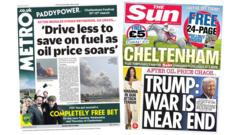
The financial press is currently drunk on a cocktail of "short-term excursion" rhetoric and presidential Truth Social posts. Following Donald Trump’s claim that the war with Iran is "very complete" and his threats to hit Tehran "twenty times harder" if they touch a single tanker, Brent crude took a dive from $119 back toward the $90 mark.
The consensus is clear: the "adults" are back in the room, the Strait of Hormuz will be "taken over" if needed, and the $100+ price tag was just a "fear premium" spike that has now been neutralized by American military swagger.
That consensus is not just lazy—it is dangerously delusional.
The markets are pricing in a return to normalcy based on the assumption that a decapitated Iranian military translates to a functional global energy corridor. I have seen traders lose billions betting on the "mission accomplished" banner before the ink was even dry. In the energy sector, kinetic victory is not the same as logistical stability.
The Ghost of the IRGC
The narrative being pushed is that because Iran has "no navy, no communications, and no air force" left, the threat to the Strait of Hormuz has vanished. This ignores the fundamental asymmetry of modern maritime warfare.
You don’t need a blue-water navy to make a chokepoint impassable. You need a handful of $20,000 loitering munitions, a few hundred magnetic mines, and a handful of radicalized insurgents with shoulder-fired missiles. Trump’s "Fire and Fury" might have leveled the command centers in Tehran, but it has done nothing to clear the thousands of mines currently drifting through the most critical 21 miles of water on the planet.
The Insurance Trap
Even if Trump sends the U.S. Navy to "escort" tankers, the math doesn't work. The global shipping industry is not run by admirals; it is run by actuaries.
- Force Majeure: Most regional producers, including the UAE and Kuwait, have already begun output cuts because their storage is full. They cannot move the product.
- The Reinsurance Lie: Washington’s $20 billion maritime reinsurance program is a drop in the bucket. A single VLCC (Very Large Crude Carrier) can carry 2 million barrels. At $90 a barrel, that’s $180 million in cargo alone, plus the $100 million+ value of the vessel.
- The Risk Threshold: Lloyd's of London doesn't care if Trump says the war is "complete." If there is a 5% chance of a drone hitting a hull, the premiums will remain at "war zone" levels, effectively keeping the Strait closed to commercial traffic regardless of who "controls" the surface water.
The Bypass Myth
Pundits love to point to Saudi Arabia’s East-West pipeline as the safety valve. They claim we can just "reroute" around the trouble.
Let’s dismantle that with cold numbers. The Strait of Hormuz typically handles 20 million barrels per day (mb/d).
- Saudi Arabia’s East-West pipeline has a total capacity of 5 mb/d.
- Half of that is already spoken for by regular pre-war contracts.
- The UAE’s Habshan-Fujairah line adds a measly 1.5 mb/d capacity, of which only about 500,000 is spare.
Even in a perfect world, you are looking at a net loss of over 15 million barrels per day. That is 15% of global demand simply vanishing. You cannot "tweet" away a 15-million-barrel deficit.
The False "Gift" to China
Trump framed the reopening of the Strait as a "gift" to China. This is a fundamental misunderstanding of the leverage at play. By "stabilizing" the market through military force, the U.S. is actually subsidizing the energy costs of its greatest strategic rival while the American taxpayer foots the bill for the Fifth Fleet’s fuel and munitions.
Imagine a scenario where the U.S. successfully "takes over" the Strait. We are now the permanent janitors of a suicide-drone alley. We have assumed 100% of the risk to ensure China gets 100% of the rewards (cheap Persian Gulf crude). This isn't "Art of the Deal"; it's a strategic disaster.
The Real Price Floor
JP Morgan and other institutions are calling for a return to $60 oil in late 2026. They are looking at "supply-demand fundamentals." This is the classic mistake of using 20th-century models for a 21st-century geopolitical earthquake.
The "fair value" of oil is no longer determined by the cost of extraction in the Permian Basin. It is determined by the Cost of Security.
- Physical infrastructure in Saudi Arabia, Qatar, and Kuwait is now within the "scatter" range of remaining Iranian missiles.
- The naming of Mojtaba Khamenei as the new Supreme Leader signals a transition to a "Resistance Economy" footing, not a surrender.
Stop Asking if the War is Over
The "People Also Ask" sections are filled with queries like "When will oil prices go back to normal?" This is the wrong question.
The right question is: "What is the new baseline for a world where the primary energy chokepoint is a permanent combat zone?"
If you are an investor, you don't buy the "dip" caused by a Trump tweet. You look at the reality of "stranded barrels." Iraq’s output has already plummeted by 60%. These aren't temporary glitches; these are structural collapses in the production chain.
The "Fear Premium" isn't an ornament you can strip off the price of a barrel. In 2026, the fear is the reality. The $90 price point we see today isn't a return to sanity—it's the eye of the storm. When the first "escorted" tanker hit by a $500 sea drone sinks in the shipping channel, $150 oil won't be a forecast; it will be a memory of the "cheap" days.
The war isn't "complete." The era of secure, cheap Middle Eastern energy is what's actually finished.
Would you like me to analyze the specific impact of these "stranded barrels" on the EU’s jet fuel reserves?