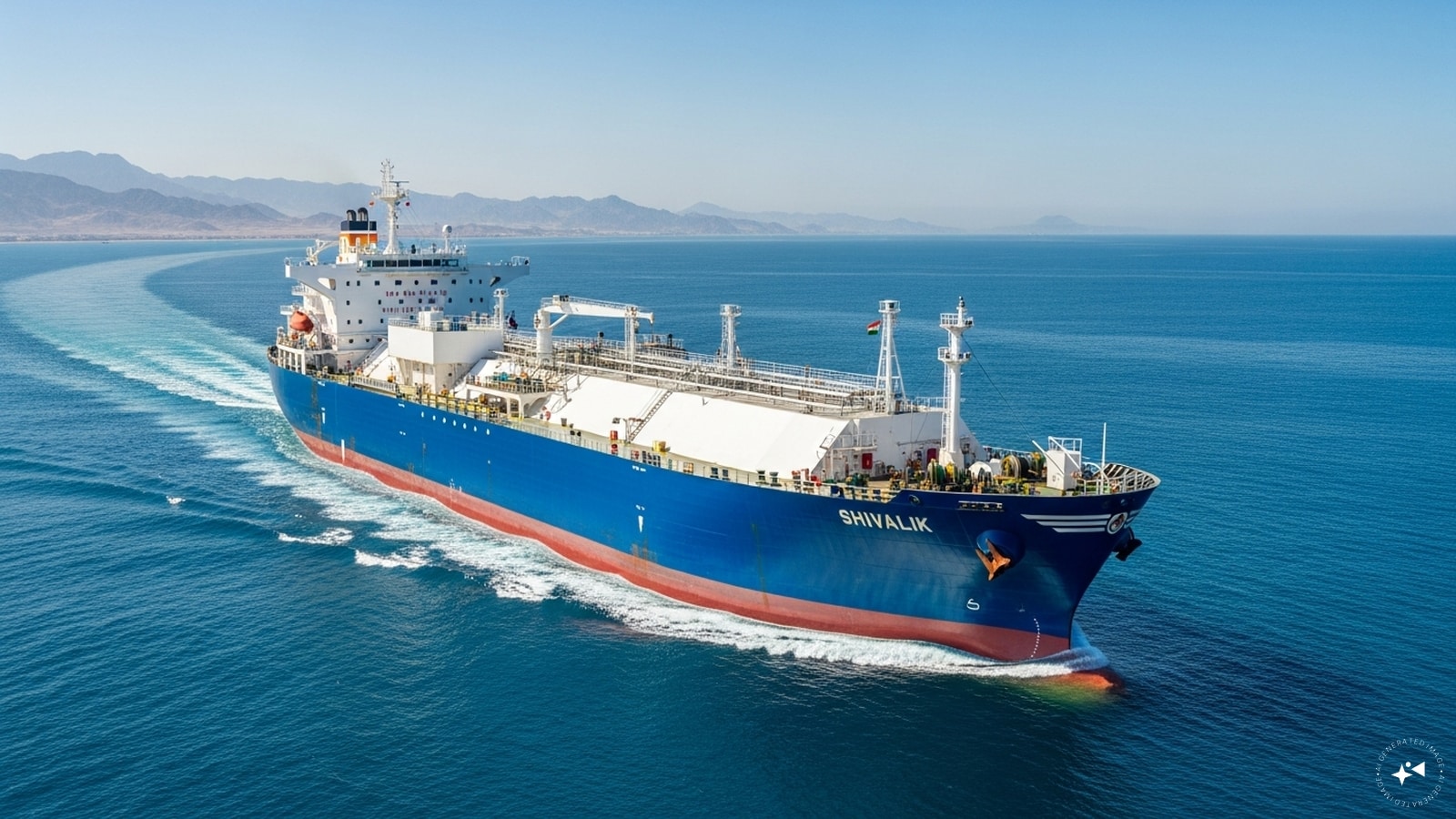
The transit of the Indian LPG tanker Shivalik through the Strait of Hormuz is not a routine maritime maneuver. It is a calculated gamble in a theater of war where the stakes are measured in millions of metric tons of liquefied petroleum gas and the stability of domestic kitchen budgets. While the vessel’s passage might appear as another blip on a tracking screen, it represents the sharp end of India’s energy dependency. New Delhi has quietly placed its naval assets on standby, a move that signals a departure from passive observation to active maritime policing in the world’s most volatile oil artery.
The Strait of Hormuz remains a narrow, claustrophobic corridor. Nearly a third of the world’s total seaborne-traded oil passes through this strip of water, which at its narrowest point is only 21 miles wide. For a vessel like the Shivalik, laden with highly flammable cargo, there is no room for error or geopolitical miscalculation. The Indian Navy’s decision to maintain a high state of readiness—likely under the umbrella of Operation Sankalp—is a direct response to the escalating shadow war between regional powers and non-state actors that have made merchant shipping their preferred target.
The Strategic Vulnerability of the Indian Kitchen
India imports roughly 50% of its LPG requirements. This is not just a statistic for industrial planners; it is a fundamental pillar of national internal security. When a tanker like the Shivalik carries fuel destined for Indian ports, it carries the political capital of the government. Any disruption in the supply chain leads to immediate inflationary pressure. Unlike crude oil, which can be stored in strategic underground reserves for months, LPG has a shorter logistical fuse. The supply must be constant.
The threat profile in the Strait has shifted. We are no longer just looking at traditional state-on-state naval engagements. The danger now comes from Unmanned Aerial Vehicles (UAVs), limpet mines, and the seizure of vessels by fast-attack craft. By positioning destroyers or frigates within striking distance of the Shivalik’s route, the Indian Navy is attempting to create a "bubble of confidence" for commercial insurers and ship owners who are increasingly wary of the Persian Gulf.
The Mechanics of Maritime Protection
Escorting a tanker is an exercise in managed tension. It involves more than just sailing a grey hull next to a black one. The Navy utilizes Information Fusion Centres to monitor every radar signature in the vicinity. If an unidentified craft approaches the Shivalik, the response is tiered.
- Electronic Warfare: Jamming frequencies to disrupt drone control links.
- Visible Presence: Positioning the naval vessel between the threat and the merchant tanker.
- Communication Intercepts: Monitoring regional coast guard and military channels to anticipate boarding attempts.
This overhead cost of energy is rising. Every hour a naval vessel spends on "standby" or active escort adds to the hidden tax on every liter of fuel consumed in Mumbai or Delhi. We are seeing the militarization of the supply chain in real-time.
Why the Shivalik Transit Matters Now
The timing of this transit coincides with a period of extreme regional friction. The "Tanker War" of the 1980s is often cited as a historical parallel, but the modern version is more complex due to the precision of modern weaponry. A single "suicide boat" or a low-cost drone can disable a multi-million dollar vessel.
The Shivalik itself is a symbol of India’s merchant marine strength, but it is also a target. For Tehran or other regional players, interfering with Indian shipping is a way to test New Delhi’s strategic autonomy. India has historically maintained a delicate balancing act, keeping friendly ties with Iran while participating in security frameworks that include Western interests. The Navy's presence on standby is a message that while India seeks no conflict, its "red lines" regarding energy transit are non-negotiable.
The Insurance Trap
One factor often ignored by general news coverage is the role of Protection and Indemnity (P&I) Clubs. When a region is declared a high-risk zone, insurance premiums skyrocket. For some ship owners, the cost of the insurance alone makes the trip through Hormuz unprofitable.
By providing a military shadow, the Indian government effectively subsidizes this risk. The Navy's presence acts as a physical guarantee that lowers the perceived risk for underwriters. Without this intervention, the price of LPG at the Indian port would be significantly higher before the gas is even unloaded. It is a massive, state-funded de-risking operation.
The Intelligence Gap in the Gulf
Naval commanders in the region are currently dealing with an "intelligence fog." In previous decades, you could identify a threat by the flag on a ship or the markings on a jet. Today, the threats are deniable. A drone attack can be launched from a remote coastline with no clear signature of origin.
The Indian Navy’s standby status implies a sophisticated level of Signals Intelligence (SIGINT). They aren't just looking at the horizon with binoculars. They are scanning the electromagnetic spectrum for the specific pulses of drone guidance systems. The Shivalik is essentially moving through a digital minefield.
Tactical Geometry in the Strait
The geography of the Strait of Hormuz favors the harasser, not the protector. The shipping lanes are divided into an inbound and outbound track, each only two miles wide. These lanes are separated by a two-mile wide buffer zone.
- Chokepoint Constraints: The Shivalik is forced to follow a predictable path.
- Proximity to Shore: Most of the navigable channel lies within the Territorial Waters of Iran or Oman.
- Reaction Time: At standard cruising speeds, a fast-attack craft can bridge the gap from the coast to the shipping lane in under ten minutes.
The Indian Navy must operate within these constraints. They cannot simply blast any boat that gets close. They have to differentiate between a local fishing dhow and a hostile actor in a fraction of a second. This requires a level of crew training and situational awareness that few navies in the world possess.
The Broader Shift in Indian Maritime Doctrine
For decades, the Indian Navy was a "brown water" force, focused primarily on its immediate coastline and the threat from Pakistan. The Shivalik escort mission proves the transition to a "blue water" force is complete. India now views the entire North Indian Ocean, from the Gulf of Aden to the Malacca Strait, as its primary area of responsibility.
This is a heavy burden. Maintaining a constant presence in the Persian Gulf drains resources from other theaters, such as the Bay of Bengal, where Chinese naval influence is growing. However, the immediate need for LPG trumps long-term theoretical threats. The government has decided that it is better to spend fuel on a destroyer today than to have a fuel riot in a major city tomorrow.
The Limits of Naval Power
We must be realistic about what "standby" actually achieves. If a state actor decides to launch a coordinated swarm attack on a tanker, a single escort vessel will be overwhelmed. The strategy is not about winning a war in the Strait; it is about deterrence through presence. It signals that an attack on the Shivalik is an attack on the Indian state.
Most regional actors are not looking for a full-scale war with India. They are looking for leverage. By putting the Navy on the board, India removes the "soft target" label from its merchant fleet. It forces any potential aggressor to calculate the cost of a diplomatic and military fallout with a nuclear-armed nation of 1.4 billion people.
The Hidden Cost of Energy Independence
While the Shivalik completes its transit, the focus will remain on the physical safety of the ship. But the real story is the eroding concept of "free seas." The fact that a merchant ship requires military protection to move a legal commodity through international waters is a sign of a decaying global order.
The global maritime commons are shrinking. We are entering an era where trade routes are no longer guaranteed by international law, but by the weight of the broadside a nation can bring to bear. The Shivalik is safe for now, but the framework that allowed it to sail unmolested for years is gone.
The Navy’s mission doesn’t end when the Shivalik reaches the Indian Ocean. Another tanker is already entering the Gulf. Another crew is checking their radar. Another commander is weighing the rules of engagement. This is the new normal for energy security: a permanent state of high-alert, where the price of a flame in a kitchen is constant vigilance on the high seas.
Assess your current exposure to these maritime risks by reviewing the frequency of Indian Navy deployments in the Persian Gulf over the last quarter.