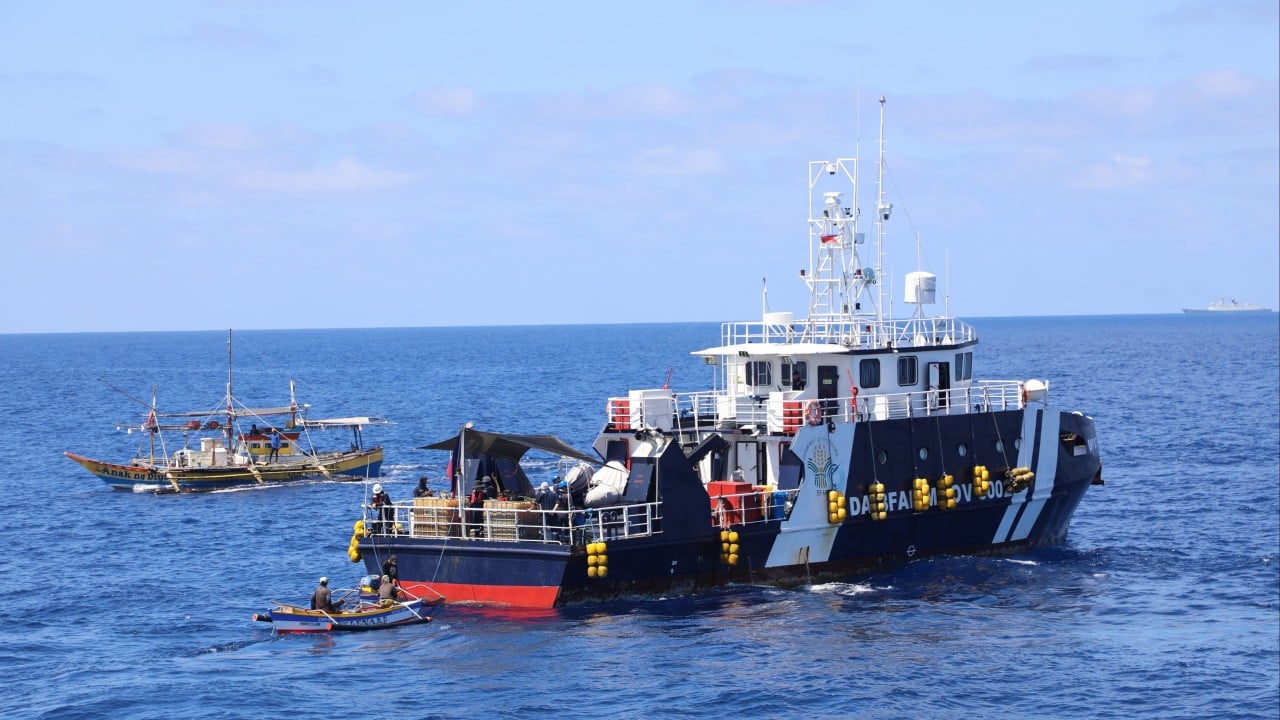
The water in the West Philippine Sea has a specific way of reflecting the sun, a blinding, diamond-crusted blue that hides everything beneath it. For the fishermen of Zambales or the sailors stationed on the rusting hull of the BRP Sierra Madre, that beauty is a mask. They know the silence of the open ocean is a lie. Beneath the waves and across the radio frequencies, a different kind of harvest is being gathered—one that doesn't involve nets or scales.
Recently, the Philippine military high command began pulling back the curtain on a new evolution in the long-standing maritime standoff with Beijing. It isn't just about the massive white hulls of the China Coast Guard or the swarming "maritime militia" trawlers anymore. The tactics have shifted into the ethereal. We are witnessing the deployment of advanced surveillance technology designed to turn the very environment of the South China Sea into a giant, listening ear.
Imagine a small, weathered fishing boat bobbing near a contested reef. To a casual observer, it looks like a relic of a simpler time. But hidden beneath its wooden floorboards or disguised as standard navigational gear are sensors capable of mapping the seafloor in high-definition, tracking the acoustic signatures of submarines, and intercepting encrypted communications. This isn't a hypothetical scenario. It is the new reality of "gray zone" warfare, where the line between a civilian vessel and a state intelligence asset has been blurred into nonexistence.
The Ghost in the Machine
The Philippine military recently flagged the presence of specialized equipment—UUVs (Unmanned Underwater Vehicles) and sophisticated "research" buoys—dropped into waters that fall strictly within the Philippine Exclusive Economic Zone. These aren't just scientific tools meant to study migratory patterns or water temperature. They are the eyes and ears of a mounting digital blockade.
When a Chinese "research" vessel spends weeks crisscrossing a specific grid of the ocean, it isn't looking for fish. It is building a digital twin of the battlefield. By measuring the salinity, temperature, and depth of these waters, they can calculate exactly how sound travels. This data is the lifeblood of anti-submarine warfare. It allows a navy to hide its own boats while ensuring that any Philippine or allied vessel sticks out like a flare in a dark room.
The stakes are personal for the men and women on the front lines. Consider a young Philippine Navy officer. He isn't just worried about a physical collision with a larger ship. He has to wonder if the very radar he relies on is being spoofed, or if his position is being broadcast in real-time to a command center in Hainan before he even clears the harbor. The psychological weight of being watched by an invisible, omnipresent force is a burden no training manual can fully prepare you for.
The Camouflage of Commerce
Beijing’s genius—if you can call it that—lies in the use of the mundane. By equipping common fishing vessels with high-tech surveillance arrays, they create a legal and moral quagmire. If the Philippine Coast Guard boards a vessel and finds a massive server rack instead of a hold full of grouper, the diplomatic fallout is messy. If they don't board, the data keeps flowing.
This is a strategy of incrementalism. It is the "salami-slicing" of sovereignty. Each buoy dropped, each cable laid, and each drone launched is a tiny piece of a larger puzzle. When finished, that puzzle depicts a South China Sea where the Philippines is a guest in its own backyard. The military calls it "situational awareness," but for the people whose livelihoods depend on these waters, it feels more like an eviction notice written in code.
The technical sophistication is staggering. Some of these devices are designed to mimic the behavior of marine life or debris. They drift with the currents, silently recording. Others are tethered to the seabed, powered by long-life batteries or solar panels that look like part of a standard navigational marker. They represent a leap from the "brute force" tactics of ramming ships to a "smart force" approach that seeks to win the conflict before a single shot is fired.
A Breach of Trust and Territory
The use of these tactics violates more than just maritime borders; it violates the spirit of international law. The United Nations Convention on the Law of the Sea (UNCLOS) was built on the idea that the oceans are a shared resource, governed by clear rules. But those rules never anticipated a world where a fishing boat could double as a signals intelligence platform.
Critics might argue that every nation conducts surveillance. That is true. However, there is a fundamental difference between a designated spy plane flying in international airspace and the clandestine seeding of another country's sovereign waters with autonomous spying hardware. It is the difference between a neighbor looking over your fence and that same neighbor planting hidden microphones inside your living room walls.
The Philippine response has had to evolve just as quickly. There is a renewed focus on "transparency warfare"—the act of filming, documenting, and broadcasting these incursions to the world. Sunlight, as they say, is the best disinfectant. By pulling these "ghost" devices out of the water and showing them to the international press, the Philippines is fighting back with the only weapon that can't be jammed: the truth.
The Human Cost of Data
While the generals talk about "denying sea control" and "asymmetric capabilities," the actual human cost is measured in the fear of the unknown. A fisherman from Masinloc told me once that he doesn't fear the storms anymore; he fears the "metal sharks." He was talking about the drones. He knows that his presence is being recorded, his face scanned, his coordinates logged. He is a data point in a computer program running in a city he will never visit.
This data collection also targets the environment itself. The installation of some of these surveillance structures often involves destroying coral reefs—ecosystems that take centuries to grow. The "intelligence" gained comes at the price of the very biodiversity that makes these waters valuable in the first place. We are trading the future of the ocean for a temporary tactical advantage.
The situation is fluid, literally and figuratively. As the Philippine military uncovers more of these "tactics," the cat-and-mouse game intensifies. Newer models of drones are smaller, quieter, and harder to detect. The artificial islands Beijing has built serve as massive hubs for this data, processing the signals caught by the net and turning them into a real-time map of every movement in the region.
The Weight of the Blue Horizon
Standing on the deck of a Philippine vessel, looking out at the horizon, the sheer scale of the challenge becomes clear. The ocean is vast. It is deep. It is incredibly easy to hide things in it. Detecting a three-foot-long sensor in a million square miles of water is a task that borders on the impossible. Yet, it is a task the Philippine military can no longer afford to ignore.
They are shifting resources, investing in their own underwater drones, and strengthening alliances with nations that possess advanced maritime domain awareness technology. It is a race against time and technology. The goal isn't just to find the sensors, but to make the cost of planting them too high to justify.
But technology alone isn't the answer. The real defense lies in the resilience of the people. It lies in the stubbornness of the sailor who stays on his post and the fisherman who continues to cast his net despite the shadows beneath his boat. They are the ones who prove that sovereignty isn't just a legal concept—it is a lived reality.
The sun begins to set over the horizon, turning the water from blue to a bruised purple. The diamond reflections fade, replaced by a deep, impenetrable darkness. Somewhere out there, a light flashes briefly—a sensor reporting home, a drone surfacing to transmit, or perhaps just the phosphorescence of a disturbed sea. In this new era, you can never be sure which it is. The sea hasn't changed, but our place within it has. We are no longer just sailing on the water; we are moving through a dense, invisible web of intent.
The silence returns, but it is no longer peaceful. It is the silence of a held breath. It is the quiet of a hunter waiting for the slightest ripple. And as the stars come out, reflecting on the surface like a second set of surveillance lights, the realization settles in: the most dangerous things in these waters aren't the ones you can see coming. They are the ones that have been there all along, watching, waiting, and listening to the rhythm of the waves.


