Kraken’s confidential filing for an Initial Public Offering (IPO) signifies the transition of cryptocurrency infrastructure from a high-growth speculative sector to a regulated utility class. By opting for a confidential S-1 filing under the JOBS Act, Kraken achieves two structural advantages: it shields sensitive financial metrics from competitors during the iterative SEC review process and defers the public "roadshow" until market conditions align with internal valuation targets. This move is not merely a liquidity event for early investors; it is a strategic repositioning designed to capture the widening spread between decentralized finance and traditional capital markets.
The Strategic Logic of Confidentiality
The decision to file confidentially allows Kraken to navigate the regulatory friction of the SEC without the immediate pressure of public market volatility. This mechanism is critical for a firm operating in a sector characterized by high regulatory flux.
- Information Asymmetry Management: Kraken can resolve accounting discrepancies regarding digital asset custody and revenue recognition—areas where the SEC has historically shown high scrutiny—before the public gains access to the prospectus.
- Valuation Floor Protection: In a public filing, a withdrawal or a down-round is a matter of public record that can damage brand equity. A confidential filer can pivot or delay without the stigma of a "failed" offering.
- Operational Secrecy: Competitors like Coinbase or Binance cannot immediately dissect Kraken’s margins per trade or their specific geographic revenue concentrations, preventing tactical counter-moves during the quiet period.
The Revenue Architecture of an Institutional Exchange
Kraken’s valuation rests on its ability to diversify away from retail transaction fees, which face inevitable compression as the market matures. An analysis of the exchange's viability requires deconstructing its revenue into three distinct pillars.
Transactional Volume and Fee Elasticity
While retail users provide the highest margins, institutional desks drive the volume necessary for deep order books. Kraken’s challenge lies in maintaining a fee structure that captures the "convenience yield" of retail while offering the ultra-low latency and competitive rebates required by high-frequency traders (HFTs). The cost of liquidity provision is the primary variable here; if Kraken cannot attract sufficient market makers through its IPO-funded infrastructure upgrades, slippage will increase, driving volume toward competitors.
Staking as a Service (SaaS) and Yield Mechanics
The regulatory environment regarding "staking as a service" remains a significant variable. Following previous settlements with the SEC, Kraken’s ability to offer yield-bearing products in the U.S. is constrained. However, its international operations continue to leverage Proof of Stake (PoS) protocols. This revenue stream is high-margin and provides "sticky" capital, as users are less likely to migrate assets that are currently locked and earning rewards.
Institutional Custody and Prime Brokerage
The launch of Kraken Institutional highlights an attempt to build a full-stack financial ecosystem. By offering custody, spot trading, and eventually derivatives under a single regulatory umbrella, Kraken reduces the counterparty risk for pension funds and family offices. The IPO capital is likely earmarked for the insurance and security audits required to compete with legacy custodians like BNY Mellon or specialized firms like BitGo.
The Regulatory Barrier as a Competitive Moat
In the post-FTX era, the "compliance premium" has become a tangible asset. Kraken’s IPO filing is an explicit bet that the cost of regulatory adherence is a barrier to entry that will eventually starve out unregulated competitors.
- The Audit Hurdle: Moving from "Proof of Reserves" to GAAP-compliant, audited financial statements is a multi-year process. Kraken’s ability to reach the filing stage suggests a level of internal data integrity that few other private exchanges possess.
- State-Level Licensing: Maintaining a BitLicense in New York and similar permits globally creates an expensive, complex legal overhead. A public listing provides the transparent balance sheet that regulators demand when issuing these licenses.
- The Banking Gap: Public status often eases the path toward securing Tier-1 banking relationships, reducing the risk of "de-banking" which has plagued the crypto industry for a decade.
The Capital Deployment Framework
An IPO typically serves two functions: providing an exit for Series A-C investors and raising primary capital for expansion. For Kraken, the focus shifts toward horizontal and vertical integration.
Infrastructure Scalability
The "Cost of Downtime" for an exchange is measured in both lost fees and reputation. A significant portion of IPO proceeds will likely be directed toward migrating legacy architecture to more resilient, geographically distributed cloud systems capable of handling 10x spikes in volatility without latency degradation.
M&A Strategy
The crypto market is currently fragmented. Kraken can use its public stock as currency to acquire smaller, niche players in the following areas:
- Localized On-Ramps: Buying regional exchanges in emerging markets to bypass local licensing hurdles.
- DeFi Integration: Acquiring non-custodial wallet technology or specialized analytics firms to bridge the gap between their centralized exchange (CEX) and the decentralized ecosystem.
- Security Firms: Bringing cybersecurity auditing in-house to protect the exchange’s "hot" and "cold" storage systems.
Risk Factors and Structural Vulnerabilities
The path to a successful listing is not guaranteed. Several external and internal pressures could derail the valuation.
SEC Enforcement Trajectory
The ongoing debate over whether specific tokens are "unregistered securities" creates a moving target for exchange listings. If the SEC mandates the delisting of high-volume assets, Kraken’s revenue could see a sudden, sharp contraction. The company must maintain a "Listing Committee" that is more conservative than the market average, potentially sacrificing short-term growth for long-term legal stability.
The Coinbase Correlation
As the only major U.S. public peer, Coinbase’s stock performance dictates the "multiple" applied to Kraken. If Coinbase experiences a compression in its P/E ratio due to macro factors or idiosyncratic failures, Kraken’s expected valuation will suffer regardless of its internal performance. This creates a systemic dependency on a competitor's health.
Liquidity Fragmentation
The rise of Decentralized Exchanges (DEXs) like Uniswap presents a long-term threat to the centralized model. As "on-chain" trading becomes more user-friendly and gas fees decrease (via Layer 2 scaling), the value proposition of a centralized intermediary diminishes. Kraken must prove that its "Prime" services—insurance, customer support, and fiat integration—provide enough value to justify the fees that DEXs largely eliminate.
Comparative Valuation Analysis
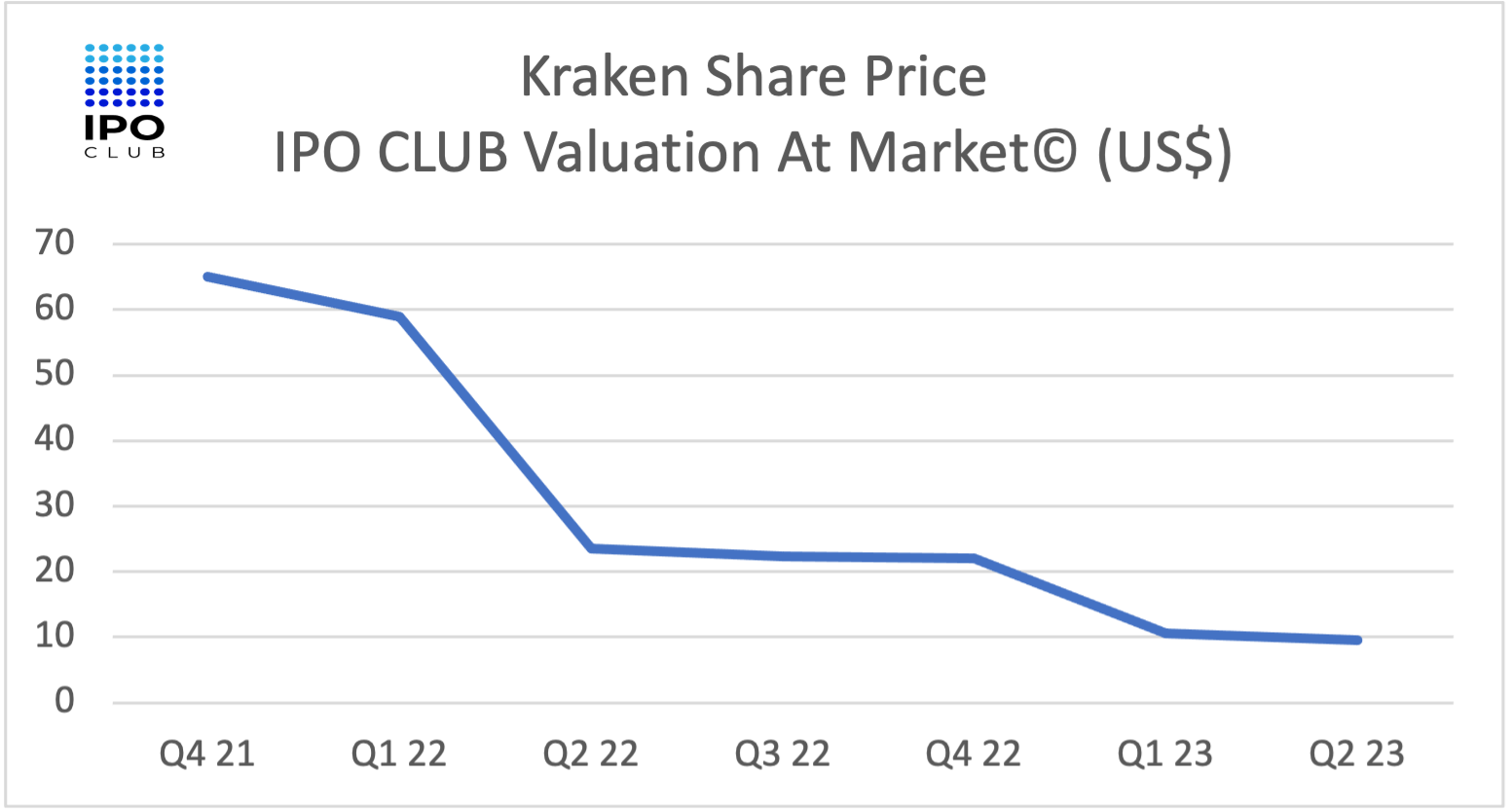
A data-driven valuation of Kraken must account for its historical private market pricing versus the current revenue-to-volume ratios of its peers. In 2021, Kraken was reportedly seeking a valuation near $10 billion. In the current environment, the market will likely apply a "regulatory discount" until the IPO process clarifies the status of its staking and altcoin listing products.
The "Velocity of Capital" on the platform is a key metric. An exchange with high volume but low net-deposit growth is a "trading pit," whereas an exchange with high AUM (Assets Under Management) growth is a "bank." Kraken's move toward a public listing is an attempt to convince the market it is the latter.
Strategic Recommendation for Institutional Participation
For institutional investors evaluating the Kraken IPO, the focus should not be on the total volume of Bitcoin traded, but on the growth of the "Institutional Services" segment. This is where the long-term, non-cyclical revenue resides.
The move to file confidentially is the correct tactical play in an election year where crypto policy is a partisan flashpoint. By waiting until the regulatory "fog" clears or until a more favorable administration is in place, Kraken optimizes for a maximum valuation peak.
Investors should monitor the following markers in the coming months:
- The S-1 Disclosure of "Custodial Risk": How Kraken defines its liability in the event of a catastrophic hack.
- Revenue Concentration: Whether more than 50% of revenue is tied to the top three assets (BTC, ETH, SOL).
- Legal Reserve Provisions: The amount of capital set aside for potential settlements with the SEC or CFTC.
The IPO is the final step in Kraken’s "legitimization" cycle. Success here will not be measured by the initial "pop" on the first day of trading, but by the exchange's ability to maintain its spreads as crypto assets are absorbed into the global financial plumbing.