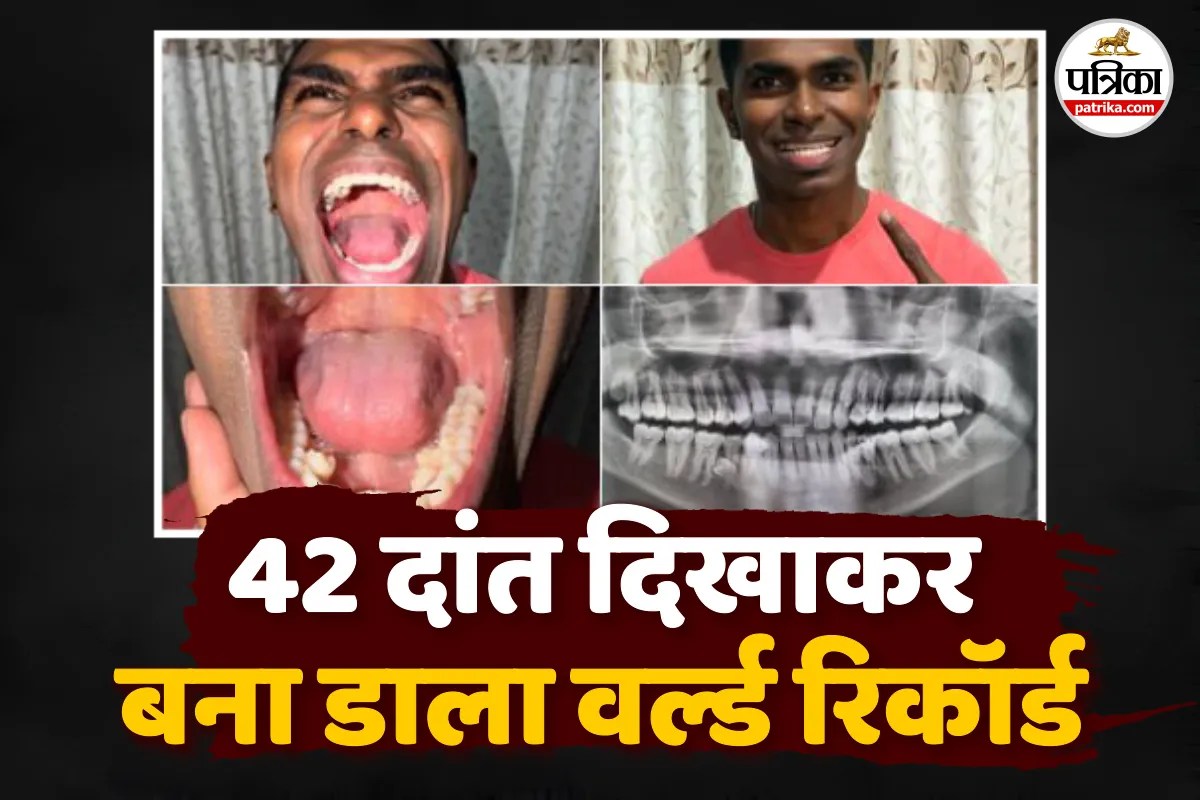
Most of us stop counting at thirty-two. It is the biological standard, the architectural limit of the human mouth. We grow them in two waves, lose the first set to the tooth fairy, and spend the rest of our lives brushing, flossing, and occasionally paying a surgeon to yank out the four "wise" ones that try to crash the party late. But for Prathapamuniandi, the math of the human body didn't just break. It doubled down.
Imagine the simple act of biting into an apple. For you, it is a mechanical certainty. For a man carrying forty-two teeth, it is a crowded, biological anomaly.
Prathapamuniandi, a man who has recently etched his name into the Guinness World Records, does not look like a medical marvel at first glance. He carries the quiet demeanor of someone who has spent a lifetime navigating a world designed for smaller proportions. Yet, inside his jaw, ten extra stowaways have taken up residence. These are not just "extra" teeth in the way one might have a spare tire in the trunk. This is hyperdontia taken to a record-breaking extreme.
The average person views their health as a series of expected outcomes. We expect two eyes, ten fingers, and a predictable set of molars. When nature decides to deviate, it creates a friction between the person and the society that defines "normal."
The Weight of the Extra Ten
Hyperdontia is rarely a silent condition. Usually, it’s a single "supernumerary" tooth—a lonely rebel popping up behind a front incisor or hiding in the gums. Doctors see it, they record it, and often, they remove it to prevent the rest of the mouth from collapsing into a structural nightmare. But ten? To reach a total of forty-two is to house a small village where there should only be a neighborhood.
Think about the sheer physics of it. The human jawbone, specifically the maxilla and the mandible, has a finite amount of surface area. When you cram ten additional calcified structures into that space, the roots begin to compete. They jostle for blood supply. They crowd the nerves. For many with severe hyperdontia, the "gift" of extra teeth is actually a sentence of constant, throbbing pressure—a physical manifestation of being "too much."
Yet, Prathapamuniandi’s story isn't one of deformity or distress. It is a story of adaptation. While the medical community looks at his X-rays with a mix of awe and clinical curiosity, he has lived the reality of those X-rays every morning in front of the bathroom mirror.
The Mirror and the Myth
There is a specific kind of vulnerability in having a record-breaking body. Every time Prathapamuniandi smiles, he is displaying a biological outlier. In many cultures, such a trait might be whispered about as a bad omen or, conversely, a sign of prehistoric strength. There is an old, lingering myth that humans are slowly evolving to have fewer teeth—that our soft, processed diets are making our wisdom teeth obsolete and our jaws smaller.
If that is the trajectory of the species, Prathapamuniandi is a defiant glitch in the system. He is a throwback to a more crowded, ancestral mouth.
But the invisible stakes here aren't just about evolution. They are about the daily logistics of existence. How long does it take to brush forty-two teeth? How does a dentist even begin a routine cleaning when the geography of the mouth is a labyrinth? There is a profound patience required to inhabit a body that does not follow the blueprint. We often celebrate world records for speed, height, or strength—things the individual did. But there is a different kind of respect owed to the person who simply is a record.
He didn't train for this. He didn't lift weights or run sprints. He simply grew, and grew, and kept growing until he surpassed the previous record-holders.
Beyond the Bone
When we read about a man with forty-two teeth, our first instinct is a mild, "Huh, neat." We move on to the next headline. But stop for a second. Consider the sensation of your own tongue resting in your mouth. You know exactly where the boundaries are. You know the familiar ridges.
Now, add ten.
The human brain is remarkably plastic. It maps our body parts into a "homunculus"—a mental map of our physical selves. Prathapamuniandi’s mental map includes territory that the rest of us literally cannot conceive. His brain has wired itself to manage a complex dental architecture that would feel like a mouthful of gravel to anyone else. It is a testament to the quiet, daily resilience of the human form.
The medical term "supernumerary" sounds like a surplus—an excess. But for the person living it, there is no such thing as "extra." There is only what is present.
The previous record belonged to a man with thirty-seven teeth. Jumping from thirty-seven to forty-two isn't just a marginal increase; it’s a significant leap in the distribution of human traits. It pushes the boundary of what we believe the human frame can support.
The Cost of the Crowded Smile
We live in an era where we try to "fix" everything that falls outside the bell curve. We straighten, we whiten, we extract, and we shave down. There is an enormous pressure to fit into the thirty-two-tooth mold.
The fascination with Prathapamuniandi stems from his refusal—or perhaps his biological inability—to fit. He stands as a reminder that nature is messy. It is experimental. It doesn't always care about the "standard" we've printed in medical textbooks.
There is a certain irony in the fact that while most people are terrified of the dentist, Prathapamuniandi’s mouth is a site of world-class interest. His teeth are not a "problem" to be solved by a drill; they are a phenomenon to be documented by a committee in London. That shift in perspective—from "medical anomaly" to "world record holder"—is a powerful one. It turns a quirk of birth into a badge of identity.
The world is obsessed with the "perfect" body, usually defined by symmetry and lack of excess. We want lean muscles, clear skin, and exactly thirty-two teeth. But there is a hidden beauty in the excess. There is something deeply human about the man who carries more than his share, who smiles a smile that is physically impossible for 99.99% of the population, and who moves through the world with the weight of forty-two white stones.
He is not just a man with a record. He is a living, breathing example of the fact that the human body still has the power to surprise us, even in 2026, even when we think we’ve mapped every inch of our DNA.
He carries the extra ten not as a burden, but as a signature.
At the end of the day, when the cameras are put away and the Guinness officials have gone home, there is just a man. He will go to sleep, his jaw will rest, and his forty-two teeth will remain—a crowded, secret forest of bone, waiting for the next morning's light.