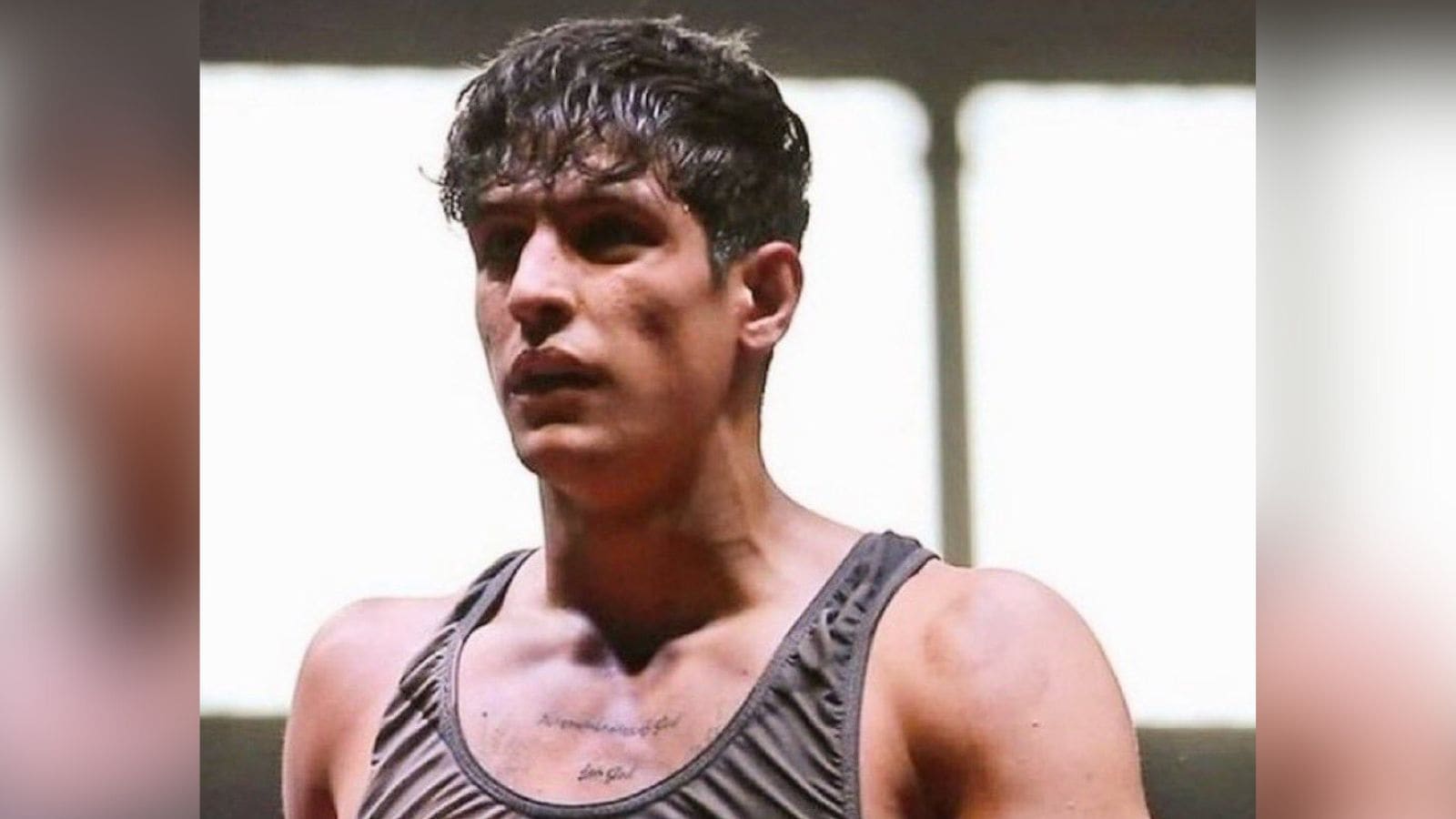
The air in a wrestling gym is a thick, singular soup of salt, bleach, and old leather. It is the smell of a body pushed past its natural limits. For Hamidreza Azari, this was the scent of home. At nineteen, his muscles were already beginning to set into the dense, coiled power of a champion. He knew the specific friction of the mat against his cheek, the way a heartbeat thunders in the ears during a heavy clinch, and the absolute, silent focus required to turn a man’s own momentum against him.
In the world of international wrestling, nineteen is a threshold. It is the age where potential hardens into reality. But in the early hours of a cold morning in Sabzevar, Iran, the trajectory of that reality was severed. There was no referee to signal the end of the bout. There was only the clinical, vertical finality of a crane in a public square.
The execution of Hamidreza Azari wasn't just a legal event or a line item in a human rights report. It was the systematic dismantling of a dream that a whole generation of Iranian athletes once shared. When a government decides that the neck of a star athlete is better suited for a rope than a medal, the message isn't sent to the international community. It is sent to every gym, every locker room, and every dirt-lot wrestling ring in the country.
The Weight of a Witness
To understand why a state would kill a teenager with the world at his feet, you have to understand the specific power of the athlete in Iranian culture. Wrestling isn't just a sport there; it is Pahlavani—a tradition of the "hero-athlete" who protects the weak and stands against injustice.
When the protests ignited across the nation, sparked by the death of Mahsa Amini, the athletes didn't stay in the bleachers. They couldn't. Their entire training is built on the idea of physical and moral strength. They became the visible tip of the spear.
Consider the hypothetical young wrestler today in Mashhad or Tehran. He wakes up at 5:00 AM. He runs. He lifts. He practices his takedowns until his knees are raw. But now, there is a ghost in the room. He knows that the same strength that earns him applause in the stadium makes him a primary target for the "Enjoining Good and Forbidding Evil" patrols.
The facts are stark and unyielding. Azari was accused of a killing during a brawl, a charge his supporters and various human rights groups claim was a convenient pretense to silence a vocal young man during a time of national upheaval. Iranian law is often a mirror of the state’s anxiety. When the state feels brittle, the law becomes a hammer.
The execution was carried out despite the fact that Azari was a minor at the time of the alleged crime, a direct violation of the International Covenant on Civil and Political Rights, which Iran has ratified. In the eyes of the judiciary, the treaty was a scrap of paper; the necessity of fear was the only law that mattered.
The Invisible Stakes
We often talk about "human rights" as if they are abstract clouds floating above our heads. They aren't. They are the right to breathe, the right to sweat, and the right to believe that if you work harder than everyone else, you will get to see tomorrow.
When the news of Azari’s death broke, it didn't just cause "concern." It caused a paralysis. Imagine being a teammate of a detained athlete like Salehi or any of the dozens of others currently sitting in Evin Prison. Every time the heavy iron door of the cell block creaks open, you aren't wondering if you’ll be released. You are wondering if your name is on the list for the morning crane.
This is the psychological warfare of the public execution. It is designed to be seen. It is designed to be ugly. It is designed to turn the hero into a cautionary tale.
But there is a flaw in this logic.
In a nation where wrestling is the soul of the people, killing a wrestler is like trying to put out a fire with gasoline. The state thinks it is showing strength. The people see a cowardice so profound that the state is afraid of a nineteen-year-old with a strong grip and a following on social media.
The Empty Podium
The international sports community often tries to stay "apolitical." It is a comfortable stance. It allows for the continuation of sponsorships, broadcasts, and high-level meetings. But there is nothing apolitical about a noose.
The United Nations and various wrestling federations have issued statements. They use words like "deplorable" and "unacceptable." These words are thin. They have no weight in a prison cell where the lights never go out. The real pressure comes from the silence of the fans—the realization that the person they are cheering for today could be the person the world is mourning tomorrow.
Statistically, the surge in executions in Iran is a graph that moves in lockstep with the level of civil unrest. When the streets are loud, the gallows are busy. Since the start of the "Woman, Life, Freedom" movement, the numbers have spiked to levels not seen in a decade.
But statistics are a way to hide from the truth. The truth is a pair of empty wrestling shoes left on the edge of a mat. The truth is a mother in Sabzevar who has to live in a city where the central square is no longer a place of commerce, but a place of trauma.
The Ripple Effect
The fear isn't just for those already in handcuffs. It is a slow-acting poison for those who are still free.
Imagine a young woman athlete in Iran. She has spent her life fighting for the right to even compete, navigating a labyrinth of modesty laws and restricted access. She sees what happened to Hamidreza. She sees the way the state treats its "stars" when they stop following the script. She has to decide: is the medal worth the target on her back?
Many are choosing to leave. The "brain drain" of Iran is well-documented, but we are now seeing a "brawn drain." The country’s best and brightest—its fastest and strongest—are seeking asylum in Europe, North America, and anywhere else where a disagreement with the government doesn't end in a death warrant.
They carry their trauma with them. They compete under different flags, but their hearts are still back in the dusty gyms of their childhood. They are the living evidence of a nation that is eating its own future.
The Final Bout
There is a specific moment in a wrestling match called the "bridge." It is when a wrestler is on their back, their shoulders inches from the mat, and they use every ounce of neck strength and willpower to arch their body, refusing to be pinned. It is a position of extreme pain and extreme resistance.
Iran’s athletic community is in a bridge right now.
The weight of the state is pressing down, trying to force the shoulders to touch the floor. The state has the rope, the prisons, and the guns. The athletes have only their voices and the collective memory of what it means to be a hero.
The execution of Hamidreza Azari was supposed to be the end of a story. It was supposed to be the final pin. But stories have a way of escaping the people who try to end them.
Every time a wrestler enters a gym in Iran today, they are making a choice. Every time they grip an opponent's arm, they are remembering the strength of a nineteen-year-old who was denied his twentieth birthday. The state can kill the athlete, but they have inadvertently turned the mat into a sanctuary and the sport into a form of silent, unbreakable prayer.
The lights in the stadium will eventually come back on. The question is who will be left to stand on the podium, and who will be forced to look at the empty space where a champion should have been.
The leather of the wrestling headgear still smells of sweat and salt. The mats are still being mopped with bleach. But the silence in the gyms of Sabzevar is no longer the silence of focus. It is the silence of a long, indomitable breath being held.