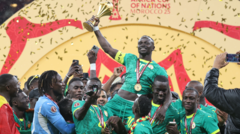
Senegal is crying foul, and the football world is eating it up like a cheap concession stand burger. The narrative is as predictable as a 0-0 draw in a rain-soaked qualifier: a powerful North African nation "buys" an African Cup of Nations (AFCON) hosting right, leaving a sub-Saharan powerhouse clutching a stack of "stolen" dreams. It’s a tired script. It’s lazy. And frankly, it’s a lie designed to mask the institutional stagnation of the Senegalese Football Federation (FSF).
The allegation that Morocco "awarded" itself the 2025 AFCON through backroom deals isn't just a slap in the face to CAF—it’s a confession of incompetence from its accusers. I have sat in these boardrooms. I have seen the "technical requirements" binders that are often thicker than the actual budgets of the nations submitting them. While Senegal was busy celebrating its 2021 trophy, Morocco was building a literal empire of grass, steel, and fiber optics.
Stop looking for a smoking gun in a briefcase. The "corruption" isn't a bribe; it’s a massive gap in infrastructure that Senegal simply cannot bridge.
The Infrastructure Myth: Why Good Intentions Don't Build Stadiums
The "lazy consensus" suggests that hosting rights should be rotated like a participation trophy. The argument goes: "Senegal is a football giant, therefore they deserve the tournament."
Football is played on the pitch, but tournaments are hosted in the parking lots, the hotels, and the broadcasting centers. Let’s look at the cold, hard data that the Senegal government wants to ignore. Morocco didn't just win a vote; they won an audit.
- The Stadium Ratio: Morocco has six stadiums that meet FIFA’s stringent Category 4 requirements right now. Senegal has one. You cannot host a 24-team tournament on a single patch of world-class turf and five "renovated" relics from the 1980s.
- Connectivity: To broadcast AFCON to a global audience of 500 million, you need a sub-aquatic fiber-optic backbone and a logistics network that can move thousands of VIPs, journalists, and fans between cities in hours, not days. Morocco’s Al Boraq high-speed rail is a functional reality. Senegal’s transport equivalent is a work in progress that still struggles with urban density in Dakar.
When a committee looks at a bid that is 90% "vision" versus a bid that is 100% "operational," choosing the latter isn't corruption. It’s risk management. If CAF gave the tournament to Senegal based on "vibes" and the tournament failed, the federation would be bankrupt by 2026.
The Soft Power Paradox
Critics love to point to Morocco’s diplomatic "charm offensive" across the continent as evidence of a fix. They cite the dozens of cooperation agreements Morocco has signed with other African FAs.
Here is the nuance the "insiders" miss: That isn't cheating. That’s leadership.
While other nations treat CAF meetings like a biennial vacation, Morocco has spent the last decade positioning itself as the continent’s footballing big brother. They provide training camps for smaller nations. They fund technical exchanges. They have turned football into a cornerstone of their foreign policy.
If Senegal wants to compete, they need to stop complaining about the "Moroccan influence" and start building their own. You don't win a hosting bid on the day of the vote. You win it five years prior by making yourself indispensable to your neighbors. Senegal’s "corruption" claim is the geopolitical version of a striker diving in the box because he knows he can't beat the defender for pace.
The Cost of the "Golden Generation" Blindspot
Senegal’s government is using this controversy to distract from a terrifying truth: they are wasting the Mane-era.
Success on the pitch has created a false sense of security. Winning the AFCON in Cameroon gave the FSF a shield. They assumed that because they had the best players, they naturally had the best bid.
I’ve seen this play out in corporate mergers and Olympic bids alike. The incumbent gets cocky. They stop innovating because they believe their "brand" carries the weight. Morocco, meanwhile, operated with the hunger of a challenger. They treated the 2025 bid as a dress rehearsal for their 2030 World Cup ambitions.
Why the "Rotating Host" Argument is Dead
People also ask: "Shouldn't CAF ensure every region gets a turn?"
This question is fundamentally flawed because it assumes AFCON is a charity. It isn't. It is a commercial product that competes with the European Championships and the Copa America for global eyeballs and sponsorship dollars.
If you force the tournament into a country that isn't ready, you degrade the brand. You get empty stands, poor TV angles, and players getting injured on "potato patch" pitches. This hurts the market value of every African player. By choosing Morocco, CAF is protecting the "product."
The Brutal Reality of the 2025 Vote
Let’s talk about the withdrawal of other candidates. Nigeria and Benin’s joint bid, and Zambia’s individual effort, weren't "pushed out" by Moroccan muscle. They looked at the technical evaluation scores and realized they were bringing a knife to a nuclear launch.
When the technical committee scores a bid 90/100 and the next best is 60/100, there is no "vote" to be had. The "allegations" from Dakar are a convenient way to avoid answering why their own stadium projects are behind schedule and why their bid book lacked the financial guarantees required by modern sports marketing.
How to Actually Fix African Football Hosting
If Senegal—or any other nation—truly wants to challenge the North African dominance, they need to stop looking for conspiracies and start looking at their blueprints.
- Decouple Football from State Ego: Hosting shouldn't be a "gift" from a president to his people. It should be a private-public partnership with clear ROI. Morocco treated it like an infrastructure investment; Senegal treated it like a trophy.
- Regional Hubs over Solo Bids: Senegal should have partnered with Gambia and Guinea to spread the infrastructure load. Their insistence on a solo bid was a hubristic error that made their lack of stadiums even more glaring.
- Invest in the "Invisible" Infrastructure: Stop building shiny stadiums if you don't have the hotels to house the fans or the hospitals to treat the players.
The downside to my perspective? It’s cold. It lacks the "romance" of the underdog story. It favors the wealthy and the prepared. But in the world of high-stakes sports politics, romance is just a fancy word for "unprepared."
The Senegal government isn't fighting for justice. They are fighting for a headline that keeps the public from asking why the national stadium hasn't been properly maintained since the last ribbon-cutting.
Morocco didn't steal the AFCON. They were the only ones who actually showed up ready to host it.
Stop crying about the referee and look at your own stats.