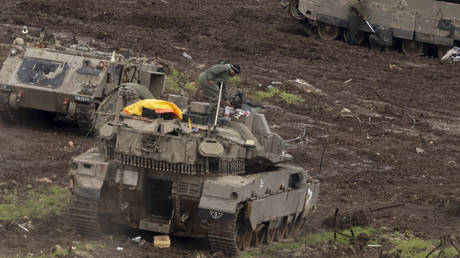
The air in southern Lebanon does not just carry the scent of thyme and cedar; it carries the weight of waiting. For weeks, that weight has been a physical presence, a pressure in the chest of every farmer in Marjayoun and every shopkeeper in Tyre. On Monday night, that pressure finally broke. It didn't break with a whisper. It broke with the rhythmic, metallic churn of treads meeting soil.
The border—a line on a map that has pulsed with tension for decades—ceased to be a conceptual boundary and became a theater of kinetic reality. Israeli commandos and armored units moved across the "Blue Line," initiating what the military described as "limited, localized, and targeted ground raids." But for those living in the shadow of the Litani River, there is no such thing as a "limited" incursion. There is only the sound of the sky tearing open and the sudden, jarring realization that the floor of your world has dropped away.
History has a cruel way of repeating its favorite choruses. To understand why a tank crossing a fence feels like a generational tremor, you have to look past the immediate tactical objectives. The stated goal is clear: to dismantle Hezbollah’s infrastructure, to destroy the tunnels and launch sites that have turned Northern Israel into a ghost town of evacuated families. Security is the logic. Survival is the heartbeat. Yet, for the person sitting in a darkened living room in a border village, the logic of "buffer zones" feels very different when it’s your olive grove being repurposed as a firing position.
The Geography of Ghost Towns
Consider the silence of Kiryat Shmona. For months, this Israeli city has been an empty shell, its residents scattered to hotels and temporary housing, fleeing the relentless rain of rockets from the north. The "human element" of this conflict isn't found in the briefings; it’s found in the dust on a child’s abandoned bicycle in an Israeli kibbutz, and in the frantic packing of a car in a Lebanese village.
The displacement is a mirror image of misery. On one side, 60,000 Israelis cannot go home because the threat of a cross-border raid—a nightmare fueled by the memories of October 7—is too visceral to ignore. On the other side, hundreds of thousands of Lebanese civilians are streaming north toward Beirut, their lives lashed to the roofs of aging Mercedes and SUVs.
The strategy of the ground operation is built on a simple, brutal equation: $D = S$. Displacement equals Security. By pushing Hezbollah’s Radwan forces back beyond the Litani River, Israel aims to create a physical distance that technology alone could not provide. But distance is a luxury neither side can truly afford.
The Invisible Architecture of the Underground
Below the surface of the rolling hills, there is a second landscape. This is not a metaphor. Over the last two decades, Hezbollah has constructed a subterranean fortress that rivals any modern subway system in complexity, if not in purpose. These are not mere "tunnels." They are nerve centers.
Imagine a soldier standing in a sun-drenched field. He sees nothing but rock and scrub. Yet, twenty feet beneath his boots, there are reinforced concrete rooms stocked with Iranian-made munitions, fiber-optic communications, and enough supplies to last months. This invisible architecture is why a ground move became, in the eyes of the Israeli High Command, an inevitability. You cannot bomb a shadow. You have to go into the dark and find it.
The danger of this approach is the friction of the unknown. Airpower is surgical, detached, and cold. Ground war is intimate. It is the sound of a door being kicked in. It is the smell of spent gunpowder and diesel. It is the moment where geopolitical strategy meets the sweating, terrified reality of a nineteen-year-old with a rifle.
The Weight of 1982 and 2006
We often talk about war as if it happens in a vacuum, but in this corner of the Mediterranean, the soil is saturated with the ghosts of previous "limited" operations. In 1982, an incursion meant to push the PLO back turned into an eighteen-year occupation. In 2006, a thirty-four-day war ended in a stalemate that merely allowed both sides to rearm for this exact moment.
The skepticism felt by the international community—and by many within the region—stems from this historical scar tissue. When the tanks roll north, they are driving over the same tracks laid by their fathers and grandfathers. There is a terrifying familiarity to the choreography. The warnings from Washington are delivered with a sense of "deja vu," a desperate hope that this time, the "limited" scope won't bleed into a regional conflagration that draws in Tehran and sparks a fire no one can extinguish.
The stakes are not just about borders. They are about the soul of two nations. Israel is fighting to restore a sense of safety that was shattered a year ago, trying to prove that it can still protect its borders through sheer force of will. Lebanon, a country already hollowed out by economic collapse and political paralysis, is fighting for its very existence as a sovereign entity, caught between a powerful non-state actor and a neighbor with the most advanced military in the region.
The Symphony of the Iron Dome and the Katyusha
If you stand on a ridge in the Galilee at night, the war looks like a lethal light show. The Iron Dome interceptors rise like golden needles, seeking out the white streaks of incoming rockets. It is a masterpiece of physics and engineering.
$$v = \sqrt{2gh}$$
The math of interception is precise. The velocity, the trajectory, the point of impact—all calculated in milliseconds by processors that don't feel fear. But the math of human suffering is far more chaotic. You cannot calculate the loss of a family legacy when a home is leveled. You cannot find the square root of a child’s trauma.
The ground operation is an attempt to break the cycle of this physics. It is an admission that the "high-tech" war has reached its limit. To stop the rockets, the soldiers must find the hands that light the fuses.
The Narrow Path
There is a specific kind of darkness that falls over a war zone when the power grids fail. It is a heavy, velvet blackness that makes every sound—a barking dog, a distant engine—sound like a threat. In the villages of southern Lebanon, that darkness is now absolute.
The people who remain are the old, the stubborn, and the ones with nowhere else to go. They sit in the dark and listen to the vibration of the earth. They know that the "limited raids" are just the opening notes of a much larger, more dangerous composition.
The international community speaks of "de-escalation," a word that sounds hollow when the gears of a ground invasion are already turning. Diplomacy is a language of the daylight. At 2:00 AM, when the paratroopers are moving through the brush, the only language is survival.
What comes next is not a matter of if, but of how far. How far will the tanks go? How far will Hezbollah retreat before they decide to stand and die? How far will the rest of the world look away?
The orchards are silent now. The harvest, which should be the focus of this season, will go unpicked. The olives will wither on the branch, and the citrus will rot in the groves, because the ground they grow in is no longer a place of life. It is a grid on a commander's screen.
The moon hangs over the Litani, indifferent to the movement of men and machines below. It has seen this before. It will likely see it again. The tragedy isn't that the world is watching another war; the tragedy is that the world knows exactly how this story ends, and yet we are all forced to watch the first chapter be written once more in the dust and the blood.
A soldier's boot crushes a fallen pomegranate, spilling its red juice into the dry earth, a small, quiet stain in a night that is just beginning to bleed.