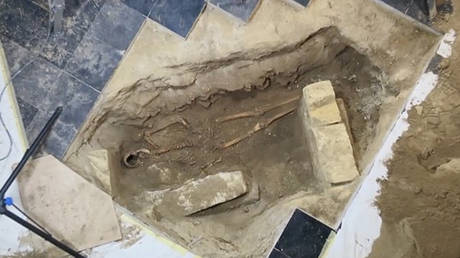
Archeologists in the Netherlands think they might have found the bones of Charles de Batz de Castelmore. You know him as D'Artagnan, the fourth musketeer. The media is eating it up. History buffs are swooning.
It is a complete waste of time.
Let us be brutally honest about what is happening here. Researchers are digging in the dirt near Maastricht, chasing the ghost of a French soldier who died in 1673 during the Franco-Dutch War. They are obsessed with matching skeletal remains to a swashbuckling brand. They want the romantic payoff of finding the real D'Artagnan.
This is not historical science. It is pop-culture necrophilia.
Chasing celebrity bones actively harms our understanding of the past. It drains funding from site excavations that actually matter. It warps public perception of how history works.
If we want to understand the seventeenth century, we need to stop looking for heroes and start looking at systems.
The Great Archaeological Bait-and-Switch
The competitor narrative is easy to read and easy to digest. It goes like this: D'Artagnan died at the Siege of Maastricht. We found some bones of healthy, middle-aged men near the site. Let us run the DNA tests and see if we can prove it is him.
Here is what that narrative leaves out.
Finding the specific remains of a single battlefield casualty from 350 years ago is like finding a specific grain of sand on a beach after a hurricane. Battlefield burials are notoriously messy. Bodies were stripped. Men were tossed into communal pits. Identification tags did not exist.
Even if a skeleton matches the physical description—a male in his late fifties with trauma consistent with musket fire—the margin of error remains massive.
The Cult of the Individual
History is not a collection of biographies. It is the study of human societies, economies, and movements.
When a dig site becomes "The Hunt for D'Artagnan," the science takes a backseat to PR.
- The Funding Trap: Governments and donors do not want to fund a three-year study on seventeenth-century latrine deposits or the diet of camp followers. They want a shiny object. They want a name they recognize.
- The Narrative Bias: Once you decide you are looking for D'Artagnan, you start interpreting every artifact through that lens. A scrap of lace becomes a musketeer's collar. A rusted blade becomes his rapier. It is confirmation bias dressed up in lab coats.
I have spent years watching cultural institutions bend over backward to find a celebrity tie-in just to get a grant renewed. It is exhausting, and it cheapens the discipline. We do not need another celebrity skeleton. We need to understand the logistics of seventeenth-century siege warfare.
People Also Ask: And Why Their Questions are Flawed
The public curiosity surrounding this discovery is understandable, but the questions people are asking reveal how badly the media has skewed historical literacy. Let us dismantle the premises of the internet's favorite questions about this dig.
Where is the real D'Artagnan buried?
This is the wrong question because it assumes there is a single, intact, identifiable grave waiting to be found. D'Artagnan was killed by a musket ball to the throat at the Tongeren Gate in Maastricht. It was a brutal siege.
The French army was in the middle of a heavy assault. While he was a captain-lieutenant of the Musketeers and a trusted agent of Louis XIV, he was still just a casualty in a war zone.
He was likely buried in a churchyard or a trench near the battlefield. Over three centuries, urban sprawl, subsequent wars, and the natural degradation of soil have destroyed any clean context. The real answer is: he is part of the Dutch soil now. Let him stay there.
Will DNA prove it is him?
Probably not. To prove a DNA match, you need a control sample. You need DNA from a known, verified relative of D'Artagnan.
Most of his direct descendants died out or their graves are equally lost or disturbed. Comparing ancient DNA to modern distant relatives is incredibly complex and rarely yields the 100% certainty the public craves. It yields probabilities. But "There is a 42% chance this is a distant cousin of a musketeer" does not make for a good headline.
Why does this find matter if it is him?
It does not.
Let us run a thought experiment. Imagine a scenario where a skeleton is found, the DNA is a perfect match, and we are absolutely sure it is Charles de Batz de Castelmore.
What does that change about our knowledge of the Franco-Dutch War? Nothing. What does it tell us about the rise of French absolutism under Louis XIV? Nothing. It gives us a tourist attraction. It gives us a gift shop. It does not advance historical knowledge by a single inch.
The Economics of Vanity Archeology
Let us talk numbers. Archeology is expensive.
A standard excavation requires ground-penetrating radar, trenching, artifact washing, carbon dating, osteological analysis, and massive data storage. In Europe, most of this is funded by taxpayer money or development contracts.
When a project pivots to "celebrity hunting," costs balloon. Isotopic analysis to determine where a person grew up is expensive. DNA sequencing is expensive.
Every dollar spent trying to find out if Bone Fragment A belongs to a famous person is a dollar taken away from studying the other 200 nameless skeletons in the same trench. Those nameless skeletons are the ones who can tell us about:
- Epidemiology: What diseases were tearing through military camps?
- Nutrition: Was the French army actually well-fed, or were they starving on the march?
- Physical Labor: What kind of repetitive stress injuries did seventeenth-century laborers suffer while building siege works?
The answers to those questions tell us how the modern world was built. The answer to "Is this D'Artagnan?" tells us nothing.
How to Actually Consume Historical News
If you are reading about the Maastricht digs, you need to change your filter. Stop looking for the names. Look for the context.
Here is how you evaluate a historical discovery without falling for the romantic trap:
1. Ignore the Names, Look at the Assemblage
An assemblage is the collection of artifacts found together in the same layer of soil. A single coin might have been dropped by anyone. A collection of clay pipes, leather boot scraps, and animal bones tells you how a military unit lived day-to-day.
If an article focuses entirely on one skeleton and ignores the trash pits around it, it is a press release, not science.
2. Follow the Stratigraphy
The past is layered. If archeologists find a body, the most important question is not who it is, but what layer of earth it sits in. Is it sealed beneath a destruction layer from the 1673 siege? Or is it in a layer disturbed by nineteenth-century construction? If the context is disturbed, the data is useless.
3. Check the Osteology Profile
Skeletal analysis should tell a story of a life, not a label.
- Does the skeleton show signs of childhood malnutrition?
- Are there healed fractures from previous campaigns?
- Does the bone density suggest a horseman or a foot soldier?
This data tells us about the physical reality of seventeenth-century life. It does not matter if the man was named Charles or Jacques. The data is exactly the same.
The Hard Truth About Heritage Tourism
There is a downside to my stance. I know exactly what it is.
Public interest drives funding. If the public wants D'Artagnan, and promising them D'Artagnan gets the site dug, then archeologists will use that leverage to get their foot in the door. It is a devil's bargain. You promise the public a celebrity, and you use the leftovers of the budget to do the real science on the side.
But we have let the bargain flip. The celebrity hunt is no longer the Trojan horse used to get real science funded. The celebrity hunt is the science now.
When Alexander the Great’s supposed family tombs were found in Vergina, Greece, it sparked decades of nationalist debates and academic fistfights. The science was buried under politics and tourism. When Richard III was found under a parking lot in Leicester, it became a massive PR win for the city, but it did very little to alter our understanding of the Wars of the Roses. We already knew he died at Bosworth. We already knew he was buried in Leicester. Finding the bones just gave us a face to put on a coin.
We are doing it again in Maastricht.
We are digging up the dead not to learn from them, but to entertain ourselves. We are turning the brutal reality of seventeenth-century warfare—the starvation, the gangrene, the religious fanaticism, the absolute disregard for human life—into a cozy mystery about a man with a big hat and a sword.
If you want to honor the past, stop looking for the heroes. Start looking at the masses of nameless people who actually built the world we live in. Leave the musketeers in the fiction section where they belong. Stop digging for ghosts and start looking at the dirt.