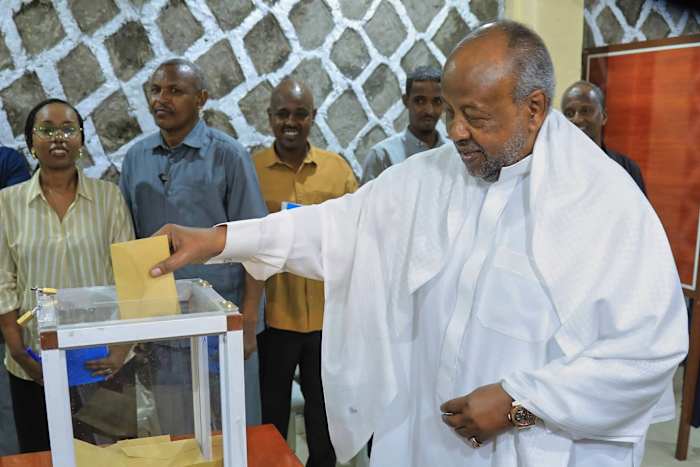
Ismaïl Omar Guelleh has secured a sixth term as the President of Djibouti, continuing a twenty-six-year streak that has turned the tiny Horn of Africa nation into a family-run fortress. The official results show a victory so lopsided—exceeding 90 percent of the vote—that it functions more as a statistical statement of power than a democratic exercise. While the international community often pays lip service to democratic transitions elsewhere, Guelleh’s grip on power remains unchallenged by the global powers that pay him billions in rent. The reason is simple. Djibouti is the world’s most expensive parking lot for foreign militaries.
To understand the 2026 election, one must look past the ballot boxes. This was not a contest of ideas or a referendum on policy. It was a logistical confirmation of the status quo. Guelleh has managed to make himself indispensable to the United States, China, France, and Japan by leveraging a single, unchangeable asset: geography. Situated at the mouth of the Red Sea and the Bab al-Mandab Strait, Djibouti sits on a chokepoint through which 10 percent of global oil exports and 20 percent of all commercial goods pass.
The Geography of Compliance
Djibouti is a country roughly the size of New Jersey, largely composed of volcanic wasteland and salt flats. It produces almost nothing. Yet, it enjoys one of the highest concentrations of foreign military bases on earth. This "basing diplomacy" provides Guelleh with a dual shield. First, the rental income from these bases—estimated at over $120 million annually from the U.S. and China alone—funds the state apparatus and the security forces that keep the opposition in check. Second, the presence of these powers ensures that no one will push too hard for human rights reforms.
The United States operates Camp Lemonnier, its only permanent base in Africa, which is vital for counter-terrorism operations in Yemen and Somalia. Directly across the way, China has established its first overseas naval base, a massive concrete manifestation of its Belt and Road Initiative. When your landlords are the two most powerful nations on the planet, you don't worry about election monitors. You worry about the lease renewals.
A Defanged Opposition and the Politics of Exclusion
This sixth term was paved by a 2010 constitutional amendment that scrapped term limits, a move Guelleh originally claimed would be his last. That promise has since vanished. In the lead-up to the recent vote, the primary opposition coalitions, including the Movement for Democratic Renewal (MRD), faced a familiar pattern of bureaucratic hurdles and outright bans.
The 2026 "contest" featured only one real challenger, a businessman perceived by many locals as a mere placeholder intended to give the proceedings a veneer of legitimacy. Most veteran activists have either been jailed, driven into exile in France, or silenced by the heavy-handed tactics of the Guelleh administration. The local police force and the Republican Guard are not just state institutions; they are the guarantors of the Guelleh family’s longevity.
The streets of Djibouti City tell a different story than the official victory tallies. While the downtown area boasts gleaming new ports and luxury hotels built with Chinese debt, the outskirts are a sprawl of poverty. Youth unemployment sits near 70 percent. There is a profound disconnect between the nation’s high-tech maritime infrastructure and the lived reality of its citizens. The wealth generated by the port of Doraleh and the foreign military presence rarely trickles down past the political elite.
The Chinese Debt Trap and the Sovereignty Gamble
Guelleh’s sixth term begins under a mountain of debt. In his drive to turn Djibouti into the "Singapore of Africa," the President turned to Beijing. China has financed the lion’s share of the country’s infrastructure, including a $3.5 billion free trade zone and a railway linking the port to Addis Ababa.
Djibouti’s debt-to-GDP ratio has frequently spiked above 70 percent. This creates a precarious situation where the nation's most valuable assets are effectively collateral for Chinese loans. If Djibouti cannot pay, China gains even more leverage over a territory that the West considers vital for security. This "debt-trap diplomacy" is not a theoretical risk here; it is the fundamental economic reality of Guelleh’s twilight years.
The United States finds itself in a strategic bind. Diplomats in Washington may grumble about Guelleh’s authoritarian streak, but they are terrified of what comes after him. A power vacuum in Djibouti would be a catastrophe for Western interests in the Middle East and Africa. Consequently, the State Department's critiques remain muted, often buried in dry human rights reports that the Djibouti government simply ignores.
Family Ties and the Succession Question
At 78, Guelleh is the only leader many Djiboutians have ever known. His predecessor was his uncle, Hassan Gouled Aptidon, who handpicked him for the role in 1999. This is not just a presidency; it is a dynastic transition in slow motion. Speculation now turns to who will follow him.
Rumors often circle around his wife, Kadra Mahamoud Haid, who is widely considered the second most powerful person in the country, or his children. The consolidation of power within the presidential palace has prevented the rise of any independent political figures. This creates a brittle stability. The government appears rock-solid because it has crushed all competitors, but that lack of a safety valve makes the eventual transition—whenever it happens—dangerously unpredictable.
The Port Power Play
The economy of Djibouti is the port, and the port is the state. The legal battle over the Doraleh Container Terminal remains a cautionary tale for international investors. After the government seized the terminal from Dubai’s DP World in 2018, it ignored multiple rulings from the London Court of International Arbitration.
This total disregard for international contract law sends a clear message: in Djibouti, the President’s word is the only law that matters. For the global shipping industry, this is an acceptable risk as long as the cranes keep moving. For the people of Djibouti, it means that the nation's primary source of income is managed with zero transparency and no public oversight.
The High Cost of the Status Quo
The international community's silence on Djibouti’s democratic deficit is a calculated trade-off. We exchange the aspirations of the Djiboutian people for a stable refueling station and a drone launchpad. This pragmatism has kept Guelleh in power for a quarter-century, but it ignores the growing resentment beneath the surface.
When a leader wins with 90 percent of the vote for the sixth time, it isn't a sign of popularity. It is a sign of a system that has stopped breathing. Guelleh has built a nation that functions perfectly as a logistical hub but fails as a society. The ports are efficient, the bases are secure, and the presidency is permanent. But as history in the region shows, the more rigid a structure becomes, the more spectacularly it eventually breaks.
Guelleh’s sixth term is not a new beginning. It is the continuation of a long-term lease on a country that has been sold, piece by piece, to the highest bidders in the global security market. The world will keep paying the rent, and Guelleh will keep collecting the checks, until the geography of the Red Sea eventually finds a new landlord.