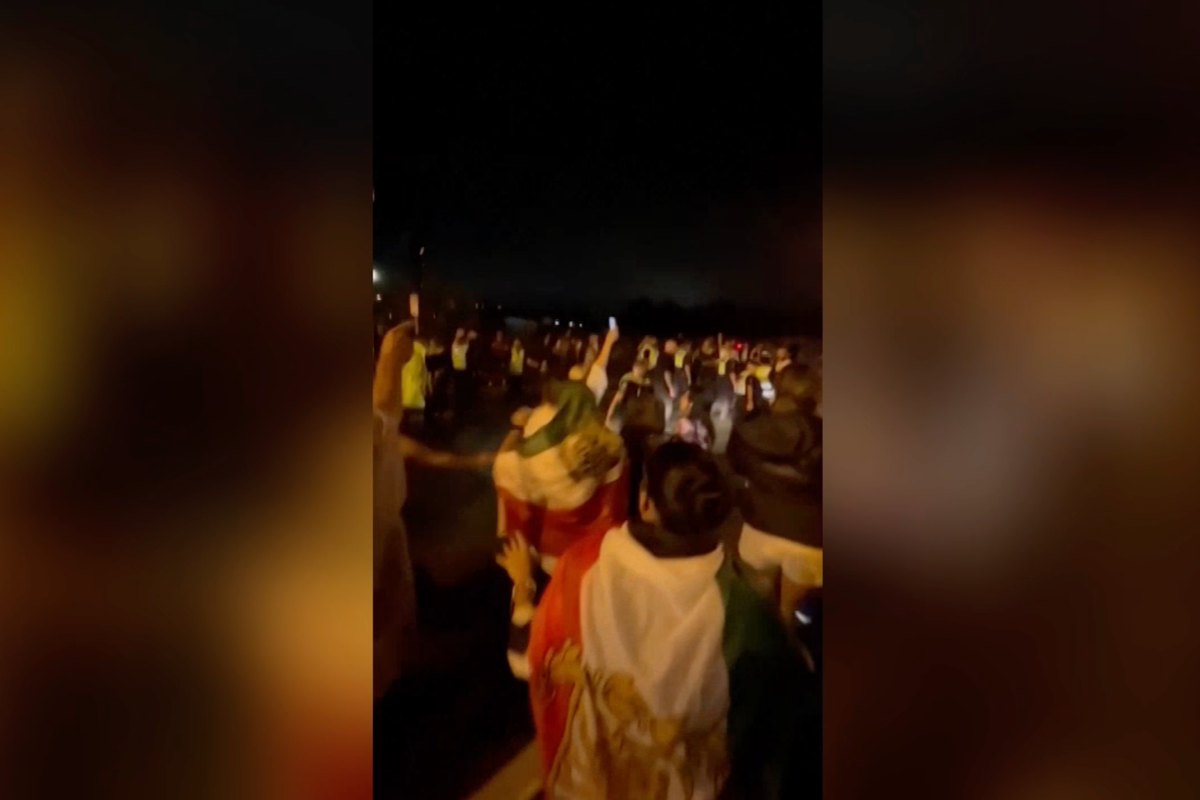
When the Iranian women’s national football team touched down in Perth for the Olympic qualifiers, the pitch was the least volatile surface they would encounter. Outside the stadium gates and surrounding the team bus, a roar erupted that had nothing to do with goals or offside traps. It was the sound of a diaspora desperate to bridge a thousand-mile gap between the relative safety of Western Australia and the tightening grip of the Islamic Republic. The scenes of fans chasing the team vehicle, screaming for the players to seek asylum, turned a standard FIFA fixture into a high-stakes political confrontation.
This was not a spontaneous outburst of hooliganism. It was a calculated, visceral plea directed at a group of elite athletes who occupy one of the most precarious positions in global sport. For these women, every international cap is a tightrope walk. They play for a regime that many of their supporters view as an oppressor, yet they represent a national identity that predates and transcends the current clerical rule. When the crowds in Perth demanded they defect, they weren’t just asking for a roster change; they were asking these players to trade their lives, their families, and their history for a chance to speak freely.
The Pitch as a Political Theater
International sport often masquerades as a neutral ground, but for Iranian athletes, the grass is always stained with the politics of Tehran. Since the "Woman, Life, Freedom" protests ignited following the death of Mahsa Amini, the scrutiny on female athletes has reached an atmospheric high. The Iranian football federation operates under the heavy shadow of the state, ensuring that players adhere to strict "moral" codes even while competing in a modern, professionalized sport.
The fans in Australia understood this reality intimately. Many were exiles themselves, people who had already made the harrowing choice to leave. By surrounding the bus, they forced a confrontation with the uncomfortable truth of the Iranian sporting model. The government uses these teams to project an image of normalcy and participation to the world, while simultaneously enforcing restrictions at home that would make those same players second-class citizens the moment they step off the plane at Imam Khomeini International Airport.
The Machinery of State Control
To understand why a player doesn’t simply walk away and claim asylum the moment they hit Australian soil, you have to look at the mechanics of the Iranian sports system. This is not a matter of simple paperwork. The Iranian Revolutionary Guard Corps (IRGC) and various intelligence wings have a long history of utilizing "shadow chaperones" on international trips. These are not coaches or trainers. Their job is to ensure that no player wanders off, no player speaks to the wrong journalist, and certainly, no player removes her headscarf in a moment of televised defiance.
Financial and familial leverage serves as the ultimate deterrent. Athletes often have to post significant bonds or have family members sign guarantees before they are granted exit visas for competitions. If a player defects, the consequences do not stop at the border. The families left behind become targets for interrogation, asset seizure, and harassment. When those fans in Perth were banging on the bus windows, they were looking at women who were essentially playing with a metaphorical gun to their heads.
Australia as the Unlikely Backdrop
The choice of Australia for these qualifiers added a layer of complexity to the drama. Australia has a vocal, organized Iranian community that has become increasingly militant in its opposition to the Islamic Republic. Perth, often seen as a quiet outpost of the sporting world, became a pressure cooker because of its accessibility. Unlike tournaments held in the Middle East or regions with closer ties to Tehran, Australia offered a space where the diaspora felt safe enough to be loud.
However, the Australian government finds itself in a diplomatic bind. While the public sentiment overwhelmingly favors the protesters, the official state apparatus must balance its commitment to human rights with the bureaucratic reality of sports visas and international relations. Providing asylum is a rigorous legal process, not a gesture made at a stadium gate. The disconnect between the raw emotion of the crowd and the cold machinery of immigration law is where the tragedy of the Perth standoff truly lives.
The Heavy Burden of Representation
We often demand that athletes be heroes, but we rarely account for the cost of that heroism. For an Iranian footballer, a simple gesture—like not singing the national anthem or wearing a black wristband—is a career-ending, life-altering move. The players are caught in a pincer movement between a state that demands absolute loyalty and a diaspora that demands absolute defiance.
In the locker room, these women are focused on tactics, fitness, and the technical demands of the Asian qualifiers. Out on the street, they are symbols, avatars for a revolution they might support in their hearts but cannot acknowledge with their lips. The exhaustion on their faces as the bus pulled away from the crowds wasn't just physical fatigue from the match. It was the weight of carrying an entire nation’s trauma while trying to defend a corner kick.
The Myth of the Neutral Athlete
There is a persistent, naive argument that sports and politics should remain separate. This is a luxury afforded only to those who live in stable democracies. For the Iranian women’s team, their very existence on the field is a political act. The fact that they are allowed to play at all is a concession the regime makes to avoid total international isolation and FIFA sanctions.
The protesters in Perth were not there to watch football. They were there to disrupt the narrative of "business as usual." By chasing the bus, they stripped away the veneer of the sporting event and forced the onlookers to see the players as individuals in crisis. They were highlighting the fact that the jersey these women wear is owned by a state that restricts their movements, their clothing, and their speech.
The Consequences of the Perth Incident
The fallout from the Australian trip will likely be felt for months in Tehran. The images of the team being hounded by asylum seekers are an embarrassment to a government that obsesses over its global image. It is almost certain that security protocols for future away matches will be tightened. We can expect even fewer opportunities for players to interact with the public and more "handlers" in the delegation.
For the players, the return home is fraught. Even if they did nothing to encourage the crowds, the mere fact that they were the center of such a demonstration puts them under a microscope. Every social media post will be scanned, every interview parsed for a hint of sympathy for the "seditious" elements abroad. The psychological toll of being the target of such intense, conflicting pressures is immeasurable.
A Broken System of Global Oversight
FIFA and the Asian Football Confederation (AFC) have remained largely silent on the specific pressures facing Iranian players. Their "neutrality" often functions as a shield for repressive regimes. By failing to provide specific protections or monitored safe-zones for athletes from high-risk nations, these governing bodies effectively outsource the policing of players to the regimes themselves.
The scenes in Perth should serve as a wake-up call for the international community. If the global sports architecture continues to allow states to use athletes as political props while threatening their families, then the "fair play" touted in every pre-match ceremony is a lie. The fans who chased that bus were acting out of a desperate sense of justice that the official institutions have ignored for decades.
Beyond the Stadium Gates
The Iranian women’s team will continue to play, and the diaspora will continue to protest. Each match is merely a new chapter in a long-running struggle for the soul of Iranian identity. The "Save our girls" chants are a reminder that for these athletes, the final whistle doesn't mean the end of the contest. It just means the beginning of a different, more dangerous game played in the shadows of the state.
The next time a bus pulls out of a stadium under heavy guard, remember that the people inside are not just athletes. They are hostages of a geopolitical reality that values their performance on the grass more than their safety in the world. The roar of the crowd in Perth was a demand for recognition—not of a scoreline, but of a fundamental human right to exist without fear.
Search for the names of the players who have already gone quiet since returning from international duties.