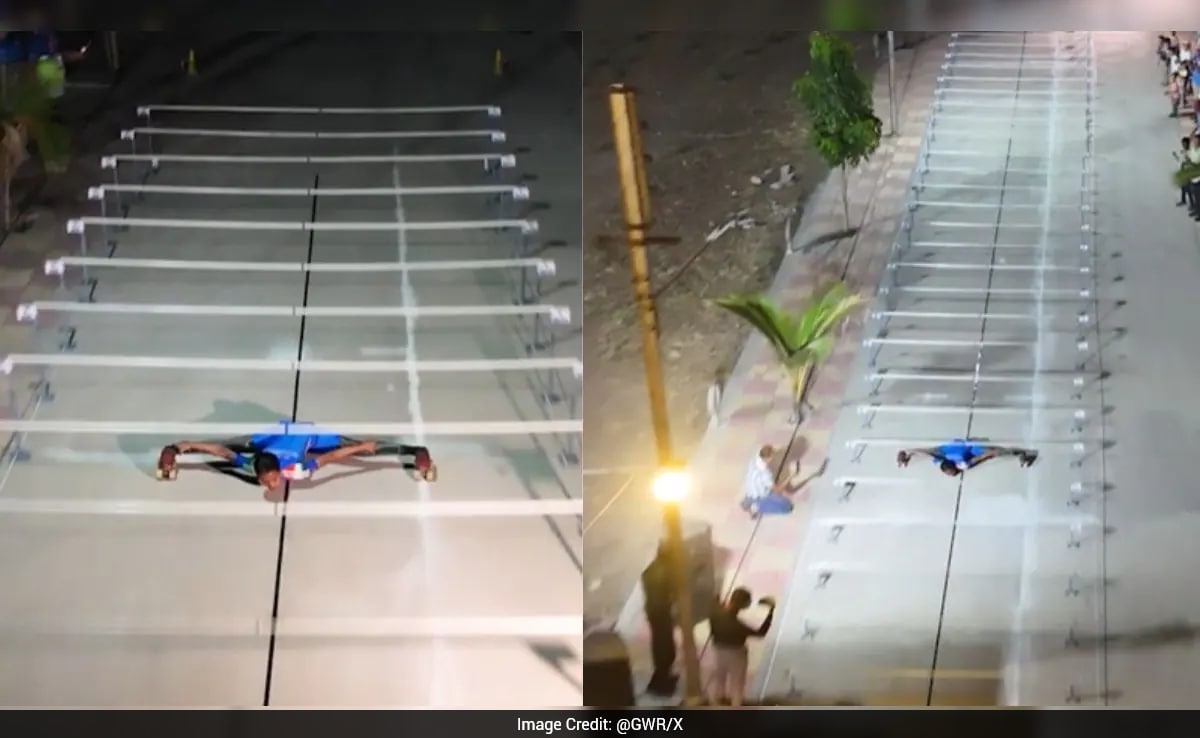
In the grueling world of niche athletic feats, the record for the fastest 50-meter limbo skating under descending poles represents more than just a fleeting headline. It is a calculated collision of extreme flexibility, centrifugal force, and a high-stakes gamble with the human spine. When a young skater from India maneuvers their body into a horizontal plane just inches above the pavement while maintaining high-velocity momentum, they are not just "breaking a record." They are defying the biomechanical limits of the human frame.
The feat involves skating under a series of bars set at a height that would make a standard crouch impossible. To succeed, the athlete must achieve a full split—often exceeding 180 degrees—while leaning their torso forward until it is parallel to the ground. This position must be held while traveling at speeds that would cause a typical skater to lose balance and succumb to friction.
The Mechanical Reality of the Descending Pole
Most spectators focus on the speed, but the true difficulty lies in the "descending" nature of the challenge. This is not a static obstacle course. As the skater progresses, the clearance height often drops, requiring an active, mid-motion adjustment of the center of gravity.
To maintain velocity while the torso is essentially dragging an inch above the floor, the skater relies on a specific type of lateral thrust. Traditional vertical skating uses a stride that pushes back and out. In limbo skating, the power must come from the ankles and the outer edges of the wheels, as the knees cannot bend upward without hitting the poles. It is a specialized, agonizing form of propulsion that puts immense strain on the hip flexors and the lower lumbar region.
The Cost of Hyper-Flexibility
We see the gold medals and the certificates, but we rarely discuss the physiological price of admission. Achieving the level of flexibility required for world-record limbo skating involves years of training that begins in early childhood. This is because the cartilaginous structure of a child’s skeleton is more malleable than an adult's.
However, forcing the hip joints into repetitive, extreme abduction can lead to long-term issues. Sports medicine practitioners have noted that athletes in these hyper-mobile disciplines often face:
- Labral tears: The ring of cartilage that follows the outside rim of the hip socket can fray or tear under the pressure of extreme splits.
- Spondylolysis: Stress fractures in the small bridge of bone in the lower spine caused by repeated over-extension.
- Ligamentous laxity: A condition where ligaments become so stretched that they no longer provide adequate support to the joints, leading to chronic instability.
The drive for these records in India is fueled by a massive grassroots infrastructure. Small skating clubs in cities like Belgaum, Pune, and Ahmedabad have turned this into a science, using specialized stretching racks and low-clearance bars to prune the next generation of record-breakers. It is a conveyor belt of talent, but one that operates with very little oversight regarding the long-term orthopedic health of the participants.
The Equipment Factor
You cannot break these records on standard recreational skates. The hardware is stripped down to the essentials. Pro-grade limbo skates feature low-profile boots to shave off precious millimeters of height. The wheels are often smaller than those used in speed skating—typically 90mm or 100mm—to keep the skater’s center of mass as close to the asphalt as possible.
Bearings are cleaned of heavy grease and lubricated with thin oils to ensure zero resistance. In a race where a fraction of a second is the difference between history and obscurity, even the air pressure in the wheels is scrutinized. A wheel that is too soft will grip the ground too much, slowing the skater down; a wheel that is too hard will vibrate, potentially knocking the skater’s flat torso upward into a pole.
Beyond the Spectacle
The fascination with limbo skating in India mirrors the country’s broader obsession with unique, quantifiable milestones. It is a sport that translates well to social media and news broadcasts—it is visual, it is easy to understand, and it looks impossible.
But as the bars get lower and the distances get longer, we have to ask where the ceiling—or in this case, the floor—actually is. There is a point where the human anatomy simply cannot flatten any further. When that point is reached, the only way to break the record is to increase the speed, which exponentially increases the risk of a catastrophic wipeout. At 20 kilometers per hour, hitting a metal pole with your forehead while in a full split isn't just a "failed attempt." It's a life-altering injury.
The Economic Engine
This isn't just about glory; it's a business. The manufacturers of the skates, the coaches who charge for specialized "limbo camps," and the organizers of these record attempts create a micro-economy. For a family in a Tier-2 Indian city, a Guinness World Record for their child can be a ticket to sponsorships, government grants, or at the very least, local celebrity that opens doors.
The pressure is immense. The children are often on the skates for four to six hours a day, drilling the same 50-meter stretch until the movement becomes autonomic. This level of specialization at a young age is a hallmark of modern elite sports, but in limbo skating, the margin for error is uniquely thin.
Engineering a Faster Slide
If you want to understand why these records keep falling, look at the surface. These attempts aren't happening on rough outdoor pavement anymore. They are moving to specialized indoor wooden floors or treated concrete that has been polished to a mirror finish.
The friction coefficient of the surface determines how much energy is lost during the slide. By controlling the environment, coaches can ensure that the skater’s initial burst of speed carries them through the entire 50-meter gauntlet with minimal additional effort. This allows the skater to focus entirely on staying flat, rather than having to "kick" to maintain speed, which is the moment most falls occur.
The next time you see a video of a girl gliding effortlessly under bars that seem to graze her eyelashes, look past the timer. Notice the tension in the ankles, the rigid lock of the core, and the absolute stillness required to survive the run. It is a feat of engineering as much as it is a feat of athleticism.
If you are a parent or a coach looking to enter this arena, your first priority shouldn't be the stopwatch. It should be a comprehensive baseline MRI of the athlete's hips and spine.