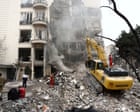
Israel has launched an unprecedented wave of airstrikes against Tehran, effectively shattering the brief illusion of a regional de-escalation. These strikes, characterized by residents as the most violent since the conflict began on February 28, hit the Iranian capital just forty minutes after U.S. President Donald Trump announced a five-day "pause" on targeting Iranian energy infrastructure. While the White House claims to be engaged in "productive" negotiations with unnamed Iranian officials to reopen the Strait of Hormuz, the Israeli Defense Forces (IDF) are operating on a separate, more aggressive timeline.
The divergence between Washington and Jerusalem is no longer a matter of quiet diplomatic friction; it is a public strategic split. While Trump attempts to use the threat of energy "obliteration" as a bargaining chip to stabilize global oil prices—which recently spiked to $112 per barrel—Israel is doubling down on a mission to dismantle the Iranian regime’s command-and-control apparatus regardless of the cost to the global economy.
The Mirage of Productive Conversations
President Trump’s claim that he is dealing with "reasonable" people in Tehran has been met with flat denials from the Iranian Foreign Ministry and Parliament. To the veteran observer, this looks less like a diplomatic breakthrough and more like a tactical stall. Trump’s "General License U," which effectively allows the sale of 140 million barrels of sanctioned Iranian oil currently at sea, was intended to flood the market and lower gas prices before they could cripple the U.S. economy. Instead, it has provided the Iranian regime with a potential multi-billion dollar lifeline at the exact moment the U.S.-Israeli "Operation Epic Fury" was designed to starve them.
Critics in Washington argue that by lifting these sanctions without an escrow mechanism, the administration is "funding the enemy" while simultaneously threatening to bomb them. This erratic policy—shifting from weekend ultimatums to five-day pauses—has created a vacuum that the Israeli military is now filling.
Israel’s Parallel War
The IDF’s latest sorties over Tehran did not target the power plants or the South Pars gas field—sites Trump has placed "off-limits" for the next 120 hours. Instead, they focused on "regime infrastructure," a broad category that includes Revolutionary Guard (IRGC) headquarters, communication hubs, and the literal foundations of the clerical administration.
Israel’s Defense Minister, Israel Katz, has been blunt: the objective is not just to degrade a nuclear program, but to ensure the "infrastructure the regime relies on" is permanently disabled. By hitting Tehran while Trump talks, Israel is signaling that it will not be bound by Washington’s desire for a quick, market-friendly exit.
The strategic friction points are becoming impossible to ignore:
- Market Stability vs. Regime Collapse: Trump needs the Strait of Hormuz open and oil flowing to protect his domestic political standing. Netanyahu needs the Iranian regime incapable of ever launching another drone.
- The "Doomsday Option": Trump views striking power plants as a final deterrent to be held in reserve. Israel views the current chaos as a once-in-a-generation window to finish a war they have been fighting in the shadows for decades.
- Negotiation Legitimacy: Trump claims to be talking to the "top person" in Iran, despite the death of Supreme Leader Ali Khamenei in the initial February strikes. The identity of these "reasonable" interlocutors remains a mystery, leading to fears that the U.S. is being played by a fractured Iranian leadership desperate for time to regroup.
The Escalation Trap
Iran’s response to the current wave of strikes has been a "horizontal escalation." Unable to stop Israeli F-35s over Tehran, the IRGC has instead targeted the lifeblood of U.S. allies in the region. Retaliatory strikes on water desalination plants in Qatar and Kuwait, and energy facilities in Bahrain, are designed to make the war too expensive for the West to continue.
This is the trap. If the U.S. remains paused while Israel continues to pound Tehran, Iran will continue to strike the global energy supply. This puts Trump in a position where he must either force a halt to Israeli operations—an unlikely prospect given the current political climate—or follow through on his threat to destroy the Iranian power grid, an act that would likely cause a total regional collapse and a global depression.
The Cost of Indecision
The markets have already voiced their verdict. While Brent crude briefly dipped to $100 on news of the five-day pause, it remains volatile. Insurance premiums for tankers in the Gulf have reached prohibitive levels, and the "shadow fleet" of tankers Trump is now trying to legitimize is a chaotic factor that no one truly controls.
The reality on the ground in Tehran is a capital under siege, with electricity failing and the sounds of "unprecedented" explosions echoing through the streets. The U.S. and Israel may have started this campaign with a unified front, but as the war enters its second month, their goals are no longer aligned. One seeks a deal; the other seeks a transformation.
If the next five days of "productive" talks yield nothing, the pause will end. At that point, the distinction between "regime infrastructure" and "energy infrastructure" will vanish, and the Middle East will enter a phase of the conflict from which there is no structured return.
Monitor the movement of the 29 tankers currently loitering off the coast of Malaysia; their ability to offload Iranian crude under the new U.S. license will be the first real indicator of whether Trump's gamble has any teeth, or if it is merely a stay of execution before the total blackout begins.