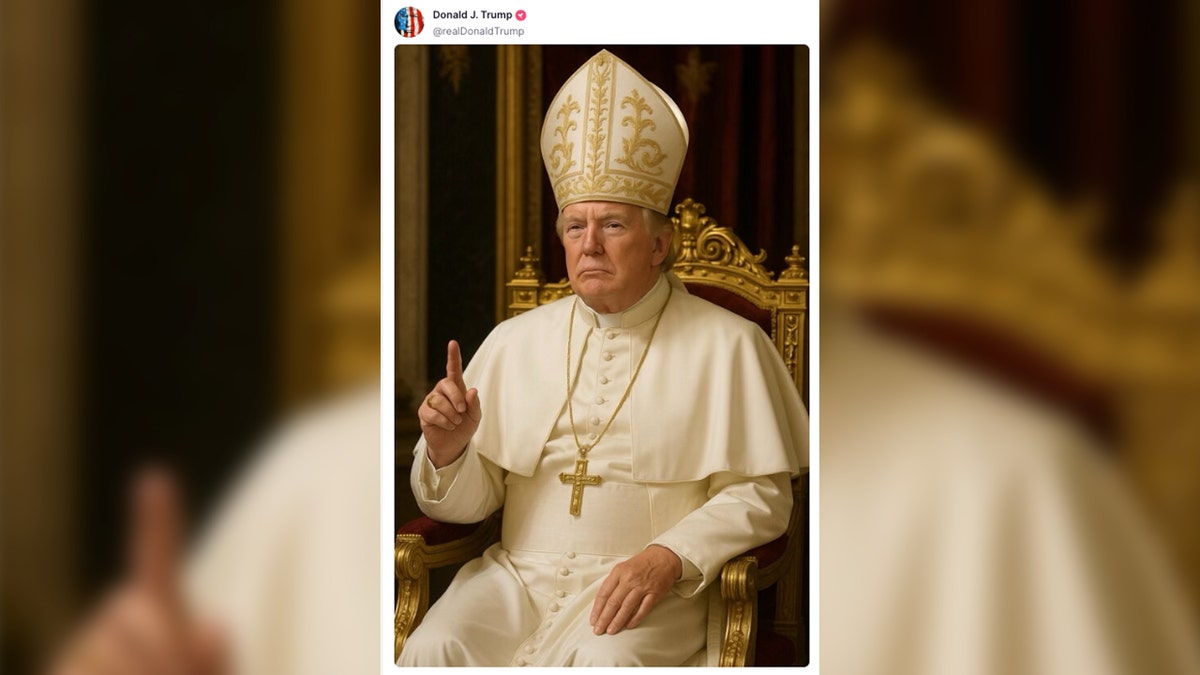
Donald Trump spent the last decade testing the structural integrity of American political norms, but his latest social media maneuver suggests he may have finally found a ceiling. On Sunday evening, the president shared an AI-generated image on Truth Social that depicted him in the role of a messianic healer, draped in a white robe and red sash, laying hands on a sick man while divine light radiated from his fingertips. By Monday morning, the post was gone.
The deletion followed a swift and unusually sharp backlash from within his own fortress of support. Unlike past controversies that pitted the president against secular liberals, this outcry was led by influential voices on the religious right—commentators and activists who typically view Trump as a flawed but divinely appointed vessel. This time, the imagery crossed a line from political theater into what several prominent supporters called "gross blasphemy."
The incident was not an isolated aesthetic choice. It occurred during an escalating public feud with Pope Leo XIV, the first American-born pontiff, who has been a vocal critic of the administration's military posture in the Middle East. By positioning himself as a literal savior shortly after attacking the head of the Catholic Church, Trump attempted a rhetorical gambit that his most loyal base found impossible to swallow.
The Anatomy of an Image
The deleted artwork was a dense tapestry of MAGA-era symbolism. In the foreground, Trump—rendered with the soft-focus glow of a Renaissance painting—touches the forehead of a bedridden man. In one hand, he holds a glowing orb. The background is a chaotic collage: the Statue of Liberty, bald eagles, screaming fighter jets, and fireworks.
However, the detail that reportedly sparked the most internal alarm was a subtle alteration from the original version of the image, which had been circulating in pro-Trump circles for months. In the version the president shared, a silhouette of a soldier in the background had been replaced by a winged, horned figure. To some evangelical observers, this wasn't just a kitschy tribute; it was a disturbing subversion of Christian iconography.
Former Representative Marjorie Taylor Greene, who has historically been one of Trump’s most unflinching allies, was among the first to signal the retreat. She described the post as projecting an "Antichrist spirit." When the "fire-breathing" wing of the GOP starts using the language of spiritual warfare against its own leader, the political calculus changes.
The War with the Vatican
To understand why Trump felt the need to post the image, one must look at the timeline of his Sunday night activity. Hours before the "healing" photo appeared, the president unleashed a 334-word tirade against Pope Leo XIV.
The Pope has spent recent weeks urging the White House to find an "off-ramp" in the ongoing conflict with Iran, suggesting that a "delusion of omnipotence" was clouding American foreign policy. Trump responded by calling the pontiff "WEAK on crime" and "terrible for foreign policy," even claiming that the Church only elevated Leo to the papacy as a strategic counter-move against his administration.
The messianic post was likely intended as a visual clapback—an assertion of spiritual authority intended to bypass the Vatican and speak directly to a base that views Trump as the ultimate protector of Western Christendom. Instead, it highlighted a growing rift. The American Catholic vote was instrumental in Trump’s 2024 victory. By attacking a popular, American-born Pope and then immediately donning the robes of Christ, Trump may have overplayed his hand with a demographic that values institutional piety over personal cults of personality.
The Doctor Defense
When confronted by reporters on Monday at Joint Base Andrews, the president’s defense was uncharacteristically literal. He denied that the image was a depiction of Jesus, claiming instead that it was a portrait of himself as a "doctor" making people better.
"I do make people better," Trump insisted. "I make people a lot better."
This pivot reflects a familiar survival strategy: reframe a controversial action as a practical service. But the "doctor" explanation falls flat when viewed against the actual aesthetic of the post. The use of a red shawl, the specific hand placement of the Christus Medicus (Christ the Physician) tradition, and the radiant aura are unmistakable religious signifiers.
For the religious right, the issue isn't that Trump sees himself as a healer; it’s that he has stopped using the Bible as a political prop and started trying to rewrite it with himself in the lead role.
The Institutional Breaking Point
Political analysts have long wondered what it would take for the evangelical and Catholic wings of the GOP to distance themselves from Trump. Previous scandals involving personal conduct were dismissed as the "broken vessel" narrative—the idea that God uses imperfect men to achieve holy ends.
But this "healer" image represents a different category of transgression. It moves from policy-based alignment to theological competition. By suggesting he is the source of the "healing light" rather than a mere instrument of it, Trump is challenging the very hierarchy his supporters hold sacred.
The deletion of the post is a rare admission of a tactical error. It shows that even in an era of polarized, "post-truth" politics, there are still certain cultural guardrails that cannot be bulldozed. The religious right is willing to fight for a Caesar, but they aren't quite ready to worship one.
The fallout suggests that the administration may need to recalibrate its approach to the Vatican and its own religious base. As the conflict in the Middle East deepens and domestic tensions rise, the president cannot afford a multi-front war that includes his own pews. If he continues to frame his political struggles as a literal passion play, he risks turning his most devoted followers into his most formidable critics.