The water was still, a dark mirror reflecting the bruised purple of an English twilight. It should have been a scene of absolute carnage. In any textbook, in any nature documentary voiced by a somber narrator, this is the moment where the shadow in the reeds becomes a blur of orange fur and snapping teeth. A fox stands on the bank, eyes locked on the rhythmic paddling of a mallard. The duck is dinner. The fox is the reaper.
But at a small pond in the heart of a quiet village, the script broke.
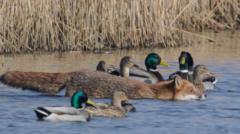
Witnesses didn't see a hunt. They saw a swimmer. The fox didn't creep; it slid into the water with the practiced ease of a golden retriever. It didn't lunge; it paddled. Within moments, the predator was surrounded by a fleet of mallards and several heavy-set geese. Any one of those birds should have been frantically beating their wings against the surface to escape. Instead, they just drifted. They watched the fox. The fox watched the sky. They moved together in a strange, silent flotilla, a multi-species peace treaty signed in the ripples of a stagnant pond.
We are used to the world having rules. Gravity pulls down. Fire burns. Foxes eat ducks. When those rules vanish, we feel a collective shiver of unease mixed with wonder. It forces us to ask if we actually understand the "wild" at all, or if we have simply projected our own violent tendencies onto the creatures living in our backyards.
The Myth of the Eternal Hunger
We have spent centuries painting the red fox as a villain of Shakespearean proportions. To the farmer, he is the thief in the night. To the folklorist, he is Reynard, the trickster who outsmarts the proud and devours the weak. We have built an entire cultural identity around the idea that the fox is defined by its appetite.
Biology tells a more nuanced story, though one rarely told. A fox is an opportunist. It isn't a mindless killing machine. It is a creature of high intelligence, deep social bonds, and—most importantly—profound laziness. If a fox is well-fed, if its belly is heavy with the spoils of a nearby garden or a surplus of rodents, the fire of the hunt simply goes out.
The village pond fox is a living testament to that biological luxury. This animal wasn't swimming with ducks because it was "friends" with them in the way we imagine a Disney movie. This was something far more surreal. It was a mutual recognition of non-threat. The ducks, creatures of high-alert instinct, watched the fox's body language. They didn't see the tensed muscles of a pounce. They didn't see the dilated pupils of a predator. They saw a fellow traveler, a hot animal in a cool pond, and they gave him his space.
But there’s a deeper, more unsettling layer to this.
Why the Rules Broke
Consider the shift in our shared environments. We have pushed the wild into the cracks of our suburbs. We have turned our gardens into sanctuaries and our parks into buffet lines. In doing so, we have inadvertently started a massive, unplanned evolutionary experiment.
The urban fox is a different animal than its forest-dwelling ancestors. It hears sirens and doesn't flinch. It walks past human beings on the sidewalk as if we were just particularly slow-moving trees. When food is plentiful—when the bins are overflowing and the kind elderly neighbor is putting out bowls of cat food—the fundamental drive of the fox changes.
The "kill or be killed" narrative begins to erode.
When we see a fox swimming among geese without a single feather being ruffled, we are looking at the end of a million-year-old conflict. It’s a peace treaty bought with human calories. The fox has been de-radicalized. It has moved from the edge of starvation into the comfortable middle class of the animal kingdom.
The Invisible Stakes of a Gentle Fox
There is a cost to this peace. It’s a cost we rarely talk about because it feels so good to watch a fox play with a duckling. We want the world to be kind. We want the lion to lie down with the lamb. But nature isn't built for kindness; it’s built for balance.
When the fox stops hunting, the geese multiply. The pond becomes crowded. The water turns sour with excess nutrients. The delicate cycle of life and death, which has ground on for eons, starts to stutter and stall. The fox’s swimming lessons aren't just a charming anecdote for the local paper. They are a symptom of a world that is losing its edge.
I remember watching a similar scene years ago. It wasn't a fox, but a stray cat that lived in a park near my apartment. The cat had been so thoroughly pampered by the neighborhood that it had lost the ability to even recognize a pigeon as prey. One afternoon, a pigeon landed directly on the cat’s back while it was sleeping. The cat didn't wake up. The pigeon didn't fly away.
It was beautiful. It was peaceful. It was also profoundly wrong.
A Mirror for Ourselves
We love stories of the fox and the ducks because we want to believe that our own nature is malleable. If a fox can choose not to kill, perhaps we can choose to be better. We project our own aspirations for peace onto a red-furred predator that is simply enjoying a bath.
But there is a danger in this projection. By turning the fox into a human-like neighbor, we strip it of its dignity as a wild thing. We make it an extension of our own domesticity. The swimming fox is a creature that has been subtly broken by our presence. It is a wolf that has forgotten how to howl.
The "human element" in this story isn't the people who took the photographs. It’s the invisible hand that we have laid across the natural world. We have changed the temperature of the water. We have changed the stakes of the game. Now, the players are just floating, waiting for the next meal that they didn't have to fight for.
The fox finishes its swim. It shakes itself dry on the bank, a spray of diamonds flying off its coat in the dying light. The ducks watch him go, their necks craned in curiosity. For a brief moment, the world was still. The predator walked away from the prey, and the prey didn't even blink.
It feels like progress. It looks like a miracle. But if you listen closely to the silence left behind, you might realize it’s actually a eulogy for a wildness we are slowly, politely, killing.
The fox disappears into the shadows of the hedges. The ducks turn back to the center of the pond. The water closes over the ripples, erasing the path they shared. It’s just a pond again. But the rules have shifted, and nobody knows what the new ones are yet.