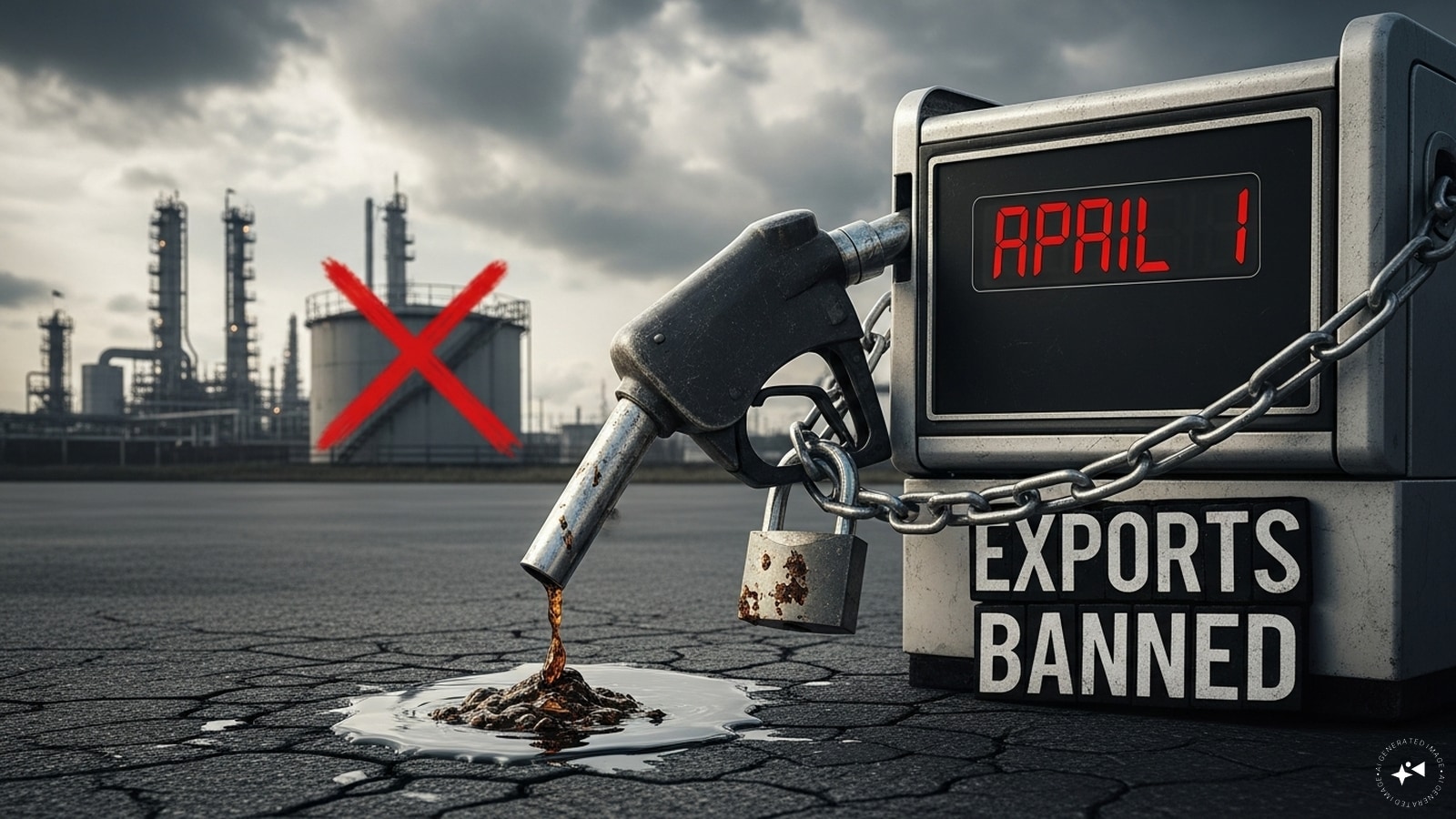
The headlines are screaming about a supply crunch. They want you to believe that Russia—one of the world's energy titans—is suddenly gasping for air because of a few drone strikes and some "seasonal maintenance." The narrative is simple: Russia is desperate, the refineries are crumbling, and the export ban starting April 1 is a white flag of surrender to internal inflation.
It’s a neat story. It’s also completely wrong.
If you’re looking at the gasoline export ban as a sign of weakness, you’re playing the wrong game. This isn't a panic move. It’s a sophisticated calibration of a war economy that has realized it doesn't need Western markets to maintain its internal stability. The "lazy consensus" among energy analysts is that Russia is being forced into this corner. In reality, they are choosing the corner and decorating it.
The Myth of the Vulnerable Refinery
The prevailing argument suggests that Ukrainian drone strikes on facilities like Nizhny Novgorod (Norsi) have crippled Russia's ability to process fuel. People see smoke and assume the engine is dead.
I have spent years watching how state-controlled energy entities respond to physical disruption. They don't react like private corporations. A private firm in the West sees a refinery fire and worries about Q3 dividends. A state-controlled entity in a wartime posture sees a refinery fire and moves the decimal point on its export quotas.
Russia produces roughly 10% of global refining capacity. Even with the recent strikes, we are talking about a temporary loss of maybe 400,000 to 600,000 barrels per day of refining throughput. In a vacuum, that sounds high. In the context of a country that pumps nearly 10 million barrels of crude daily, it’s a rounding error.
The ban isn't because they can't produce enough; it’s because they refuse to let the global market dictate the price at their local pumps. By cutting off exports, Moscow is effectively subsidizing its domestic population and its military logistics chain at the expense of international buyers. They are choosing social stability over foreign currency reserves. That isn’t a crisis—it’s a strategy.
Why the Market Misreads "Price Jumps"
The media points to the 20% rise in wholesale gasoline prices on the St. Petersburg International Mercantile Exchange (SPIMEX) as evidence of a system in freefall.
Let’s dismantle that.
Wholesale prices in a managed economy are a political signal, not a pure market reflection. The Kremlin uses these "jumps" as a justification to hammer the oligarchs and the oil majors (the "Vertical Integrated Oil Companies" or VIOCs). By banning exports, the government forces these companies to dump their product onto the domestic market.
What happens when you flood a domestic market with supply that was intended for Europe or the Global South? Prices collapse. The "jump" is the pretext for the intervention. It’s a classic squeeze. The state wins, the consumer stays quiet, and the oil majors eat the loss.
If you think this is a sign of a failing economy, you’ve never seen how a command-and-control system actually functions. They aren't trying to satisfy shareholders; they are trying to keep a tank fueled for less than the price of a loaf of bread.
The Refinery Maintenance "Coincidence"
The timing of this ban—running from April through the end of the summer—is being framed as a desperate response to technical failures.
Look at the calendar.
Russia enters its peak agricultural demand season in the spring. Sowing season requires massive amounts of diesel and gasoline. Simultaneously, the "driving season" begins. Any savvy energy minister knows that if prices spike while farmers are trying to plant crops, you have a political nightmare on your hands.
The maintenance at refineries isn't an "accident" caused by lack of western parts. Is it harder to get Honeywell or Siemens components? Sure. But China and India have spent the last 24 months becoming the world's most efficient middlemen for industrial hardware. I’ve seen warehouses in Dubai and Istanbul packed with "prohibited" Western tech waiting for a flight to Moscow. The "parts shortage" narrative is a feel-good story for Western sanctions hawks that doesn't hold up in the greasy reality of the black market.
The EAEU Loophole: The Ban That Isn't
The most glaring omission in the mainstream reporting is the list of exceptions. The ban doesn't apply to:
- Member states of the Eurasian Economic Union (EAEU).
- Mongolia.
- Uzbekistan.
- South Ossetia and Abkhazia.
This isn't a total withdrawal from the world stage. It’s a pivot. Russia is securing its sphere of influence. By exempting Belarus, Kazakhstan, Kyrgyzstan, and Armenia, Moscow is using fuel as a leash. "Stay with us, and your pumps stay full."
If Russia were truly "out of gas," they wouldn't be honoring supply agreements with their neighbors. They are redirecting the flow to where it buys the most political capital. The West gets the cold shoulder; the "Near Abroad" gets the fuel.
The Hidden Logic of Crude vs. Product
There is a fundamental misunderstanding of the relationship between crude oil exports and refined product exports.
When Russia stops exporting gasoline, they don't necessarily stop pumping crude. If they can’t refine it because of "maintenance" or strikes, they simply export the raw crude. To the global market, this is actually bearish for crude prices because it increases the supply of raw feedstock.
The irony? By banning gasoline exports, Russia might actually help lower the global price of crude oil, which in turn makes it cheaper for them to buy back whatever specialized chemicals or additives they need through third parties. It’s a feedback loop that the "Russia is collapsing" crowd refuses to acknowledge.
Stop Asking if the Ban Will Work
The question I see everywhere is: "Will the ban be enough to stabilize prices?"
It’s the wrong question.
The right question is: "How much pain is the Kremlin willing to inflict on its own energy sector to maintain the illusion of a stable ruble?"
The answer is: "Infinite."
In the West, we view energy as a commodity. In Russia, it is a weapon of internal defense. When the Ministry of Energy mandates a 16% minimum of produced diesel be sold on the domestic exchange, they aren't "fostering" a market. They are requisitioning supply.
The ban is a blunt instrument. It will cause localized gluts. It will lead to some refineries running at suboptimal levels. It might even lead to a temporary dip in tax revenue from export duties. But none of that matters compared to the optics of a gas station in Moscow having a "No Fuel" sign. That is the only metric that matters to the security apparatus.
The Opportunity You’re Missing
While the world watches the Russian gasoline ban, they are ignoring the real shift: the permanent decoupling of the Russian refining complex from Western standards.
Every day this ban stays in place, Russian engineers are forced to find workarounds for Western tech. Every day the export routes are closed, the logistical infrastructure to the East gets more "robust"—to use a word I hate, but which fits the physical hardening of pipelines.
The ban is a stress test. Russia is checking to see if it can survive as an autarkic energy island. If they can keep the lights on and the tractors moving from April to September without Western export revenue, the sanctions regime has officially lost its teeth.
The Brutal Reality of Energy Warfare
We need to stop treating these market maneuvers like they are happening in a vacuum. This isn't a supply-and-demand issue. This is a logistics-and-will issue.
The "experts" will tell you that the ban is a sign that the sanctions are finally "biting." They will point to the loss of export revenue as a victory. They are missing the forest for the trees. Revenue doesn't matter when you can print rubles to pay domestic workers and use gold or oil-for-goods swaps to pay for everything else.
The export ban is a fortification. Russia is pulling its resources behind the castle walls for the summer. They are betting that the global market will feel the pinch of missing Russian molecules more than Russia will feel the pinch of missing Euro notes.
Given the fragility of the global energy balance, they might be right.
Don't wait for the "return to normal" in the Russian energy sector. The April 1 ban isn't a temporary fix; it’s a preview of a future where Russian fuel is a regional tool, not a global commodity. If you’re still holding onto the idea that Russia needs our markets more than we need their stability, you’re about to get run over by a T-90 that has plenty of gas in the tank.