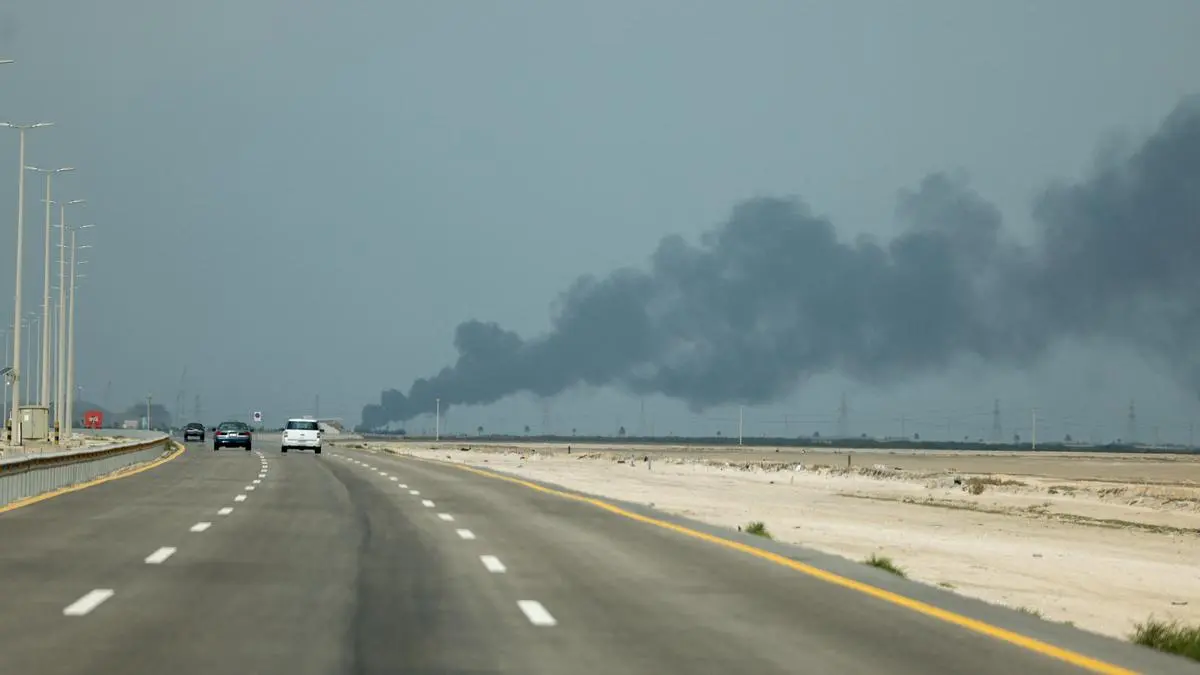
The recent targeting of the Saudi Aramco Mobil Refinery Company (SAMREF) in Yanbu serves as a blunt reminder that the world’s energy supply is only as secure as the perimeter fencing of its most critical nodes. For decades, the Yanbu industrial corridor has functioned as the quiet powerhouse of the Red Sea, a strategic counterweight to the often-volatile Arabian Gulf. However, when a facility of this magnitude—a 400,000 barrel-per-day joint venture between the world’s largest oil exporter and an American supermajor—comes under fire, it isn't just a local security breach. It is a direct hit to the stability of global fuel markets.
SAMREF is not just another refinery. It produces high-quality gasoline and jet fuel that feeds both the domestic Saudi market and international shipping lanes. An interruption here ripples through supply chains, affecting everything from logistics costs in Europe to pump prices in North America. The immediate question isn't whether the fire was extinguished or if production resumed within hours; the question is how deep the structural vulnerabilities run in an era where low-cost, high-impact technology can bypass multi-billion dollar defense systems.
The Strategic Weight of the Red Sea Corridor
Saudi Arabia has spent years pivoting its export strategy toward the west coast. The goal was simple: bypass the Strait of Hormuz. By moving massive volumes of crude and refined products through the East-West Pipeline to Yanbu, the Kingdom aimed to insulate its economy from Iranian threats and regional skirmishes in the Gulf. This strategy turned Yanbu from a sleepy port into a massive industrial complex.
But geographic diversification creates its own set of headaches. Moving the target doesn’t remove the target. The Red Sea is no longer a safe haven. With the rise of sophisticated drone technology and long-range ballistic capabilities among non-state actors and regional proxies, the "back door" of the Kingdom is now wide open. Security analysts who have watched this space for thirty years see a recurring pattern: as soon as a region is deemed a "safe" alternative, the threat profile shifts to meet it.
The High Cost of the Joint Venture Model
When ExxonMobil and Aramco shook hands on SAMREF, the partnership was built on a foundation of shared risk and shared expertise. Exxon brought technical sophistication and global marketing reach; Aramco provided the feedstock and the sovereign backing. This model has been the gold standard for decades, but it creates a unique political bullseye.
Attacking a joint venture isn't just an act of aggression against a nation-state. It is an attack on Western capital and corporate interests. For the perpetrators, this is a force multiplier. They aren't just rattling Riyadh’s cage; they are signaling to Wall Street and Houston that no investment is truly protected. The insurance premiums for these facilities reflect this reality. Every time a siren goes off in Yanbu, the "war risk" add-on for shipping and industrial operations in the region ticks upward, eventually squeezing the margins of the very companies the Kingdom seeks to attract.
Beyond the Physical Perimeter
Industrial security used to be about gates, guards, and guns. That world is dead. Today, the threat to a refinery like SAMREF is multi-dimensional. We are looking at a convergence of kinetic strikes—drones and missiles—and the ever-present shadow of cyber warfare.
Refineries are complex ecosystems of Industrial Control Systems (ICS) and Supervisory Control and Data Acquisition (SCADA) networks. While a physical strike causes visible fire and smoke, a sophisticated digital intrusion can shut down a hydrocracker or a distillation unit without a single explosion. The real nightmare for operators isn't a hole in a storage tank; it's a silent line of code that overrides safety protocols. If a physical attack is coordinated with a digital one, the ability to respond is paralyzed.
The industry often talks about "resilience," but true resilience is expensive. It requires redundant systems, air-gapped networks, and a workforce that can operate manually when the screens go dark. In a push for efficiency and "smart" manufacturing, many of these manual fail-safes have been phased out.
The Drone Dilemma
We have entered an era of "democratized" warfare. A drone costing less than a mid-sized sedan can disable a facility worth billions. This cost-to-damage ratio is skewed heavily in favor of the attacker. Saudi Arabia has invested heavily in Patriot missile batteries and other advanced theater defenses, but these are designed to intercept high-altitude ballistic threats. They are often overkill—and ineffective—against a swarm of low-flying, slow-moving "suicide" drones that hug the terrain and blend into the radar clutter of an industrial skyline.
Market Psychology and the Premium of Fear
Oil markets are notoriously skittish. Traders don't just price in current supply and demand; they price in the perception of future risk. When news of an incident at Yanbu hits the wires, the immediate reaction is a "fear premium" on Brent and WTI.
Even if the damage is superficial, the psychological impact persists. It reinforces the narrative that the global energy heartland is under constant siege. This volatility is bad for long-term planning. Refiners need stable prices to manage their crack spreads—the difference between the price of crude oil and the products extracted from it. When geopolitical shocks jump the price of crude, refiners like SAMREF can find themselves in a pinch, unable to pass the costs onto consumers quickly enough, leading to "margin squeeze."
The Myth of Energy Independence
Events in Yanbu shatter the illusion that any region can truly be energy independent. The global market is a bathtub; if you pull the plug in one corner, the water level drops everywhere. The U.S. might be a net exporter of certain grades of crude, but it remains a massive importer of others, and it is deeply tied to the global price.
If SAMREF’s output of specialized fuels is curtailed, the gap must be filled by refineries in Singapore, South Korea, or the U.S. Gulf Coast. This shifts tanker routes, raises freight rates, and creates bottlenecks elsewhere. The interconnectedness of the 21st-century energy economy means that a fire in a Saudi port is, for all intents and purposes, a fire in the global engine room.
Critical Vulnerabilities in Aging Infrastructure
While SAMREF has seen significant upgrades, the core of many major refineries dates back several decades. This presents a specific set of challenges:
- Integration Pains: Layering modern digital sensors over 1980s-era mechanical systems creates "seams" that attackers can exploit.
- Physical Footprint: These sites are massive. Patrolling tens of kilometers of fencing with traditional methods is a losing game.
- Concentration of Risk: Putting 400,000 barrels of processing capacity in one location makes it an efficient target. A single successful hit on a "long-lead-time" component, like a custom-built reactor vessel, can take a plant offline for eighteen months.
Moving Toward a New Security Doctrine
The response to the Yanbu incident cannot simply be more of the same. More anti-aircraft guns won't solve the problem of a localized, asymmetrical threat. Instead, the industry needs to rethink the very architecture of energy hubs.
This might mean moving toward modularity—smaller, distributed refining units that don't offer a single point of failure. It definitely means a massive shift in how public-private partnerships handle intelligence. Currently, there is often a lag between government-detected threats and private-sector implementation of defenses. That gap is where the damage happens.
The "Yanbu wake-up call" is an opportunity to stress-test the entire Red Sea strategy. If the Kingdom cannot guarantee the safety of its west coast facilities, the entire economic logic of Vision 2030—which relies on these industrial cities to drive non-oil growth and manufacturing—comes into question. You cannot build a world-class manufacturing hub on a foundation of insecure energy.
The Reality of Asymmetrical Warfare
The attackers know they don't have to "win" a war. They only have to make the cost of doing business unbearable. By targeting SAMREF, they are hitting the point where the Saudi state meets global capital. It is a surgical strike on the Kingdom’s credibility as a reliable supplier.
The era of "set and forget" security for energy infrastructure is over. Every refinery, every pipeline, and every pumping station is now a front line. The industry's ability to adapt to this reality—not through platitudes about safety, but through hard-nosed engineering and intelligence integration—will determine the price of fuel for the next decade.
Investors and analysts must look past the immediate "all clear" signals and investigate the long-term hardening of these assets. The next incident won't necessarily be a carbon copy of the last. It will target the gaps left by the previous response. Staying ahead requires a level of cynical, preemptive thinking that many corporate boards are still struggling to adopt.
Stop looking at the fire. Start looking at the system that allowed the spark. Would you like me to analyze the specific insurance implications for Red Sea shipping in the wake of these persistent industrial security breaches?