The tea in the plastic cup is the color of rust and far too sweet. It is the only thing currently warm in this corner of the Zagros Mountains. Outside the cinderblock walls of the base, the wind howls through the scrub brush, a low, mourning sound that the men here have learned to ignore. They don’t listen to the wind anymore. They listen for the buzz.
It is a sound like a hornet, or perhaps a lawnmower in a distant yard. But in the borderlands of Iraqi Kurdistan, that sound is a precursor to fire. It is the signature of an Iranian drone, a loitering munition that can hover for hours, watching, waiting for a door to open or a group to gather for a meal.
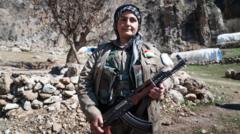
Rizgar, whose name has been changed for the safety of the family he left behind in Sanandaj, rests his Kalashnikov against a stack of sandbags. He is thirty-two, but his face is a map of deep-set lines and sun-beaten skin. He isn't a soldier in a traditional army. He is a member of a Kurdish opposition group, living in an exile that feels more like a cage.
For decades, the story of the Iranian Kurds has been one of mountains and persistence. They are a people without a state, caught between the jagged geography of four different nations. But the nature of their struggle has shifted. The mountains, once their greatest allies, no longer offer a ceiling. The sky is open. The sky is occupied.
The Invisible Perimeter
War used to be a matter of territory. You held a hill, you guarded a pass, you knew where the enemy stood because you could see their campfire or hear their trucks. Modern asymmetric warfare has deleted those boundaries.
The Iranian regime has turned the border into a laboratory for remote suppression. They don’t need to send battalions across the line to neutralize the dissidents they fear. They simply send a Shahed. These drones are cheap to produce and devastatingly effective. They represent a democratization of air power that has stripped away the last remnants of sanctuary for exiled groups.
Consider the physics of fear. When a jet flies overhead, it is a sudden, thunderous event. It passes. When a drone circles, it creates a psychological weight that never lifts. It is a persistent surveillance that turns every daily necessity—hanging laundry, fetching water, walking to a communal kitchen—into a potential death sentence.
Rizgar describes it as living under a glass roof. You can see the sun, but you know there is a lens somewhere, focusing that light into a laser that can guide a missile directly into your living room.
In late 2022, this isn't a metaphor. It is history. Tehran launched waves of missile and drone strikes against these camps, claiming they were the "engine" behind the domestic protests sparked by the death of Mahsa Amini. The reality on the ground was far more visceral. Schools were hit. Residential areas were leveled. The exiles, who thought they had found a thin sliver of safety in Iraq, realized the border was an imaginary line that provided no protection against a digital eye.
The Logistics of Exile
Behind the political rhetoric of "regime change" and "liberation" lies a gritty, exhausting reality. Life in these camps is a slow grind of waiting. Most of the people here aren't active combatants in the sense of engaging in daily firefights. They are families. They are teachers, mechanics, and students who fled across the mountains because their existence in Iran had become untenable.
The camp economy is built on grit. Money is scarce. Resources are smuggled or donated. And now, everything must be camouflaged.
The Iranian government views these outposts as "terrorist nests." The Kurds view them as the last embers of a culture being systematically snuffed out. To bridge this gap in understanding, one must look at the data of displacement. There are tens of thousands of Iranian Kurds living in the Kurdistan Region of Iraq (KRI). They are a population in limbo, caught between a host government in Erbil that is under immense pressure from Baghdad and Tehran to disarm them, and a homeland that wants them silenced.
Pressure is a physical force here. It comes from the drones above, but it also comes from the diplomatic offices in Baghdad. Treaties are signed. Security pacts are drafted. The Iranian government demands that these groups be moved further from the border, stripped of their weapons, and placed into "refugee-like" camps where they can be monitored more easily.
The Ghost in the Machine
We often talk about technology as a tool for progress, but for the dissident, technology is a snitch.
The drones are only half the story. The other half is the digital footprint. In the camps, phones are both a lifeline and a liability. To call a mother back in Mahabad is to potentially hand the Iranian intelligence services a GPS coordinate. Every byte of data is a breadcrumb.
Rizgar shows me his phone. It’s an old model, the screen spider-webbed with cracks. He uses it sparingly. He knows that the Iranian Revolutionary Guard Corps (IRGC) has sophisticated signals intelligence capabilities. They can intercept signals, track movement patterns, and build a digital twin of the camp’s life.
This is the hidden cost of the modern surveillance state. It forces a human being to become a ghost. To survive, you must stop behaving like a person and start behaving like a target that doesn't want to be hit. You stop following routines. You sleep in different places. You learn to read the weather not for rain, but for cloud cover that might obscure an infrared lens.
The Weight of the Wait
The most agonizing part of this existence isn't the threat of the drone. It’s the uncertainty of the purpose.
The "Woman, Life, Freedom" movement ignited a spark of hope that many thought would burn the old structures down. From the mountains, the exiles watched their cousins and sisters take to the streets. They waited for the call to return. They waited for the moment when the border would finally open.
It didn't happen.
Instead, the regime cracked down with a cold, calculated efficiency. The protests were met with bullets, and the camps were met with drones. Now, the atmosphere is one of a slow, simmering frustration.
"We are waiting for a revolution that is happening without us," Rizgar says. He rubs a thumb over the wooden stock of his rifle. "And we are waiting for a strike that could come while we sleep. It is a strange way to spend a life."
There is a deep irony in the way the international community views this conflict. On paper, it is a matter of regional stability and territorial integrity. In the news, it is a footnote in the larger geopolitical struggle between Iran and the West. But for the person sitting on a plastic chair in a mountain outpost, it is an existential crisis.
If they stay, they are targets. If they move further into Iraq, they lose their connection to their land. If they disarm, they lose their only leverage and their sense of identity as a resistance movement. They are being squeezed by forces that operate on a scale far beyond their control—satellite imagery, international treaties, and the cold logic of regional hegemony.
The Sound of Silence
Silence in the Zagros is never truly silent. There is always the hum of the earth, the rustle of the wind, and the heartbeat of a man who hasn't seen his home in a decade.
But there is a specific kind of silence that falls over the camp when the "hornet" is heard. Conversation dies. People move toward the shadows. Eyes turn upward, squinting against the glare of the sun, searching for a speck of white or silver that shouldn't be there.
It is a moment of pure, unadulterated vulnerability. In that second, all the political theories and historical grievances vanish. There is only the hunter and the hunted.
The world moves on. The headlines shift to other wars, other drones, other tragedies. But in the mountains, the cup of tea goes cold. Rizgar stands up and adjusts his vest. He looks at the horizon, where the peaks of Iran are visible through the haze. They are so close he could walk there in a day. They are so far they might as well be on another planet.
He walks back toward the bunker, his boots crunching on the dry earth. He doesn't look up again. He has decided that if the sky is going to take him, he would rather be walking toward the door than cowering under a roof.
The sun begins to dip behind the ridges, casting long, skeletal shadows across the valley. For a few hours, the infrared cameras will struggle with the cooling earth. For a few hours, there is a reprieve. But the batteries will recharge, the operators will switch shifts in a command center hundreds of miles away, and the eyes in the sky will open again, searching for a flicker of life in the dark.
The drone doesn't care about the history of the Kurds. It doesn't care about the poetry of the mountains or the sweetness of the tea. It only cares about the heat signature of a human heart, beating in a place it isn't supposed to be.