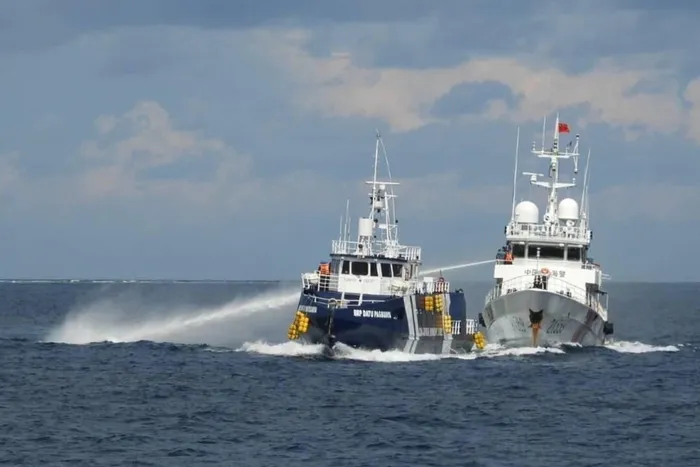
China’s recent combat patrols near the Scarborough Shoal mark a aggressive pivot from mere presence to active psychological warfare. While Beijing’s official channels frame these maneuvers as a defensive reaction to Philippine "provocations," the reality on the water reveals a calculated effort to normalize military dominance in contested spaces. By accusing Manila of disturbing regional peace, China is employing a classic "gray zone" tactic: projecting its own expansionist actions onto the smaller nation attempting to defend its sovereign rights. This isn’t just a border dispute. It is a systematic dismantling of the international maritime order.
The tension centers on the South China Sea, a waterway that carries trillions of dollars in global trade and sits atop massive untapped energy reserves. China claims nearly the entire sea via its "nine-dash line," a demarcation that an international tribunal in The Hague ruled had no legal basis in 2016. Beijing ignored that ruling. Since then, it has transformed reefs into unsinkable aircraft carriers and used its massive Coast Guard to bully Filipino fishermen and resupply missions.
The Mechanics of Accusation as Strategy
Beijing’s rhetoric follows a predictable, highly effective pattern. When the Philippines conducts joint exercises with allies like the United States or Australia, China immediately launches "combat patrols" in the same vicinity. The state-run media then floods the airwaves with narratives of a "disrupted peace."
This reversal of roles serves two purposes. First, it provides a veneer of legitimacy to domestic audiences within China, portraying the People’s Liberation Army (PLA) as a stabilizing force against Western-backed interference. Second, it attempts to exhaust the diplomatic resolve of the Philippines. By framing every Philippine move as a "disturbance," Beijing seeks to make the cost of defending sovereignty so high that Manila eventually calculates that submission is the only path to stability.
The "peace" Beijing refers to is a state of quietude where no one challenges Chinese hegemony. In this world view, any assertion of international law by a smaller neighbor is, by definition, an act of aggression.
The Scarborough Shoal Flashpoint
Scarborough Shoal, known as Panatag Shoal in Manila, is a triangular chain of reefs and rocks with a rich fishing lagoon. It was seized by China in 2012 after a tense standoff. Since then, Chinese vessels have maintained a constant presence, frequently using water cannons and dangerous maneuvers to block Filipino access.
The latest patrols aren't just about ships in the water. They are about sovereignty projection. By conducting high-readiness combat drills in these waters, China signals that it considers the area its internal territory. The message to the Marcos administration is clear: The more you lean on your Mutual Defense Treaty with the U.S., the harder we will squeeze your maritime borders.
Why the Philippines Changed Its Tune
Under the previous Duterte administration, the Philippines largely tried to appease China in exchange for promised infrastructure investment. That investment mostly failed to materialize. When Ferdinand Marcos Jr. took office, he shifted the strategy toward "radical transparency."
Manila began embedding journalists on resupply missions to the BRP Sierra Madre—a rusted WWII-era ship grounded on Second Thomas Shoal to serve as a military outpost. For the first time, the world saw high-definition footage of Chinese ships ramming wooden supply boats and blasting them with high-pressure water cannons.
This transparency has humiliated Beijing. It stripped away the "peaceful rise" narrative and forced the Chinese government to lean harder into the "Philippine provocation" storyline. If you cannot hide your bullying, you must convince the world that the victim deserved it.
The Limits of US Intervention
The United States has repeatedly affirmed that its Mutual Defense Treaty (MDT) with the Philippines covers armed attacks in the South China Sea. However, China is careful to stay just below the threshold of an "armed attack."
- Water Cannons: These damage ships and injure sailors but are technically "non-lethal" equipment.
- Acoustic Devices: Used to disorient Filipino crews without firing a shot.
- Maritime Militia: Thousands of "fishing boats" that are actually state-funded paramilitary units used to swarm and block paths.
The U.S. finds itself in a difficult position. If it intervenes too aggressively against these gray-zone tactics, it risks escalating to a total war. If it does nothing, the MDT looks like a paper tiger, and China wins by default.
The Economic Shadow Over the Sea
Beyond the flags and the cannons lies a more cynical driver: Resource Scarcity. The South China Sea contains an estimated 11 billion barrels of oil and 190 trillion cubic feet of natural gas. For a China facing economic headwinds and a massive energy appetite, controlling these fields is a matter of national survival.
The Philippines, meanwhile, is facing a looming energy crisis as its main gas field, Malampaya, nears depletion. Manila needs to explore the waters within its Exclusive Economic Zone (EEZ) to secure its future. China’s "patrols" are a physical barrier to that exploration. Every time a Philippine seismic survey ship tries to head out, it is met by a wall of Chinese steel.
This isn't just about fish; it's about who fuels the next century of Asian growth.
Logistics of the Gray Zone
To understand how China maintains this pressure, one must look at the "Great Wall of Sand." Over the last decade, China has built over 3,000 acres of artificial land across the Spratly Islands. These bases feature:
- Runways: Capable of handling fighter jets and heavy bombers.
- Sensor Arrays: Providing total situational awareness of every ship and plane in the region.
- Missile Batteries: Making it incredibly risky for foreign navies to operate nearby during a conflict.
These bases allow Chinese ships to stay "on station" for months at a time, whereas Philippine ships must return to the mainland for fuel and supplies. This is a war of attrition, and China has the bigger engine.
A Regional Ripple Effect
The neighbor states are watching closely. Vietnam, Malaysia, and Indonesia all have overlapping claims or interests that clash with China’s ambitions. If the Philippines successfully resists through legal and diplomatic means, it creates a blueprint for the rest of Southeast Asia. If the Philippines buckles under the weight of these patrols, the South China Sea effectively becomes a Chinese lake.
The Association of Southeast Asian Nations (ASEAN) remains frustratingly divided. Some members, like Cambodia and Laos, are heavily dependent on Chinese aid and frequently block any unified statement that would condemn Beijing’s actions. This lack of unity is China’s greatest asset. It allows them to deal with neighbors one-on-one, where the power imbalance is most extreme.
The Risk of Miscalculation
The greatest danger in the South China Sea today is not a planned invasion, but an accidental collision. As the density of ships in the Scarborough Shoal increases, and as tempers flare under the hot sun and high-pressure water cannons, the margin for error shrinks.
A Filipino sailor killed by a water cannon or a Chinese vessel sinking after a collision could trigger a chain of events that neither Washington nor Beijing can easily de-escalate. China’s current "combat patrols" are intentionally provocative, designed to test the nerves of young Philippine officers. They are playing a game of chicken with multi-thousand-ton ships.
The Legal Fiction of Peace
When China speaks of "regional peace," it is referring to the Code of Conduct (CoC) negotiations that have dragged on for over two decades. Beijing uses these negotiations as a stalling tactic. While diplomats argue over the wording of a non-binding treaty, the PLA builds more bases and conducts more patrols.
The Philippines has correctly identified that the CoC is a dead end as long as China refuses to acknowledge the 2016 arbitral ruling. Peace cannot be built on a foundation of ignored international law.
The current patrols are an admission of failure in the diplomatic arena. If China could convince the Philippines to stand down through words, it wouldn't need to deploy warships. The fact that the PLA is out in force suggests that Manila’s new strategy of standing its ground and filming the encounters is actually working. It has forced the bully into the open.
The next time a Chinese spokesperson blames the Philippines for "disturbing the peace," look at the map. Look at whose ships are hundreds of miles from their own coast and whose ships are in their own backyard. The disturbance isn't coming from Manila; it is the sound of an old order breaking under the weight of a new, more aggressive ambition.
Monitor the movement of the Chinese Maritime Militia tankers currently loitering near the Spratlys for the next sign of a permanent blockade.


