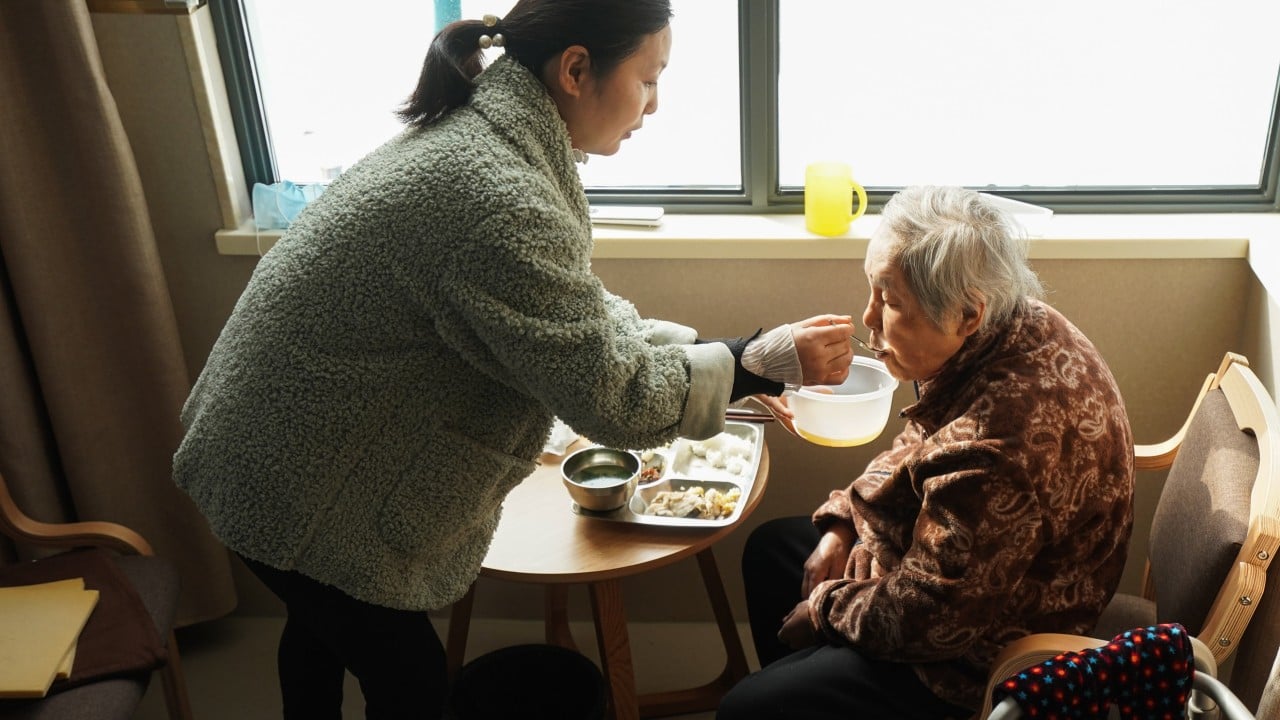
The ceramic bowl is chipped at the rim, a small, jagged reminder of a decade’s worth of breakfasts. Zhang Wei watches his father, a man who once managed a provincial textile factory with an iron grip, struggle to coordinate his chopsticks with a piece of soft-boiled bok choy. The silence in the small Beijing apartment is heavy. It isn’t the silence of peace. It is the silence of a clock ticking toward an inevitable, mathematical crisis.
For centuries, the social contract in China was written in the ink of filial piety. You grow up. You work. You carry your parents’ old age on your shoulders because they carried your childhood on theirs. It was a simple, circular logic that sustained dynasties. But the circle is breaking.
Wei is an only child. He is forty-four. He has a daughter who needs cram school fees and a wife who works ten-hour shifts at a logistics firm. He represents the "4-2-1" problem—a demographic bottleneck where four grandparents and two parents rely on a single adult child for support. There is no backup. There is no sibling to take the night shift at the hospital. There is only Wei, and he is exhausted.
The Arithmetic of Loneliness
The numbers are cold, but they tell a story of a nation graying faster than it can get rich. By 2035, an estimated 400 million people in China will be over the age of sixty. That is more than the entire population of the United States. In the past, the "silver hair" was a crown of honor. Today, for many middle-class families, it is a source of quiet, desperate anxiety.
This isn't just about money. It is about the physical impossibility of being in two places at once. When Wei’s father fell in the bathroom last Tuesday, Wei was in the middle of a performance review. He had to choose: the promotion that would pay for his daughter’s future, or the immediate safety of his father’s present. He chose his father, sprinted to the subway, and felt the crushing weight of guilt the entire way. Guilt for being late. Guilt for wanting to be at work. Guilt for the fact that, deep down, he wondered how much longer he could do this.
China’s traditional family-based care system is colliding with a modern economy that demands total mobility and grueling hours. The "996" work culture—9 a.m. to 9 p.m., six days a week—leaves no room for spoon-feeding an Alzheimer's patient or navigating the labyrinthine bureaucracy of local clinics.
The Ghost of the One-Child Policy
We often speak of the One-Child Policy as a historical footnote, a grand social experiment that ended in 2016. But for the generation currently entering middle age, it is a living ghost. It stripped away the safety net of the extended family.
Consider a hypothetical woman named Meiling in Shanghai. If she had a brother, they could split the cost of a private nursing home. If she had a sister, they could take turns staying at their mother’s bedside during a flu outbreak. Instead, Meiling is a solo pilot flying a plane with failing engines. She looks at the state-run nursing homes and sees long waiting lists. She looks at the high-end private facilities and sees a price tag that would consume her entire mortgage.
The government is trying to bridge the gap. They are pushing for "community-based care," a middle ground where seniors live at home but receive state-subsidized medical visits. It sounds perfect on paper. In reality, the resources are spread thin. The demand is a tidal wave; the current infrastructure is a sandcastle.
The Stigma of the Nursing Home
There is a word that haunts these conversations: bu xiao. Unfilial.
To put a parent in a nursing home is still viewed by many as a public admission of failure. It suggests that the child is either too poor to provide care or too heartless to want to. Wei’s father once told him, "I didn't raise you to be a stranger." That sentence carries more weight than any government mandate.
Yet, the definition of "home" is changing. In rural areas, the problem is even more acute. The young have migrated to the "megacities" for work, leaving behind "left-behind elderly." These are men and women in their seventies and eighties tending to subsistence crops, their only connection to their children being a crackling video call once a week. They are the keepers of a tradition that is dying with them.
The Commercialization of Devotion
Where the state and the family falter, the market rushes in. A new industry is blooming: "professional children."
It sounds like something out of a dystopian novel, but it is a booming reality. You can now hire someone to take your parents to the doctor, to sit with them in the park, or even to perform the ritual sweeping of ancestral graves. It is a commercialized version of filial piety. It is efficient. It is practical. It is also heartbreakingly transactional.
Wei looked into these services. He saw a brochure for a "companion" who would visit his father twice a week. The price was reasonable. The person was trained. But as he looked at his father’s shaking hands, Wei realized that his father didn’t just need someone to help him walk. He needed someone who remembered the stories he used to tell. He needed a witness to his life. No amount of yuan can purchase a shared memory.
The Breaking Point
The pressure is creating a new kind of internal migration. Some families are attempting "migratory bird" lifestyles, moving parents from cold northern provinces to the tropical south during winter to ease respiratory issues. But moving an eighty-year-old away from their social circle—the neighbors they’ve played mahjong with for forty years—often leads to a rapid decline in mental health. Loneliness is as much a killer as heart disease.
The math simply doesn't add up anymore. The labor force is shrinking. The elderly population is exploding. The pension funds are under immense strain.
Wealthy families in Tier 1 cities might buy their way out of the crisis with live-in help from provinces like Sichuan or Anhui. But those helpers are often leaving behind their own aging parents to take care of someone else’s. It is a cycle of displacement that moves the problem around without ever solving it.
The New Social Contract
Perhaps the most radical change isn't coming from a policy memo, but from a shift in the hearts of the elderly themselves. A small but growing number of seniors are starting to reject the burden they place on their children. They are looking at "fire-fly" communal living, where groups of friends move in together to support each other, sparing their children the "4-2-1" trap.
They are the pioneers of a new way of aging, one that recognizes that the old world is gone. They are trying to find dignity in independence, even if it feels like a betrayal of the past.
Wei sits back down at the table. He reaches out and gently takes the chopsticks from his father’s hand. He begins to feed him, one small bite at a time. It is a slow, methodical act of love, but Wei knows he cannot do this forever. He knows that one day, he will have to make a choice that will break his heart, no matter what he decides.
The light in the apartment dims as the sun sets over the Beijing skyline, casting long shadows across the linoleum floor. Outside, millions of other windows are lit with the same flickering glow, each one a stage for a quiet struggle between the weight of history and the reality of the present.
The chair at the head of the table is still occupied, but the legs are wobbling, and there is no one left to catch it when it finally tips.