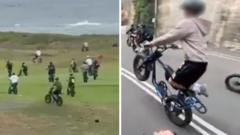
Sydney’s Northern Beaches are currently gripped by a moral panic that smells suspiciously of expensive sunscreen and unearned entitlement. If you read the local rags or listen to the talkback radio circuit, you’d think a swarm of two-wheeled locusts—the dreaded fat-tire e-bike—was systematically dismantling the social fabric of Avalon and Manly.
The narrative is predictable. Pedestrians are "terrorized." Sidewalks are "war zones." The solution? Heavy-handed regulation, police crackdowns, and a return to the quiet, stagnant status quo of 1995.
They’re wrong. Not just slightly off, but fundamentally, structurally wrong. The fatbike "menace" isn't a public safety crisis; it’s a successful disruption of the most inefficient transportation system on earth: the short-haul car trip.
The Lazy Math of the "Danger" Argument
The primary weapon used against fatbikes is the safety statistic, usually cited without context or basic physics. Critics point to the weight of these bikes—often $30kg$ to $40kg$—and their speed, typically capped at $25km/h$ by law but frequently "unlocked" by tech-savvy teens.
Let’s apply some actual logic. A standard SUV weighs roughly $2,000kg$. Kinetic energy is calculated as $E_k = \frac{1}{2}mv^2$. Even a "heavy" fatbike traveling at $30km/h$ carries a fraction of the lethal force of a distracted parent in a Land Cruiser doing the same speed in a school zone.
The outrage isn't about safety. It's about spatial hierarchy.
For decades, the wealthy beach suburbs have been designed around the car. Driveways, street parking, and arterial roads are the "natural" order. When a teenager on a fatbike zips past a line of idling Mercedes-Benzes stuck in Saturday morning surf traffic, it creates a psychological friction. The driver feels a loss of status. The pedestrian feels a loss of territory.
Instead of admitting they hate being overtaken by a fourteen-year-old with bleached hair, the locals hide behind the shield of "community safety."
Why the "Fat" Tire is Actually a Feature, Not a Bug
The very thing people mock—the oversized, 4-inch wide tires—is what makes these machines the first viable car replacement for the coastal terrain.
Standard road bikes are fragile. They require spandex, clip-in shoes, and a death wish to navigate Sydney’s potholed gutters. Mountain bikes are better, but they still demand a level of physical exertion that makes them impractical for a commute to the office or a quick run to the grocery store in 30-degree heat.
The fatbike changed the physics of the "last mile":
- Stability: The high contact patch makes them nearly impossible to slide on sandy coastal roads.
- Comfort: They act as natural suspension, allowing riders to traverse cracked pavement without needing $5,000$ worth of Fox Racing shocks.
- Utility: These are the SUVs of the bike world. They can carry surfboards, groceries, and a second passenger without folding under the pressure.
We are watching the birth of a decentralized transit network. While the government spends billions on light rail projects that take a decade to move three kilometers, the market solved the problem with $2,000$ worth of aluminum and lithium.
The Class Warfare Nobody Wants to Mention
Look at where the complaints are coming from. You don’t hear this level of vitriol in Blacktown or Campbelltown. The "havoc" is localized in the wealthiest postcodes in the country.
This is a clash between the Asset-Rich Stagnants and the Mobile Future.
The residents of the Northern Beaches have spent forty years inflating their property values by restricting development and fighting off public transport. They created a geographic fortress. The fatbike is the Trojan Horse that bypassed the gate. Suddenly, the "quiet street" isn't a private driveway anymore. It's a thoroughfare.
The irony is thick. The same people complaining about "reckless" kids on e-bikes are the ones who bought those same kids the bikes to keep them from asking for a ride to the beach. You funded the revolution because it was convenient, and now you’re upset that the revolutionaries are using the sidewalk.
The Regulatory Trap
The "lazy consensus" says we need more registration, more licenses, and more fines.
I’ve seen this play out in dozens of industries. When a legacy system is threatened by a low-cost, high-efficiency competitor, the legacy system tries to regulate the newcomer into extinction. We saw it with Uber. We saw it with Airbnb. Now we’re seeing it with micro-mobility.
Requiring registration for e-bikes is a move straight from the "How to Kill Innovation" handbook.
- Administrative Bloat: The cost of managing a registry for millions of bicycles would outweigh any revenue generated.
- Barrier to Entry: It punishes the very people who benefit most—low-income workers and students.
- The "Safety" Lie: A license plate doesn't stop a teenager from popping a wheelie. It just gives the government a way to tax the behavior after the fact.
Imagine a scenario where we applied the same "zero tolerance" logic to cars in these suburbs. If we banned every vehicle that exceeded the speed limit or parked illegally in Manly, the streets would be empty by noon. We tolerate car-related "havoc" because we’ve been conditioned to see it as the price of modern life. We refuse to grant the same grace to bikes because they don't contribute to the "car-owner" identity.
Dismantling the "Nuisance" Narrative
"They’re too quiet. I didn't hear him coming!"
This is perhaps the most absurd argument in the anti-bike arsenal. We have spent a century trying to make cities quieter. We muffled engines, built sound walls, and transitioned to electric cars—all to reduce noise pollution. Now that we have a vehicle that is virtually silent, the complaint is that it’s too quiet?
The problem isn't the volume; it's the velocity differential.
Our brains are programmed to expect objects on the sidewalk to move at $5km/h$ and objects on the road to move at $50km/h$. The fatbike blurs these lines. It moves at $25km/h$ in a space where we expect stillness.
The solution isn't to slow the bike down. It’s to redesign the space.
Sydney’s beach suburbs have some of the widest, most underutilized road verges in the world. We have space for "nature strips" that serve no purpose other than to be mowed by a petrol-powered lawnmower once a fortnight. If the community actually cared about safety, they’d be screaming for separated, protected bike lanes that take space away from parked cars.
But they won't. Because taking away a parking spot is a greater sin in Sydney than a dozen sidewalk collisions.
The Real Danger: Hyper-Regulation
If the "ban-it-all" crowd wins, we don't just lose a trendy bike. We lose the only viable alternative to the car-dependent death spiral of our coastal cities.
The fatbike is a gateway drug to car-free living. I’ve spoken to parents who sold their second car because their kids can now get to footy practice, the beach, and school independently. That is a massive win for the environment, for traffic congestion, and for the physical health of the next generation.
By demonizing the fatbike, we are telling our youth that the only "legitimate" way to move is in a two-ton metal box. We are reinforcing the idea that the street belongs to the wealthy and the stationary, rather than the active and the mobile.
The Brutal Truth for the Complainants
Stop asking "How do we stop these bikes?" and start asking "Why is my infrastructure so fragile that a bicycle ruins my day?"
If you feel "terrorized" by a 15-year-old on a bike with big tires, the problem isn't the bike. It's your refusal to adapt to a world that is moving faster than your 1980s urban planning can handle.
The fatbike isn't wreaking havoc. It’s exposing the havoc that car-centric planning has already caused. It’s showing us that our sidewalks are too narrow, our roads are too dangerous, and our sense of "community" is actually just a thin veil for NIMBYism.
Stop calling the cops. Start building bike lanes. And maybe, if you're feeling brave, get on one yourself. You might find that the "menace" is actually the most fun you’ve had since you stopped being a curmudgeon.
The tires aren't the problem. Your perspective is.