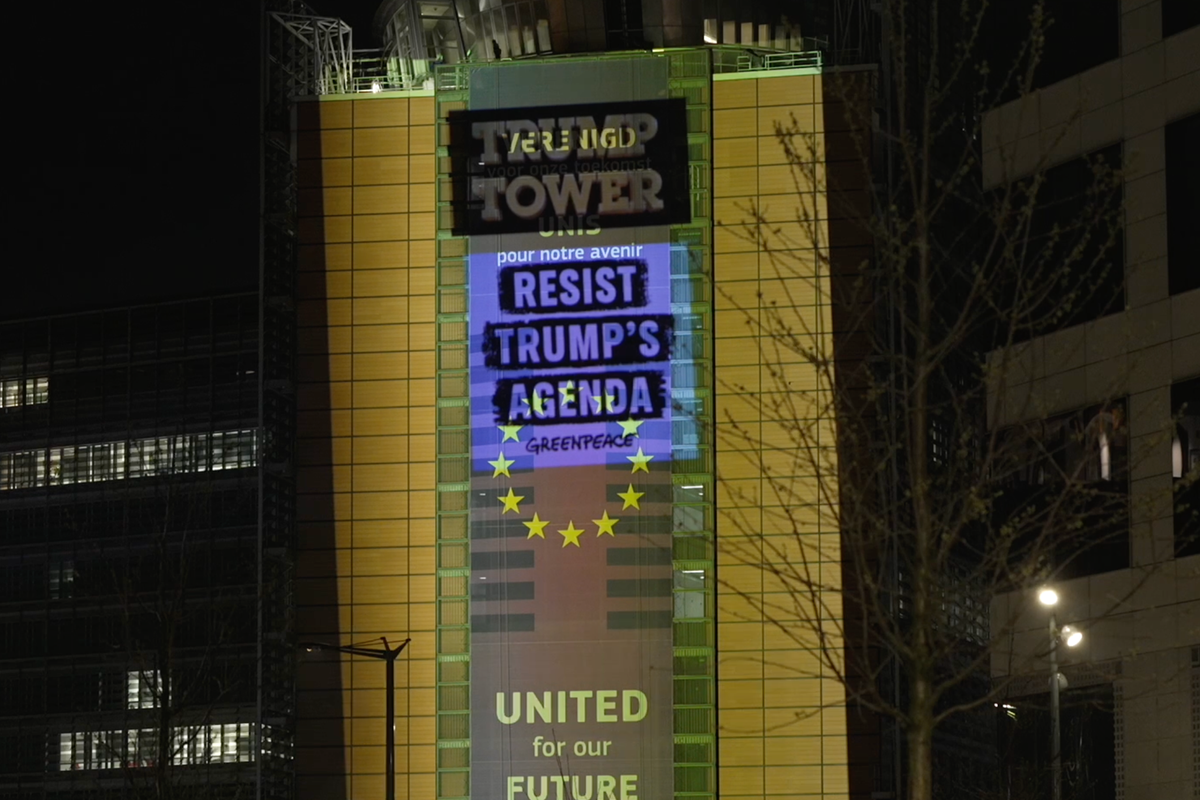
Brussels woke up to a sight that made more than a few diplomats choke on their espresso this morning. The iconic Berlaymont building, the nerve center of the European Commission, was buried under a massive, shimmering projection of a golden facade. Emblazoned across the top in unmistakable block letters were the words TRUMP TOWER.
It wasn't a hostile takeover or a new real estate acquisition by the American president. It was a high-voltage stunt by Greenpeace Belgium. As the 27 EU heads of government gathered inside for a high-stakes summit, the message from the activists outside was blunt. Stop acting like Europe is a subsidiary of the Trump administration.
The high cost of playing nice with Washington
Greenpeace didn't just pick the Trump aesthetic for the shock value. They're targeting a specific shift in European policy that looks a lot like a surrender. Since President Trump's return to power, the pressure on Brussels has been relentless. We're talking about a massive $750 billion pledge by Commission President Ursula von der Leyen to import U.S. energy—mostly oil and gas—by the end of 2028.
By 2025, the U.S. already supplied about 27% of the EU's gas. If the current trajectory holds, that number hits 40% by 2030. Greenpeace argues this isn't "energy security." It's just trading one master for another. You're swapping a dependence on Russian pipelines for a dependence on American tankers, and both come with strings attached that pull Europe away from its own climate goals.
Trading away the green deal for a seat at the table
The summit today was supposed to focus on the fallout from U.S. and Israeli strikes on Iran and the resulting spikes in energy prices. But the real tension lies in the fine print of a proposed EU-US trade deal. To avoid the threat of crippling tariffs, European leaders have begun discussing "simplifying" regulations.
In activist circles, "simplifying" is a dirty word. It’s shorthand for gutting the environmental and social protections Europe spent decades building. Specifically, we're seeing threats to:
- The Anti-Deforestation Law: A landmark piece of legislation that Trump’s lobbyists have been desperate to dismantle.
- Methane Regulations: Essential for meeting any semblance of a net-zero target.
- Digital Privacy and Taxes: Protections that get in the way of "tech bros" and their data-harvesting empires.
Ariadna Rodrigo, a lead campaigner for Greenpeace, didn't mince words. She pointed out that while European politicians talk about "competitiveness," what they're actually doing is letting toxic chemicals back into food and clothes just to stay on the good side of a White House that flouts international law.
Sovereignty isn't found in a gas tanker
There’s a deep irony in the "Trump Tower" projection. The EU often prides itself on being the global "moral superpower," the place where the rule of law and the environment matter more than raw corporate power. But as Trump puts the squeeze on Europe regarding Ukraine, Iran, and trade, that moral high ground is looking pretty shaky.
The Greenpeace argument is that true sovereignty doesn't come from signing 10-year contracts for liquefied natural gas (LNG). It comes from a 100% renewable energy system and ecological agriculture. Those are things an American president can't put a tariff on. They can't be shut off by a tweet or a change in a foreign administration.
What happens next in Brussels
The timing of this stunt is surgical. The European Parliament’s trade committee is set to vote on the approval of this massive trade deal on March 25 and 26. If it passes, the "Trumpification" of European energy and environmental standards moves from a protest slogan to a legal reality.
EU leaders are currently stuck between a rock and a hard place. They fear a trade war with the U.S. could wreck their already fragile economies, especially with the war in Ukraine continuing to drain resources. But as the golden light of the projection faded from the Berlaymont walls, the question remained: what's the point of "protecting" the European economy if you have to destroy the European environment and legal standards to do it?
If you're following the trade committee vote next week, watch how many "green" MEPs suddenly find reasons to support the deal. It’ll tell you exactly where the power lies. You should call your local MEP before the March 25 vote if you think "Trump Tower Brussels" shouldn't become a permanent state of mind.